Laboratory Forceps / Tweezers
Handling small, delicate, or contamination-sensitive items in the lab often depends on one simple tool: a well-matched pair of forceps or tweezers. From transferring samples and holding filters to working with fragile components, Laboratory Forceps / Tweezers help improve precision, reduce direct contact, and support cleaner, safer lab workflows.
This category brings together practical tools for routine laboratory handling, preparation, and light technical tasks. The selection includes straight tweezers, tissue forceps, and polymer-coated or plastic options designed for users who need better control when working with fine materials, sensitive surfaces, or items that should not be touched by hand.

Why forceps and tweezers matter in laboratory work
In many lab environments, direct hand contact is not practical. Small vessels, thin films, filter media, tissue samples, and lightweight parts can be difficult to grip accurately, especially when repeatability and cleanliness matter. Forceps and tweezers provide fine handling control while helping reduce contamination risk and accidental damage.
They are also useful for tasks that require consistent positioning or retrieval of items from narrow spaces. Whether the work involves wet chemistry, sample preparation, inspection, or general bench handling, the right tool shape and tip style can make routine work more efficient and comfortable.
Common types in this category
This category covers several practical formats for different handling needs. Straight tweezers such as the M&R MR11 Straight tweezers (140mm) are suitable for general-purpose precision work, especially when operators need a direct line of sight to the part being held.
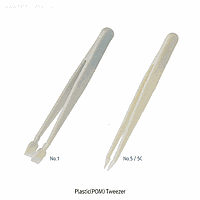
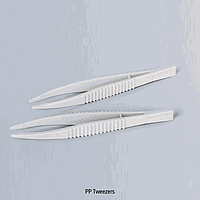
For sample-oriented handling, options such as the Vetus SS-JP Tissue Forceps are relevant where grip stability is more important than ultra-fine point access. There are also polymer and plastic models for applications where metal contact may be undesirable. Examples include POM and PTFE forceps, as well as lightweight plastic tweezers that support non-marring handling of sensitive items.
Material choices and when they are useful
Material selection is often just as important as shape. Stainless steel styles are commonly chosen for durability, mechanical stability, and routine bench use. They are a practical option when users need a familiar tool for general handling, inspection, and positioning tasks.
Plastic and engineering polymer options can be useful when working with delicate surfaces or when lower abrasion and reduced risk of scratching are priorities. Models such as the SciLab SL.For3063 Tweezer plastics white l120㎜ and SciLab SL.For3053 Tweezer fine pom clean-type illustrate this need. PTFE-coated or PTFE-based forceps, including several Cowie models in this category, are also relevant for applications where chemical resistance or gentler contact characteristics are preferred.
Tip style, length, and handling precision
Choosing forceps only by overall appearance can lead to awkward handling in daily use. Tip geometry affects how securely an object can be held and how easily the operator can approach it. Fine sharp tips are typically more suitable for very small items and precise pick-up points, while blunt or square styles may be better for more stable gripping and reduced risk of puncturing or marking the sample.
Length also plays a practical role. Shorter forceps can improve tactile feedback and close control, while longer versions help reach deeper containers or keep the hand farther from the work area. In this category, products range from compact styles around 100 mm to longer designs such as the VITLAB VI.683.99 Forcep yellow POM, blunt-tip l250mm, giving users more flexibility based on access distance and bench setup.
Representative products and brand options
Several brands in this range address different day-to-day laboratory needs. VITLAB offers blunt-tip POM forceps in multiple lengths, which can be useful for non-metallic handling tasks and general sample manipulation. M&R provides straightforward metal tweezers for routine precision work, while Vetus adds tissue-oriented forceps that suit more specialized gripping applications.
SciLab contributes lightweight plastic and fine POM tweezer options, and Cowie expands the selection with PTFE fine-type forceps in square and sharp versions. This mix allows buyers to compare not just brands, but also handling approach, tip profile, and material compatibility for their actual lab tasks.
How to choose the right laboratory forceps or tweezers
A good starting point is the object being handled. If the item is small and rigid, a fine-point tweezer may offer the best control. If it is soft, delicate, or more easily damaged, a blunt-tip or square-tip design may be safer. For surfaces that scratch easily or for applications where metal contact is less desirable, plastic, POM, or PTFE-based tools are often worth considering.
It is also helpful to think about workflow conditions. Users working near reagents, transfer setups, or consumables may want to review related handling products such as laboratory bags or bench-use materials like adhesives where appropriate. In practice, the right forceps are the ones that fit the sample size, reduce handling errors, and remain comfortable during repeated use.
Typical laboratory applications
Forceps and tweezers are widely used in laboratories for picking and placing small samples, holding filters or membrane pieces, positioning soft materials, and handling components that should remain clean. They are equally useful for routine preparation, sorting, transfer, and inspection tasks at the bench.
Depending on the material and tip style, they can support work in educational labs, quality control spaces, industrial laboratories, and general research environments. Their value is not limited to one process; instead, they serve as versatile hand tools that improve consistency across many simple but important operations.
Find a practical fit for your lab workflow
The best choice in this category usually comes down to a few essentials: tip shape, tool length, material, and the sensitivity of the item being handled. A straight stainless tweezer may be ideal for general precision tasks, while POM, PTFE, or plastic forceps may be more appropriate for delicate or contact-sensitive work.
By comparing the available designs from brands such as VITLAB, M&R, Vetus, Cowie, and SciLab, buyers can select tools that better match their daily handling needs. A well-chosen pair of laboratory forceps or tweezers supports cleaner handling, steadier manipulation, and more dependable bench work over time.
Get exclusive volume discounts, bulk pricing updates, and new product alerts delivered directly to your inbox.
By subscribing, you agree to our Terms of Service and Privacy Policy.
Direct access to our certified experts