
Stopcocks
Precise flow control matters in many laboratory setups, especially when working with vacuum lines, gas handling, liquid transfer, or glass apparatus that must be opened and closed reliably. In these applications, stopcocks are small but critical components that help regulate media movement, isolate sections of a system, and support safer, more repeatable lab work.
This category brings together laboratory stopcocks used in glassware and related assemblies, including standard, angled, spare, and 3-way configurations. The range includes options from DURAN and Pyrex, making it easier to compare designs suited to different bore sizes, valve styles, and vacuum-oriented applications.
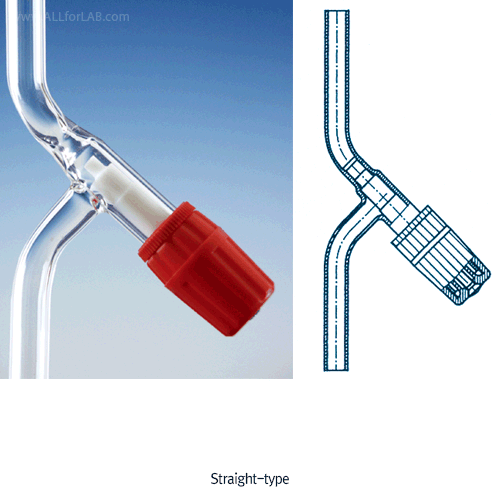
Where stopcocks are used in laboratory workflows
Stopcocks are commonly integrated into glass assemblies where controlled opening, closing, or directional switching is required. Typical use cases include vacuum manifolds, distillation and filtration setups, sampling lines, gas distribution systems, and other bench-scale processes where stable control over flow paths is important.
Depending on the apparatus design, the stopcock may be used simply as an on/off valve or as a more precise flow adjustment point. In more complex systems, a 3-way version can help redirect flow between lines without dismantling the setup, which is especially useful in analytical and preparative laboratory work.
Common stopcock types in this category
The product mix in this category reflects several practical design approaches. Straight and angled stopcocks are typically selected based on the geometry of the glassware, while vacuum-oriented versions are chosen where leak control and stable sealing are more important than simple liquid dispensing.
You will also find examples with PTFE needle valve construction, which are often preferred when finer control is needed. Models such as the DURAN SM.28605800, SM.28605810, SM.28605820, and SM.28605860 illustrate this style across different bore sizes, while angled variants such as DURAN SM.28605700 and SM.28605710 are suited to layouts where line direction changes are built into the apparatus.
For applications requiring switching between pathways, 3-way designs such as Pyrex Pyg.HP3TW.5 and Pyrex Pyg.HP6TW.7 offer a practical solution. Spare stopcock components, including Pyrex Pyg.LR6, Pyg.LR10, and Pyg.HP6K, are also relevant when maintaining or restoring existing glass systems rather than replacing the entire assembly.
Key selection points before ordering
Choosing the right stopcock starts with the bore size and the overall geometry of the apparatus. Bore dimensions influence flow capacity and responsiveness, so a small-bore valve may be suitable for controlled dosing or vacuum regulation, while a larger bore may better support faster transfer or lower restriction.
The body style is equally important. A 90° angled stopcock can simplify tubing or glassware routing in tight spaces, while a straight-through design may be easier to integrate into linear assemblies. If the process involves switching between ports, a 3-way configuration is often more efficient than using multiple separate valves.
Material compatibility should also be reviewed carefully. PTFE valve or plug elements are widely used because they support smooth operation and chemical resistance in many lab environments, but users should always confirm suitability for the actual media, temperature range, and operating conditions of the application.
Why valve style matters in vacuum and controlled-flow setups
In vacuum service, the quality of sealing and the ability to make controlled adjustments can have a direct effect on process stability. Needle-valve designs are often selected when a gradual change in flow is preferred over a quick open-close action. This is especially relevant in setups where pressure changes need to be introduced carefully rather than all at once.
High-vacuum or vacuum-bore stopcocks, including examples from Pyrex and DURAN in this category, are typically used where leak reduction and repeatability are key considerations. The choice between a standard bore and a vacuum-focused design should be based on the demands of the process, the apparatus construction, and the level of control required by the user.
Representative products and brand context
DURAN appears prominently in this category with several stopcocks built around PTFE needle valve concepts and multiple bore sizes. These products are relevant for laboratories that need compact control elements for glass assemblies, including both straight and 90° angled formats. The available range supports practical selection based on flow path and installation layout rather than a one-size-fits-all approach.
Pyrex products in this category highlight another important part of the ecosystem: 3-way stopcocks, vacuum-bore designs, and spare components such as locking-ring and valve-related parts. This is useful for laboratories maintaining existing apparatus where replacing only the worn stopcock element may be more efficient than changing a complete glass assembly.
In broader lab workflows, stopcocks are often used alongside other handling and transfer accessories such as bottle top solvent pumps for chemical dispensing, or supporting consumables such as laboratory bags for storage and sample handling.
Maintenance and replacement considerations
Because stopcocks are moving components, wear can develop over time through repeated operation, chemical exposure, or inadequate cleaning. Common reasons for replacement include stiffness, reduced sealing performance, visible damage to the plug or valve section, or incompatibility with a modified process setup.
Where spare parts are available, replacing only the stopcock element can help extend the life of laboratory glassware and reduce unnecessary replacement cost. This is particularly relevant when the rest of the apparatus remains in good condition and only the sealing or switching component has reached the end of its service life.
How to compare options in this category
When comparing products, it helps to look beyond the product name and focus on application fit. Start with the required function: on/off isolation, fine regulation, directional switching, or vacuum service. Then match the bore size, angle, and valve design to the actual process conditions and the physical layout of the system.
For example, a product such as DURAN SM.28605870 may be relevant where a GU 90 PTFE needle valve with a 6.0 mm size suits the assembly, while a model like Pyrex Pyg.HP6TW.7 may be more appropriate where a 3-way vacuum-bore arrangement is needed. The right choice depends less on brand alone and more on how the stopcock supports the intended laboratory operation.
Finding the right stopcock for your setup
A well-matched stopcock improves control, supports safer handling, and helps laboratory systems operate more consistently over time. Whether you are replacing a worn part, building a vacuum line, or specifying components for a glass apparatus, this category provides practical options across different bore sizes and configurations.
If your application involves fluid transfer, vacuum work, or directional flow management in labware, reviewing the available stopcock type, valve style, and geometry will usually lead to a better fit than selecting on price or appearance alone. A careful match at the component level can make the entire setup easier to operate and maintain.
Get exclusive volume discounts, bulk pricing updates, and new product alerts delivered directly to your inbox.
By subscribing, you agree to our Terms of Service and Privacy Policy.
Direct access to our certified experts