Tubing
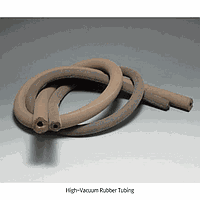
Fluid handling in the lab depends on more than just pumps and containers. The tubing you choose has a direct impact on transfer accuracy, chemical compatibility, cleanliness, and day-to-day reliability, especially in workflows involving sampling, reagent delivery, dispensing, or controlled drainage. For many laboratories and industrial environments, selecting the right Tubing is a practical way to reduce leakage risk, simplify connections, and maintain stable flow paths.
Where laboratory tubing is used
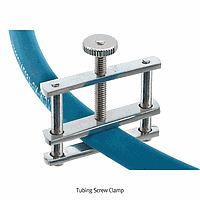
Laboratory tubing is used wherever liquids or gases need to move safely between vessels, valves, pumps, or test setups. Common applications include chemical transfer, sample routing, drainage, bottle connections, and low-pressure distribution in research, quality control, and production support labs.
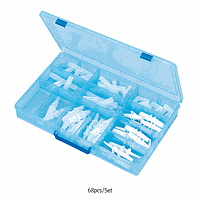
In practice, tubing is rarely considered in isolation. It works as part of a broader fluid path that may also include stopcocks, connectors, bottles, and transfer accessories. If your process also involves manual solvent transfer, related equipment such as bottle top solvent pumps can help create a more complete and controlled dispensing setup.
Why tubing selection matters
The right tubing helps maintain flow stability, supports safe handling, and reduces avoidable contamination or material degradation. Even when dimensions appear similar, differences in material, bore size, and intended use can affect flexibility, sealing performance, and suitability for specific chemicals.
For laboratory buyers, the decision often comes down to several practical factors: what media is being transferred, how often the line is used, whether the setup is temporary or permanent, and how the tubing connects to valves or glassware. This is especially important in systems that use compact shutoff or directional control components such as stopcocks.
Typical configurations in this category
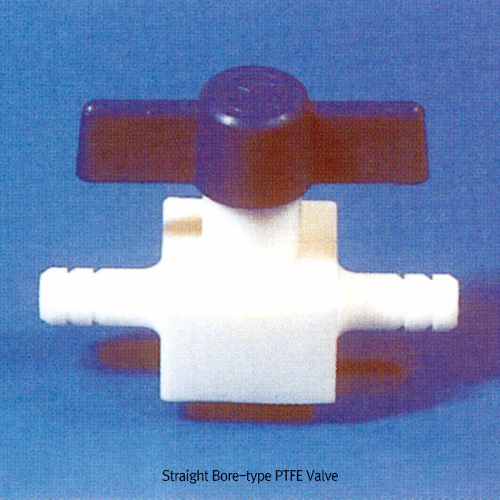
This category is commonly associated with fluid-routing components used in laboratory assemblies, including tubing-compatible stopcocks and related flow-control parts. Straight and T-type layouts are relevant when building or maintaining simple transfer paths, branch connections, or manual switching points in a line.
Examples from the current range include Cowie CW.016.703.2, Cowie CW.016.704.2, and Cowie CW.016.705.2 for straight configurations, along with T-type options such as Cowie CW.016.802.2, Cowie CW.016.804.2, and Cowie CW.016.803.2. These references illustrate how tubing systems may be matched to different arm sizes or bore arrangements depending on the intended connection geometry.
For users looking at broader fluid-handling brands, Cowie and Burkle are two names represented in the available products. Burkle BK.8608.0100, for example, shows a three-way stopcock approach for tubing-related routing where directional control is required.
How to choose tubing for a lab setup
A good starting point is to define the process media. Water-based liquids, solvents, aggressive chemicals, and mixed reagents do not all place the same demands on tubing and flow components. Material compatibility should always be checked first, followed by the expected temperature range and whether the line will be used for repeated cycles or occasional transfer.
The second step is connection fit. Terms such as arm size, outside diameter, and bore are important because they influence how securely the tubing mates with the rest of the assembly. In the products listed here, size variations such as 4.5 mm, 6 mm, 8 mm, 10 mm, and 11 mm indicate that the category supports different connection requirements rather than a one-size-fits-all approach.
It is also useful to think about whether you need a straight pass-through or a branched path. Straight versions are typically chosen for simple inline control, while T-type or three-way designs are more suitable when one line must be redirected, isolated, or shared between multiple routes.
Material and chemical handling considerations
Material choice strongly affects service life and handling safety. In this range, PTFE- and PVDF-related product naming points to use cases where chemical resistance and clean fluid contact surfaces may be important. These materials are often selected in laboratory environments because they are associated with broad chemical tolerance and practical handling benefits.
That said, material selection should always be aligned with the actual substances in use. A tubing assembly carrying neutral aqueous media may have different requirements from one used for corrosive or solvent-based liquids. Buyers comparing product options should focus on compatibility, sealing behavior, cleaning routine, and how frequently the line will be changed or reused.
Integrating tubing with the rest of the lab workflow
Tubing performs best when it is selected as part of a complete handling process rather than as an isolated spare part. A well-matched setup supports smoother filling, draining, sampling, and decanting while reducing the need for improvised adapters or repeated replacement.
In some workflows, tubing is used alongside storage and transfer consumables such as laboratory bags or specialized containers. In others, it sits closer to bench-scale assemblies where compact valves, stopcocks, and support labware define the overall path. Thinking in terms of the whole system usually leads to better reliability than focusing on a single component dimension alone.
Representative product examples
Several listed products help show the range of connection styles available. Cowie CW.016.702.5.2 and Cowie CW.016.702.2 illustrate straight PTFE arm variants in smaller sizes, while Cowie CW.016.805.2 and Cowie CW.016.802.5.2 represent T-type options for more flexible routing. Cowie SL.Sto4011 adds another example of a one-way configuration with a defined arm and bore format.
These examples are useful not because every laboratory needs the same geometry, but because they reflect common purchasing considerations: connection size, line direction, material preference, and whether the installation is intended for simple shutoff or multi-path flow control. If your application extends into broader sample preparation or containment tasks, adjacent labware groups such as ampoules may also be relevant depending on how samples are stored or transferred.
Finding the right option for your application
When comparing products in this category, it helps to begin with the operating task rather than the part number. Define what is being transferred, how the line connects, and whether you need straight-through flow, shutoff, or diversion between paths. From there, you can narrow the selection based on size and material cues shown in the product names.
Overall, this category supports laboratories that need dependable fluid transfer and practical line control within everyday workflows. A suitable tubing-related component should fit the physical connection, support the chemical environment, and work cleanly with the surrounding labware so the full setup remains safe, efficient, and easier to maintain.
Get exclusive volume discounts, bulk pricing updates, and new product alerts delivered directly to your inbox.
By subscribing, you agree to our Terms of Service and Privacy Policy.
Direct access to our certified experts