Hyperspectral camera is a valuable approach for quality control and inspection when the object being studied cannot be sampled, altered, or damaged. In cultural heritage work, it can help researchers examine paintings beyond what is visible under normal lighting. By combining an image with spectral information at each pixel, the method creates a detailed dataset that can be processed to investigate materials, hidden features, and changes beneath the visible surface.
For museums, conservation teams, and researchers, this makes hyperspectral imaging especially relevant to the non-destructive examination of artworks. It supports broad-area inspection rather than relying only on isolated sample points, while preserving a digital record for continued study.
What Is Hyperspectral Imaging?
Hyperspectral imaging combines imaging and spectroscopy. Instead of recording only conventional color information, it captures spectral data across many narrow bands. In the referenced painting examination, the spectral range extended from visible light into short-wave infrared, from 400 to 1700 nm.
The resulting information is often described as a three-dimensional data cube: two dimensions represent the position of each pixel in the image, and the third represents its spectral response. This structure allows analysts to compare areas of a work based on their spectral behavior, not only their appearance.
For large or detailed paintings, push-broom scanning can be used to acquire data progressively across the surface. In the reported case involving Raphael's The Deposition, the painting was scanned in eight sections and the data was stitched together for a full-frame analysis. This illustrates how spectral imaging may be adapted for examination of an entire artwork, including areas where traditional point-based measurements would be limited.
Revealing Features Hidden from Normal View
A major benefit of hyperspectral imaging is its ability to help identify features that are difficult to see with the naked eye. Data-processing methods such as Principal Component Analysis (PCA) and Minimum Noise Fraction (MNF) can assist in separating meaningful spectral variation from noise.
In the reported examination, spectral processing indicated earlier landscape features beneath the visible sky. Trees and vegetation that had been more clearly defined in an earlier composition appeared to have been softened in later paint layers. The mountain forms also showed changes. Findings of this kind can provide evidence of an artist's revisions and can help art historians better understand compositional development.
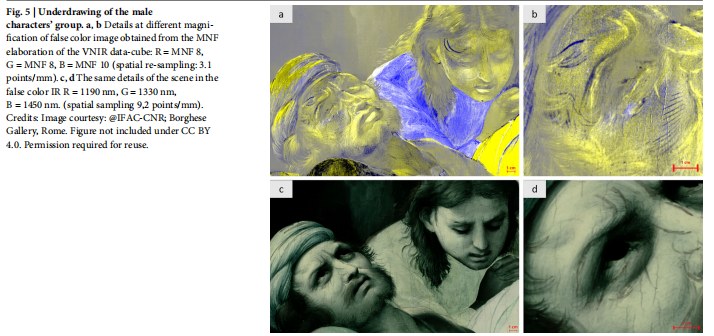
Hyperspectral imaging may also assist with the study of underdrawings. The source case describes the use of selected infrared bands and false-color images to reveal fine drawing features, including hatching on male faces and stronger outlines around the Virgin Mary's cheeks and lips. These observations suggested that the underdrawing was completed in multiple stages and with different materials.
Such information is important because a painting is not simply a final surface. It may contain preparatory drawing, adjusted forms, covered elements, layered colors, and later interventions. A non-destructive inspection workflow can make these layers more accessible without requiring physical removal or sampling.
Using Hyperspectral Imaging with MA-XRF
Hyperspectral imaging provides spectral patterns, but it does not independently establish every pigment component. For this reason, it can be used alongside Macro X-ray Fluorescence (MA-XRF), which maps elemental distribution across an object.
In the referenced study, researchers used Spectral Angle Mapping (SAM) to distinguish three spectral characteristics in red-painted areas. Two were associated with red lakes, while another was associated with vermilion. MA-XRF results were then compared with these spectral groupings: mercury signals were observed in vermilion areas, potassium signals supported the identification of red lakes, and iron did not correspond to the red regions under discussion.
The combined interpretation identified vermilion and red lake as the two red materials described in the study. It also distinguished different paint applications, including thick single-layer paint, multilayer glazing, and red lake applied over vermilion. The central figure, Grifonetto, was reported to use a vermilion base with a red lake glaze.
This complementary workflow demonstrates why inspection results should be interpreted in context. Spectral imaging can identify differences and patterns across a surface, while elemental mapping can add another layer of evidence for material investigation.
Value for Cultural Heritage Inspection
For cultural heritage conservation, hyperspectral imaging offers several practical advantages. It can be applied without taking samples from the artwork, can survey a broad surface area, and creates data that can be archived for future comparison. These strengths make it useful for research, condition assessment, conservation planning, and digital documentation.
The approach is also suited to questions that cannot be answered through visible observation alone. Teams may investigate underdrawings, pigment distribution patterns, covered compositional elements, and possible restoration-related differences. The method does not replace careful interpretation by conservators and researchers, but it provides a richer evidence base for their decisions.
In quality control and inspection settings, the central lesson is clear: non-destructive spectral data can reveal meaningful variation while keeping the original object intact. When hyperspectral imaging is combined with techniques such as MA-XRF, it can connect visual evidence, spectral behavior, and elemental information in one coordinated examination process.
Multispectral camera expands art inspection from surface viewing to data-driven analysis of hidden and layered information. The examination of Raphael's The Deposition shows how it can contribute to the study of compositional changes, underdrawings, and red pigment use. For cultural heritage objects where preservation is essential, this non-destructive approach provides a careful way to investigate the stories retained beneath the visible paint layer.