Paint Surface Testing Equipment
Surface condition often determines whether a coating system performs as expected in production, inspection, or field maintenance. Before painting, after curing, or during failure analysis, reliable test instruments help teams verify contamination, identify visible defects, and evaluate optical or thermal surface behavior with more confidence. This is where Paint Surface Testing Equipment becomes especially useful for quality control and technical decision-making.
Why surface testing matters in coating inspection
Paint performance is influenced by much more than film thickness alone. Surface contamination, incomplete curing effects, visual flaws, and reflectance or emissivity characteristics can all affect adhesion, appearance, durability, and downstream acceptance. A practical testing workflow helps detect these issues early, before they lead to rework or coating failure.
In many applications, surface testing is used alongside tools such as a coating thickness meter or an adhesion tester. Together, these instruments give a more complete view of coating quality, from substrate preparation and film build to bond integrity and final surface condition.
Main equipment types in this category
This category covers several different testing needs rather than one single measurement method. Some instruments are designed to check for surface contamination, such as soluble salts, pH-related conditions, iron contamination, or amine blush on cured coatings. Others support visual inspection by improving the detection of scratches, unevenness, or other surface flaws under controlled lighting.
There are also more specialized instruments for measuring cleanliness, reflectance, and emissivity. These are relevant in technical sectors where painted or coated surfaces must meet functional optical or thermal requirements, not just cosmetic ones. As a result, the category serves users in coating application, industrial maintenance, laboratory evaluation, and materials performance testing.
Examples of instruments used for paint surface evaluation
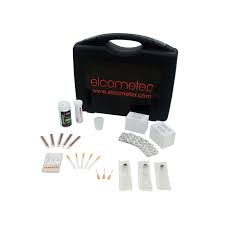
For contamination checks on prepared or coated surfaces, ELCOMETER offers practical kit-based solutions such as the ELCOMETER 138/2 Surface Contamination Kit, which supports checks related to pH, iron, and chloride conditions. For epoxy-related surface issues, the ELCOMETER 139 Amine Blush Swab Test Kit and ELCOMETER 139 Amine Blush Chip Screen Test Kit are examples of tools used to assess whether amine blush may be present before further coating steps or analysis.
Where visual flaw detection is important, the Otsuka BARLIGHT2 MW LED light is a useful example of an inspection aid built for checking surface flaws under stable illumination. For higher-level cleanliness verification, the SITA CleanoSpector uses fluorescence-based measurement to evaluate technical cleanliness on small surface areas, which can be relevant when residues must be controlled before coating, bonding, or assembly.
In more advanced material evaluation, Surface Optics instruments such as the 410-Solar, 410-Solar-i, ET-100, ET-10, and SOC410-DHR support reflectance and emissivity assessment across defined wavelength ranges. These tools are particularly relevant when painted surfaces must meet thermal management, solar reflectance, or optical performance criteria.
How to choose the right paint surface testing equipment
The first step is to define what surface problem you need to verify. If the concern is contamination before painting, a contamination kit or cleanliness measurement device is usually more relevant than a visual inspection light. If the issue is appearance or defect detection, lighting-based inspection may be the better starting point. For functional coatings, reflectance or emissivity instruments may be necessary.
It also helps to consider where and how the instrument will be used. Portable kits are often preferred for field inspection, maintenance shutdowns, or shipyard and site work. In contrast, more advanced optical instruments may be better suited to laboratories, R&D environments, or technical qualification tasks where repeatability and data handling are more important than fast spot checks.
Finally, check whether your workflow requires compliance with a specific method, internal quality procedure, or customer specification. In some projects, the instrument is not only for detection but also for documenting measurable results that support release, acceptance, or troubleshooting.
Typical applications across industry
Paint surface testing equipment is used in industries where coating reliability and surface condition directly affect product performance. Common examples include metal fabrication, protective coatings, marine maintenance, infrastructure, automotive components, industrial equipment, and technical manufacturing environments where pre-treatment and finishing quality must be controlled.
These instruments are also useful when investigating coating defects after application. Surface contamination, curing by-products, visible flaws, or unwanted thermal behavior may all contribute to poor service performance. In those cases, surface-focused testing provides context that complements hardness measurement, thickness verification, or checks with holiday detector equipment where coating continuity is also important.
Brands commonly selected for this category
Several manufacturers in this category address different levels of inspection complexity. ELCOMETER is widely associated with practical coating inspection tools, especially for field-oriented contamination and surface assessment tasks. Otsuka supports visual inspection needs with dedicated lighting solutions for flaw detection, while SITA focuses on cleanliness measurement where residue control is critical.
Surface Optics serves more specialized applications involving reflectance, emissivity, and optical characterization of coated surfaces. Depending on project requirements, users may also compare this category with related coating inspection tools such as coating hardness testers when the goal is to evaluate both surface condition and mechanical performance.
Building a more complete coating inspection workflow
Surface testing is most effective when it is integrated into a broader inspection process rather than treated as an isolated step. For example, a team may check substrate cleanliness before coating, inspect the cured surface for visual defects, confirm thickness after application, and then evaluate adhesion or other performance characteristics depending on service conditions.
This approach reduces uncertainty when investigating failures or approving finished work. Instead of relying on appearance alone, inspectors can build a more structured record of coating condition using complementary data points that reflect real process risks.
Final thoughts
Choosing the right paint surface testing equipment depends on the type of surface issue, the level of data required, and the inspection environment. Whether the task involves contamination screening, flaw detection, cleanliness verification, or advanced reflectance and emissivity measurement, the right instrument helps turn surface observations into actionable quality information.
For buyers and engineering teams, the most practical approach is to start from the application: what needs to be detected, when it needs to be measured, and how the results will be used in acceptance, troubleshooting, or process control. That makes it easier to select tools that fit the coating workflow instead of adding unnecessary complexity.
Get exclusive volume discounts, bulk pricing updates, and new product alerts delivered directly to your inbox.
By subscribing, you agree to our Terms of Service and Privacy Policy.
Direct access to our certified experts