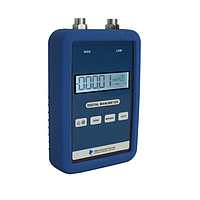
Differential Pressure Digital Gauge
When stable pressure readings are critical for airflow monitoring, filter supervision, duct balancing, or low-pressure process checks, a digital display can make day-to-day work faster and easier. Differential Pressure Digital Gauge products are designed to show the pressure difference between two points with clear readouts, helping technicians and engineers verify system performance without relying only on pointer-based interpretation.
In industrial HVAC, cleanroom environments, ventilation systems, and light process applications, differential measurement is often more useful than single-point pressure alone. By comparing upstream and downstream pressure, these instruments support tasks such as checking pressure drop across filters, confirming fan and blower performance, and monitoring air movement in non-corrosive dry gas service.
What this category is used for
A digital differential pressure gauge measures the difference between two pressure ports rather than the pressure at a single location. This makes it especially useful in systems where performance is defined by pressure drop, such as filters, ducts, air handling units, isolation spaces, and other low-pressure gas applications.
Compared with a mechanical alternative, a digital unit can improve readability, reduce parallax error, and make it easier to work with small pressure values. For users comparing options, this category also sits naturally alongside differential pressure analog gauges when a non-powered visual indication is preferred.
Typical applications in industrial and building systems
These gauges are commonly selected for monitoring air and other non-corrosive dry gases in commercial and industrial environments. Typical use cases include measuring pressure drop across filters, verifying airflow conditions in ducts, checking draft or ventilation performance, and supporting commissioning or maintenance routines.
They are also relevant where low-pressure resolution matters. In many systems, the goal is not simply to know whether pressure exists, but whether the differential across a component is rising, falling, or remaining within an acceptable operating window. That is why digital differential instruments are often considered together with a digital pressure switch when local indication and switching functions are both part of the control strategy.
Key selection points before choosing a model
The first decision is the required measurement range. In this category, representative models cover very low ranges such as 0.25 inH₂O and 0.5 inH₂O, as well as broader ranges including 1, 2, 5, 10, 15, 25, and 50 inH₂O. Choosing a range too high can reduce useful resolution in low-pressure applications, while choosing a range too low can limit the instrument in systems with fluctuating pressure.
Another important factor is whether the application is focused on differential pressure only or on derived airflow indication. Some products in this category are presented as digital differential flow gages, while others are digital differential pressure gages. In practical terms, both are based on differential measurement, but the intended use and scaling may differ depending on how the system is being monitored.
Power and installation conditions also matter. Several listed devices support battery operation or 9 to 24 VDC supply, which can be helpful for standalone mounting or panel-integrated use. Environmental protection, connection style, and media compatibility should always be checked against the installation site and the process gas involved.
Examples from the available Dwyer range
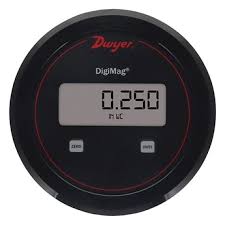
Dwyer is the most visible manufacturer in the current product selection, with multiple pre-calibrated digital differential models covering different pressure spans. For example, the DM-1202 is suited to very low differential measurement at 0.25 inH₂O, while the DM-1204 and DM-1205 extend into 1 inH₂O and 2 inH₂O ranges for applications that need slightly more headroom.
For broader operating windows, models such as the DM-1207, DM-1208, DM-1209, DM-1210, and DM-1211 cover 5 to 50 inH₂O. The DM-1125, DM-1127, and DM-1128 represent differential pressure gage options with bidirectional-style ranges centered around zero, which can be useful when pressure can move positive or negative relative to a reference point.
Across these examples, common characteristics include LCD display, compact field-ready construction, and enclosure ratings such as IP66 and NEMA Type 4X. The listed specifications also indicate suitability for air and selected non-corrosive dry gases, which aligns with many HVAC and light industrial measurement tasks.
Digital vs. analog: which approach fits better?
Digital instruments are often chosen when operators need quick reading, easier setup verification, or improved visibility of low differential values. A numeric display can be especially useful during balancing, troubleshooting, or preventive maintenance, where repeatable interpretation matters more than a quick glance trend alone.
That said, analog devices still have a place in many installations. If the requirement is a simple local visual indication with no power source, users may compare this category with single pressure analog gauge options or other analog differential solutions depending on whether the process calls for relative or differential measurement. The right choice depends on environment, readability needs, maintenance practice, and whether electrical power is available at the mounting point.
Practical considerations for installation and operation
For reliable readings, impulse tubing and port connections should be arranged carefully so that the high and low sides are connected correctly. In air systems, poor tubing layout, leaks, or contamination in the lines can create misleading differential values even when the gauge itself is working properly.
Users should also pay attention to process compatibility and operating conditions. The products listed here indicate use with non-corrosive dry gases, and several models include barbed fittings with 1/8 in process connections. Where outdoor washdown resistance or dusty environments are a concern, enclosure protection such as IP66 and NEMA Type 4X can be an important part of the selection process.
For applications that do not require differential measurement, a separate category such as single pressure digital gauges may be more appropriate. Matching the instrument type to the measurement objective helps avoid unnecessary complexity and supports more dependable results.
How to narrow down the right gauge
A practical way to shortlist models is to start with four questions: what pressure range is expected, what gas is being measured, how will the gauge be powered, and what installation environment must it withstand? From there, you can compare whether a low-range model like the DM-1202 is adequate, or whether a wider-range option such as the DM-1211 is more suitable for the application.
It is also worth considering how the reading will be used after installation. If the gauge will mainly support maintenance teams during inspection rounds, clear digital indication may be enough. If the pressure value is part of a broader control scheme, users may need to evaluate adjacent product categories for switching or additional system integration requirements.
Conclusion
This category brings together instruments built for one of the most common real-world pressure tasks: measuring the difference between two points accurately and clearly. Whether the priority is filter monitoring, airflow verification, duct pressure checks, or low-pressure gas supervision, choosing the right range and installation format will have a direct impact on usability.
By comparing measurement span, display style, power options, and environmental protection, buyers can select a differential pressure digital gauge that fits the application without overcomplicating the system. If you are refining a new specification or replacing an existing unit, the available range provides a practical starting point for both maintenance and engineering teams.
Get exclusive volume discounts, bulk pricing updates, and new product alerts delivered directly to your inbox.
By subscribing, you agree to our Terms of Service and Privacy Policy.
Direct access to our certified experts