
Single Pressure Digital Gauge
When operators need a clear pressure reading without parallax error, manual interpretation, or unit conversion at the point of use, a Single Pressure Digital Gauge is often the practical choice. These instruments are widely used in HVAC, utility lines, air and gas systems, water circuits, pump skids, and general industrial service where stable local indication matters.
Compared with traditional dial gauges, digital models make it easier to read values quickly, especially at lower ranges where small pressure changes are important. They also support more consistent maintenance checks, commissioning work, and routine troubleshooting by combining straightforward display readability with compact field installation.
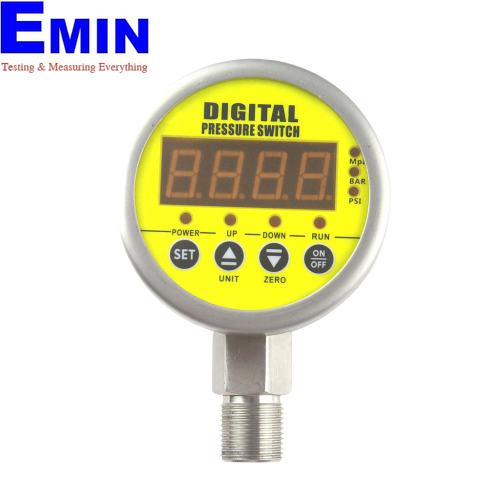
Where single pressure digital gauges fit in a measurement system
A single pressure digital gauge is designed to measure one pressure point relative to atmosphere or, in some cases, vacuum-to-pressure ranges in a compound configuration. This makes it suitable for local monitoring on compressors, regulators, hydraulic or pneumatic lines, process piping, and service manifolds where technicians need a direct numerical value instead of an analog pointer position.
In many plants, these gauges are used as a bridge between simple visual indication and more advanced instrumentation. If your application requires a conventional mechanical option for basic local display, you can also review single pressure analog gauges. For users who need electronic indication but not necessarily switching or control logic, the digital gauge category is a natural step up.
Why digital pressure indication is useful in day-to-day operation
The main advantage of digital indication is readability. A 4-digit LCD can reduce interpretation errors during inspection rounds, startup checks, and maintenance work, particularly when pressure values are close to operating limits or when low-resolution analog readings are difficult to judge.
Digital gauges can also help standardize readings across teams because the displayed value is direct and easy to compare against process targets. In practice, that is useful in HVAC balancing, compressed air management, nitrogen service, oil and water systems, and many general industrial tasks where local pressure verification is part of normal workflow.
Typical selection criteria
Choosing the right model starts with the pressure range. The selected full scale should match the expected operating window closely enough to keep readings meaningful, but not so tightly that normal surges risk overpressure. In the featured range here, examples span from low-pressure options such as 5 psi and 15 psi up to 300 psi and 500 psi versions.
The second point is media compatibility and sensor construction. Some applications involve compatible gases, liquids, oils, or water, while others are limited to dry, non-corrosive gases. This matters because wetted materials and sensor isolation influence whether a gauge is appropriate for a given process connection.
Connection style and installation environment also deserve attention. Many listed models use a 1/4 in NPT male process connection, which is common in industrial service. Battery-powered operation is practical for local indication, but buyers should still consider maintenance intervals, ambient temperature, enclosure limitations, and long-term stability when planning deployment.
Examples from the current product range
Several Dwyer models illustrate how this category covers both low-pressure and general-purpose industrial requirements. The BDG-01 is a brass digital pressure gauge with ±0.5% accuracy and a 150 psi range, making it relevant for HVAC and utility applications where a compact digital indicator is needed.
The DPGWB series provides stainless steel construction and user-selectable units across multiple ranges. Examples include the DPGWB-04 at 5 psi for lower-pressure measurement, the DPGWB-08 at 100 psi for broader general service, and the DPGWB-11 at 500 psi where a higher-range local indication point is required. A compound option such as the DPGWB-00 is also useful when both vacuum and pressure conditions need to be checked on the same gauge.
For applications focused on dry, non-corrosive gases, models such as DPGAB-10 and DPGAB-11 extend the category with similar digital readability in higher ranges. The difference between product families is not just scale; it also affects how the instrument should be matched to media and operating conditions.
Digital gauge vs. other pressure instrument types
Not every application should default to a single pressure digital gauge. If the process requires comparing two pressure points across a filter, fan, cleanroom zone, or similar restriction, a differential pressure digital gauge is usually the better fit. The measurement objective is different, so choosing the correct gauge type helps avoid installation mistakes.
Likewise, if the instrument must trigger outputs or act as part of a control function, a digital pressure switch may be more appropriate than a display-only gauge. For more traditional visual monitoring without electronics, analog alternatives still remain common in many facilities.
What to look for before ordering
Before selecting a unit, confirm whether the application involves gauge pressure only or a compound range that includes vacuum. This is especially important in suction lines, pump service, evacuation processes, and maintenance diagnostics where the pressure point may move below atmospheric pressure.
Next, review the expected process media. The products shown in this category include variants suitable for compatible gases, liquids, oils, and water, while others are intended for air and dry gases. Matching the gauge to actual media is a basic but critical step for service life and measurement reliability.
Finally, think about how the gauge will be used: continuous local indication, periodic test reading, or mobile maintenance support. Features such as user-selectable units, battery replacement, display visibility, and proof pressure margins can make one model more practical than another even when the nominal range looks similar.
Applications commonly served by this category
Single pressure digital gauges are commonly applied in compressor packages, pressure regulator stations, fluid transfer systems, pneumatic panels, water distribution skids, and HVAC service points. They are also useful during startup and maintenance because technicians can verify pressure quickly without interpreting a needle position under varying lighting conditions.
Lower-range units are especially valuable where fine pressure changes matter, while higher-range models support more robust utility and process duties. Across both cases, the category is best understood as a set of local digital indication tools for single-point pressure monitoring rather than a one-size-fits-all pressure solution.
Final considerations
If your goal is dependable local pressure indication with easier reading than a mechanical dial, this category offers a practical range of options across low, medium, and higher pressure spans. The best choice depends on process media, required range, connection type, and whether your application needs standard gauge or compound measurement.
By comparing range, wetted materials, and intended service conditions carefully, buyers can narrow down the right instrument for maintenance, OEM integration, or plant operation. For applications that go beyond single-point measurement, it is also worth reviewing related pressure gauge categories to align the instrument type with the actual measurement task.
Get exclusive volume discounts, bulk pricing updates, and new product alerts delivered directly to your inbox.
By subscribing, you agree to our Terms of Service and Privacy Policy.
Direct access to our certified experts