Barometer pressure sensor, transducer
Atmospheric pressure data is a small signal that often has a big impact on process quality, environmental monitoring, and measurement accuracy. In industrial systems, laboratories, building monitoring, and field research, choosing the right barometer pressure sensor, transducer helps convert ambient pressure into a usable electrical or digital signal for control, logging, compensation, or remote supervision.
This category brings together devices designed to measure barometric pressure in formats suited to different integration needs. Whether you need a simple analog transmitter, a network-ready remote barometer, or a compact digital sensor for embedded use, the selection here supports a wide range of technical applications.
Where barometric pressure sensing is used
Barometric pressure measurement is important anywhere ambient pressure influences a process or a calculated result. Typical use cases include HVAC and building management, weather-related monitoring, environmental data logging, laboratory instrumentation, altitude-related compensation, and industrial systems that need stable atmospheric reference values.
In research and outdoor monitoring, pressure data is also used alongside temperature and other environmental variables to improve interpretation of field measurements. For example, the Eijkelkamp 11.11.56.01 Baro-Diver is positioned for geohydrological and water quantity applications, where long-term atmospheric pressure tracking can support monitoring workflows.
Common device formats in this category
This category includes several practical formats rather than one single device style. Some products are designed as analog transmitters with outputs such as 4-20 mA or 0-10 V for direct connection to PLCs, controllers, and monitoring systems. Others provide serial or Ethernet communication for integration into supervisory platforms, remote monitoring, or data networks.
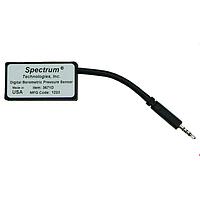
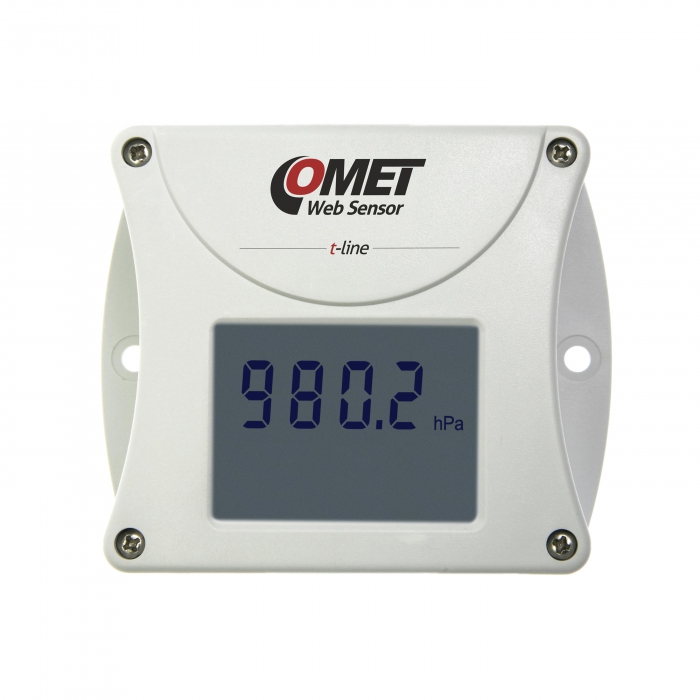
For example, Comet offers multiple options depending on signal preference, including the T2114 for 4-20 mA, the T2214 for voltage output, the T2414 for RS485, and the T2514 WebSensor for Ethernet-based access. For compact electronic integration, the Spectrum Technologies 3671D Digital Barometric Pressure Sensor is better aligned with applications that need a digital sensing component rather than a panel or wall-mounted transmitter.
If your project involves other pressure measurement principles beyond atmospheric pressure, it may also be useful to review absolute pressure sensors and transducers or industrial pressure sensors for broader system design requirements.
How to choose the right barometric pressure sensor
The first point to check is the output interface. In control cabinets and industrial automation, analog outputs such as 4-20 mA or 0-10 V are often preferred because they are easy to scale and integrate. Where data needs to be transmitted to software platforms or over longer distances, RS232, RS485, or Ethernet models can be more suitable.
The second consideration is the installation environment. Indoor devices such as the Comet T2118 and T2218 fit controlled spaces, while other models are intended for wider operating temperature ranges or more robust installation conditions. If the sensor will be exposed to varying ambient conditions, temperature range, enclosure protection, and mounting style should be reviewed carefully.
It is also important to confirm the measurement range and required accuracy. Many applications work within standard atmospheric ranges, but the acceptable error, resolution, and long-term drift will depend on whether the device is used for general monitoring, compensation in a larger instrument, or research-grade logging. The OMEGA EWS-BP-A, for instance, is a barometric pressure transmitter with selectable analog output and specified temperature compensation, which may be useful where stable signal conversion is required.
Examples from leading manufacturers
Several established brands are represented in this category, each covering different integration styles. Comet provides a broad family of barometric transmitters and remote barometers with analog, serial, and Ethernet communication, making it easier to match the device to an existing control or monitoring architecture.
OMEGA offers barometric transmitters suited to general instrumentation tasks, while Eijkelkamp addresses specialized monitoring scenarios such as geohydrological research. Evikon adds indoor transmitters with both digital communication and configurable analog outputs, and Spectrum Technologies supports compact digital sensing needs. This range is useful for buyers comparing not only price and availability, but also integration method and application fit.
Signal types and integration considerations
A barometric device is often selected less by the sensing principle itself and more by how the signal must be used downstream. A 4-20 mA output is common when noise resistance and straightforward loop integration are important. Voltage outputs can be practical in building automation or local instrumentation, while RS485 and Ethernet are preferred when centralized monitoring, networking, or protocol-based communication is required.
Some products in this category also support multiple pressure units or PC-based configuration, which can simplify commissioning. Network-capable models such as the Comet T2514 can be useful in distributed systems where users want browser-based access, ModbusTCP, SNMP, or alarm-related communication options without adding a separate converter.
Barometric sensors in a broader pressure measurement system
Barometric sensors are often part of a larger measurement chain rather than a standalone endpoint. In some systems, atmospheric pressure data is used as a reference or compensation value for other pressure measurements, environmental calculations, or process diagnostics. That is why it is important to consider how the sensor fits with controllers, loggers, SCADA software, or embedded electronics.
For compact electronics and OEM development, a separate category such as board mount pressure sensors may be relevant. Where the application is focused on low-pressure or evacuated systems instead of ambient atmosphere, vacuum pressure sensors and transducers may be a better fit.
What to review before ordering
Before selecting a model, verify the required pressure range, output type, supply voltage, operating temperature, and installation location. It is also worth checking whether your system needs local analog output, serial communication, Ethernet connectivity, or long-term autonomous logging. In field or research deployments, storage capacity, battery life, and material compatibility may be just as important as the sensing specification itself.
For B2B buyers, the most reliable approach is to match the sensor to the actual use case: control loop input, environmental monitoring point, instrument compensation, or remote networked measurement. That usually leads to a more practical selection than choosing based on headline specifications alone.
Conclusion
This selection of barometric sensing devices is intended for users who need dependable atmospheric pressure measurement in industrial, laboratory, building, and environmental applications. With options ranging from compact digital sensors to configurable transmitters and remote Web-enabled units, the category supports both simple integration and more advanced monitoring architectures.
If you are comparing models, focus on the required signal interface, installation environment, and how the pressure data will be used in the wider system. That makes it easier to narrow the choice to a barometer pressure sensor or transducer that fits your application technically and operationally.
Get exclusive volume discounts, bulk pricing updates, and new product alerts delivered directly to your inbox.
By subscribing, you agree to our Terms of Service and Privacy Policy.
Direct access to our certified experts