Field Wireable Connectors
Reliable temperature measurement often depends on small connection details that are easy to overlook during design or maintenance. In industrial sensing systems, Field Wireable Connectors help technicians terminate thermocouple wiring on site without relying on pre-molded cable assemblies, making them a practical choice for equipment retrofits, replacements, and custom installations.
For temperature sensor applications, this category focuses on connectors built for field assembly, compact wiring, and dependable signal transfer in demanding environments. They are especially useful where routing constraints, washdown exposure, or sensor replacement requirements call for a connector that can be installed or serviced directly in the field.
Why field wireable connectors matter in temperature sensor systems
In many process, packaging, laboratory, and machinery applications, thermocouple connections need to be made close to the sensing point. A field-wireable design allows installers to prepare the cable, terminate conductors, and complete the connector assembly on site. This can reduce downtime when replacing damaged connectors and gives more flexibility when cable lengths are not fixed in advance.
Compared with fully molded alternatives, field-mountable connectors are often preferred when maintenance access and installation adaptability are priorities. They are also relevant when engineers need to preserve thermocouple circuit integrity while using standardized industrial connection formats such as M12.
Typical product configuration in this category
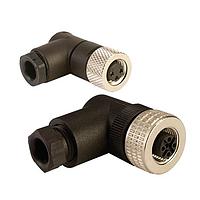
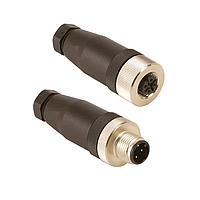
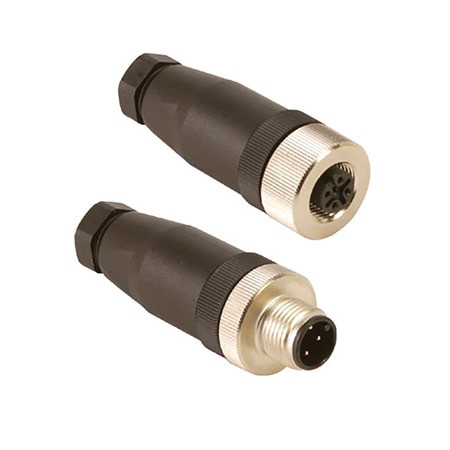
The products highlighted here center on OMEGA compensated M12 thermocouple connectors designed for field assembly. The range includes versions for common thermocouple types such as K, J, and T, along with male and female 4-pin configurations. Straight and right-angled bodies are both represented, which helps when cable exit direction matters inside tight enclosures or on moving equipment.
Examples include the OMEGA M12-KK-S-M-FM for straight male K-type connections, the M12-KK-R-F-FM for right-angled female K-type connections, and the M12-JJ-S-F-FM for J-type applications. T-type options such as the M12-TT-S-M-FM and M12-TT-R-F-FM extend the same wiring concept to additional measurement requirements. Rather than serving as generic electrical plugs, these connectors are designed for thermocouple compensation, which is important for maintaining measurement accuracy across the connection point.
Key selection points before ordering
Choosing the right connector starts with the thermocouple type. K, J, and T thermocouples use different alloy combinations, so the connector must match the sensor circuit. Selecting the wrong type can introduce measurement error, even when the mechanical fit appears correct.
The next consideration is connector gender and cable routing. Male or female M12 4-pin versions should match the mating side of the installation, while straight or right-angled styles should be selected based on panel clearance, bend radius, and cable protection needs. In many installations, a right-angled connector can help reduce stress on the cable where space is limited.
Environmental exposure also matters. Several featured products in this category are specified with IP67 enclosure protection, which can be helpful in industrial areas where dust, splashing water, or general plant contamination are concerns. Field installers should still verify that the complete assembly, including cable and mating interface, is suitable for the actual operating environment.
Where these connectors are commonly used
Field wireable thermocouple connectors are commonly applied in machines and systems where sensors are replaced periodically or wiring paths vary from one installation to another. Typical use cases include ovens, thermal process skids, packaging lines, test rigs, and OEM-built equipment where the sensor harness is assembled during commissioning.
They are also useful in maintenance scenarios where a damaged connector must be replaced quickly without rewiring the full sensor run. Because these products support wire gauges in a practical industrial range and accept common probe diameters within the listed limits, they fit well into service environments where standardization and repairability are important.
Design advantages of M12 field-wireable thermocouple connectors
The M12 format is widely recognized in industrial automation because it supports compact, secure, and repeatable connections. When adapted for thermocouple circuits, it offers the convenience of a familiar industrial connector interface while addressing the material and wiring requirements specific to temperature measurement.
Another advantage is installation flexibility. Straight versions can be suitable for open routing paths, while right-angled versions may simplify cable management around machine frames, sensor heads, or protective covers. For users comparing connection approaches across the same system, related options such as panel mount connectors and multi-pin connectors, pins and sockets may also be relevant depending on how signals are distributed and terminated.
How to match the connector to the installation
A practical selection workflow is to confirm the sensor type first, then verify the mating interface, cable exit direction, and environmental requirements. If the connection must be assembled or repaired on site, a field-wireable model is often the most straightforward option. If the sensor wiring transitions through an enclosure or control panel, the broader connection scheme may also benefit from related hardware such as jack panels for organized signal access.
It is also worth checking conductor size, probe or cable dimensions, and expected ambient temperature around the connector location. In this category, the featured products are intended for moderate operating conditions at the connector body, so engineers should evaluate the complete installation rather than focusing only on the sensor tip temperature.
Example variants in the range
This category includes several configuration patterns that cover common installation needs. Straight male and female versions are available for K, J, and T thermocouple types, while right-angled male and female versions provide additional routing flexibility. That makes it easier to choose a connector that fits both the measurement circuit and the physical layout of the machine.
Representative models include OMEGA M12-KK-S-F-FM, OMEGA M12-JJ-R-M-FM, and OMEGA M12-TT-S-F-FM. These examples illustrate the main decision points in the range: thermocouple calibration type, connector orientation, and mating gender. For buyers managing replacement parts, these distinctions are often more important than simply choosing by connector appearance.
Final considerations
When a temperature sensing application needs on-site termination, serviceability, and a standardized industrial interface, field wireable connectors can be a very practical solution. The right choice depends on matching the thermocouple type, mechanical orientation, and mating format to the actual installation conditions.
This category is especially relevant for engineers, maintenance teams, and OEM buyers looking for a clean way to integrate or replace thermocouple connections without unnecessary complexity. Reviewing the available K, J, and T variants, along with straight and right-angled options, can help narrow the selection to a connector that supports both measurement reliability and easier field service.
Get exclusive volume discounts, bulk pricing updates, and new product alerts delivered directly to your inbox.
By subscribing, you agree to our Terms of Service and Privacy Policy.
Direct access to our certified experts