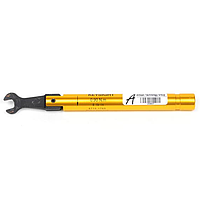
Torque wrench
Accurate fastening is critical wherever bolts and threaded joints affect safety, alignment, or long-term reliability. In maintenance workshops, production lines, and field service work, a torque wrench helps technicians apply the intended tightening force instead of relying on feel alone, reducing the risk of under-tightening or overstressing components.
This category brings together torque tools and related fastening solutions used in automotive service, industrial assembly, equipment maintenance, and mechanical repair. Whether the task involves routine installation, controlled tightening of sensitive parts, or higher-capacity fastening work, selecting the right torque range, drive size, and tool format makes a noticeable difference in both consistency and productivity.
Why controlled torque matters in assembly and maintenance
Fasteners are designed to work within a defined clamping force range. If torque is too low, vibration, thermal cycling, or repeated loading can loosen the joint over time. If it is too high, threads, bolts, seals, or connected components may be damaged before the problem is visible.
A torque wrench gives the operator a practical way to meet assembly specifications more consistently. This is especially important for machinery servicing, automotive repair, flanged connections, and any application where repeatability and traceable workmanship are valued in a professional B2B environment.
Common torque wrench formats and where they fit
In day-to-day industrial use, mechanical click-type tools remain a common choice because they are straightforward to set and easy to use in repetitive fastening tasks. For broader workshop requirements, different ranges are often needed rather than one tool trying to cover every application.
Interchangeable systems are also relevant when users need flexibility at higher torque levels or with different head styles. For example, the TOPTUL ANAP0180 Interchangeable Torque Handle and TOPTUL ANAP01A0 Interchangeable Torque Handle are suited to applications where larger torque capacity and compatible heads are part of the workflow. For more standard workshop tightening, models such as the STANLEY STMT73589-8 and TOPTUL ANBV1621 illustrate the typical handheld format used in general service and maintenance.
How to choose the right tool for the job
The first point to consider is the torque range. The required working value should fall comfortably within the usable range of the wrench, rather than near the extreme low or high end. This helps improve control and supports more reliable fastening across repeated operations.
The second factor is drive size and compatibility with sockets or heads already used in the workshop. In this category, examples include 3/8" and 1/2" drive tools such as the TOPTUL ANAV1211 Torque Wrench and TOPTUL ANBV1621. For teams that also need complete fastening assortments for routine service, a socket wrench set can be a useful companion to torque-controlled tightening.
Users should also think about working space, handle length, operator comfort, and whether quick head changes are needed. In some electrical or maintenance environments, insulated hand tools may also be relevant alongside fastening tools, such as the TOPTUL CHRI1626V4 insulated reversible ratchet handle where application conditions require that kind of supporting equipment.
Supporting tools that complete the fastening workflow
A torque wrench is rarely used in isolation. In practice, technicians often prepare, position, and finish the job with ratchets, sockets, adaptors, and open-end accessories before final torque is applied. That is why this category can naturally sit within a broader assembly and repair tool ecosystem.
Examples from the current range include the TOPTUL CHAG1626 Reversible Ratchet Handle, TOPTUL CJBG1627 Reversible Ratchet Handle with Quick Release, and the TOPTUL ANAK0132 Open End Head. These products support access, speed, and compatibility in situations where the final tightening method depends on the joint layout. For buyers building out a workshop toolkit, products grouped under repair kit categories may also help cover adjacent service tasks.
Representative products in this category
This selection includes both individual torque tools and related fastening sets that support mechanical assembly work. The STANLEY STMT73589-8 Torque Wrench offers a practical torque band for many general fastening tasks, while TOPTUL options extend coverage across 3/8", 1/2", and higher-capacity interchangeable handle formats.
For broader bench or field use, the TOPTUL GCAD2101 socket set, TOPTUL GVA1017 ratchet combination wrench set, and TOPTUL GVA5004 socket set reflect the kind of supporting kits often used before and after torque-controlled tightening. Buyers comparing brands may also want to review the wider TOPTUL range for related hand tools and workshop accessories.
Good practice when using a torque wrench
Even the right tool can give poor results if used incorrectly. The operator should confirm the specified torque value, select the correct socket or head, and apply force smoothly through the handle. Sudden jerking, using extension methods that alter leverage, or treating the tool like a standard breaker bar can affect accuracy and shorten tool life.
It is also good practice to store the tool carefully and use it within its intended application range. For maintenance teams handling multiple fastening methods, related hand tools such as a Hex Wrench set may still be necessary for screws and internal hex fasteners where torque wrench use is not the main approach.
What B2B buyers usually look for
Professional buyers often evaluate more than the tool alone. They consider range coverage across departments, compatibility with existing sockets and accessories, replacement convenience, and whether the selected tools match the maintenance standards used on site. In many facilities, the goal is not simply to buy one wrench, but to create a practical fastening system for technicians.
Brand preference can also matter when standardizing tools across teams. This category includes products from recognized names such as TOPTUL and STANLEY, allowing buyers to compare tools intended for routine workshop use as well as more specialized torque applications.
Find the right torque solution for your application
The most suitable choice depends on the torque value required, the fastener access conditions, and how often the tool will be used. A compact wrench for service work, a 1/2" drive model for general maintenance, or an interchangeable high-capacity handle for heavier jobs each serves a different purpose in a professional workflow.
By choosing a torque wrench that matches the actual fastening requirement and pairing it with the right accessories, businesses can improve assembly consistency, reduce avoidable damage, and support safer maintenance practices over time.
Get exclusive volume discounts, bulk pricing updates, and new product alerts delivered directly to your inbox.
By subscribing, you agree to our Terms of Service and Privacy Policy.
Direct access to our certified experts