A washing colorfastness tester helps textile teams evaluate how dyed materials change after washing. Color fastness to washing is an important quality consideration because repeated laundering can affect a textile’s appearance through color change or staining. For manufacturers, laboratories, and research teams, a controlled test process provides a consistent basis for assessing materials at different stages of development and quality control.
The tester may be used for washing colorfastness testing as well as dry-cleaning colorfastness testing when it is configured for the relevant procedure. Meaningful results depend on more than the instrument itself: specimen preparation, selected parameters, the applicable method, and post-test handling all need to follow the required test specification.
What Does a Washing Colorfastness Tester Evaluate?
A washing fastness tester is designed to assess the degree of color change in dyed textiles after a washing procedure. The assessment is relevant to fabrics and textile products that will be exposed to laundering during normal use. It can support quality checks for incoming materials, semi-finished goods, and finished products.
Rather than treating washing performance as a single visual judgment, the test establishes repeatable conditions for preparing and processing specimens. This makes it easier for a quality team to compare results across material batches or production stages when the same applicable method is followed.

Typical Color Fastness to Washing Workflow
1. Prepare specimens to the applicable method
Specimens should be prepared strictly in accordance with the selected standard. This step is essential because the specimen arrangement and testing requirements determine whether the result can be evaluated consistently. Before testing, identify whether the intended procedure is for washing or dry cleaning and confirm the relevant method requirements.
2. Configure time and temperature
The source configuration describes an automatic control system with built-in time and temperature control. These settings can be adjusted to suit different test requirements, allowing the tester to maintain defined conditions throughout the cycle. An automatic completion alarm can notify the operator when the cycle has finished so specimens can be removed promptly.
3. Run the required test cycle
Test execution should follow the specified operating steps and the equipment instructions. Consistent operation is particularly important where results are used to review dyeing processes, verify finished-product quality, or support commissioned laboratory work.
4. Clean after testing
After each test, the test cups and chamber should be cleaned promptly. Routine cleaning helps keep the equipment ready for subsequent work and supports its continued service life.
Standards and Method Coverage
The referenced Color fastness testing machine is described for methods including ISO 105-C01, C02, C03, C04, C05, C06, C08, C09, C10, D01, E03, and E12. Other listed methods include GB/T 5711, GB/T 3921-1 to 5, GB/T 12490, AATCC 3, 61, 62, 86, 132, 151, and 190, plus JIS L0860, JIS L0844, and JIS L0879.
The source also identifies M&S C4A, C5, C37, and P3B; BS 1006 NEXT 2, 3, and 5; IWSTM 7, 115, 177, 193, 240, and 241; and FTMS 191 Method 5610/5622. Laboratories should match the selected procedure and equipment configuration to the method required for their work.
Where Washing Colorfastness Testing Is Used
In textile dyeing operations, washing fastness testing can be used for incoming dye inspection, semi-finished material testing, and finished-product verification. Results can help technicians review dyeing formulations and processes as part of ongoing quality control.
Third-party testing laboratories may use this type of tester for commissioned testing, quality-related projects, and arbitration work. For home textiles and footwear, relevant applications include bed linens, curtains, shoe-upper fabrics, and other textile products.
Universities and textile research institutions can also apply washing colorfastness testing in new dye development, material-performance research, and teaching experiments. Controlled parameters and stable test operation provide a structured process for experimental work.
Equipment Considerations for Quality Control
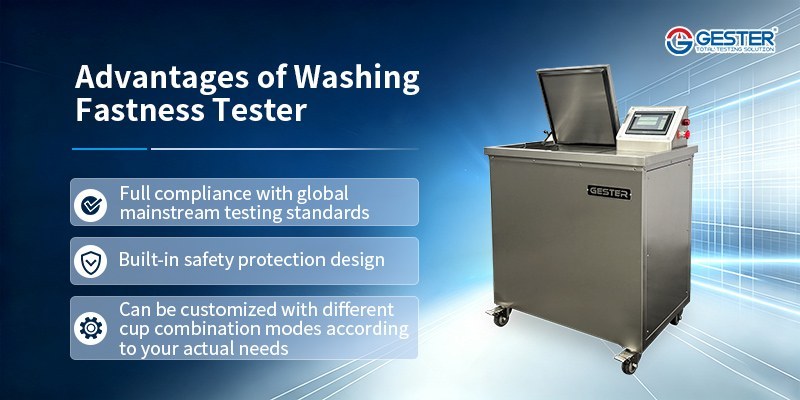
When selecting or operating a washing colorfastness tester, review the cup combination required for the expected batch size and test method. The source notes that cup combinations can be customized for specific testing needs. This flexibility can be relevant when a laboratory handles different procedures or sample volumes.
A door safety switch is also described as a standard safety feature. This type of protection is intended to support safer operation during testing. Alongside safety features, operators should follow the applicable procedure, equipment instructions, and routine cleaning practices.
A Fabric color fastness tester is most valuable when it is part of a disciplined quality-control workflow. Correct specimen preparation, appropriate time and temperature settings, adherence to the selected method, timely specimen removal, and post-test cleaning all contribute to a more consistent process. For textile dyeing, finished goods, laboratory services, and research, washing colorfastness testing offers a practical way to evaluate appearance retention after washing under defined conditions.