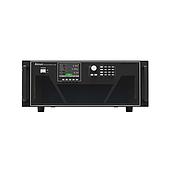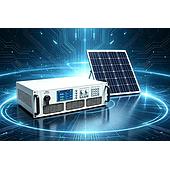
A bidirectional DC power supply can both provide DC power to a device and absorb energy returned by that device. This two-way operation makes it useful where charging, discharging, simulation, and energy recovery need to occur within one test or energy-management process.
Based on the available information, its principal application areas are electric vehicles, renewable-energy storage and microgrids, and advanced research and testing environments.
Summary: A bidirectional DC power supply supports source and sink operation. It can be used for EV battery and charging-system tests, storage-supported renewable energy, microgrid coordination, and energy-recovery testing of power equipment.
What makes a bidirectional DC power supply different from a conventional power supply?
The key difference is that a bidirectional unit can operate as both a power source and an energy-absorbing sink. A conventional supply is described as delivering energy in one direction, while a bidirectional supply can recover energy coming back from the device or system under test.
This capability is relevant when equipment alternates between charging and discharging. It also enables tests in which the same system must emulate an energy source at one moment and accept returned energy at another.
How is a bidirectional DC power supply used in electric vehicles?
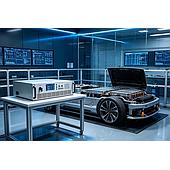
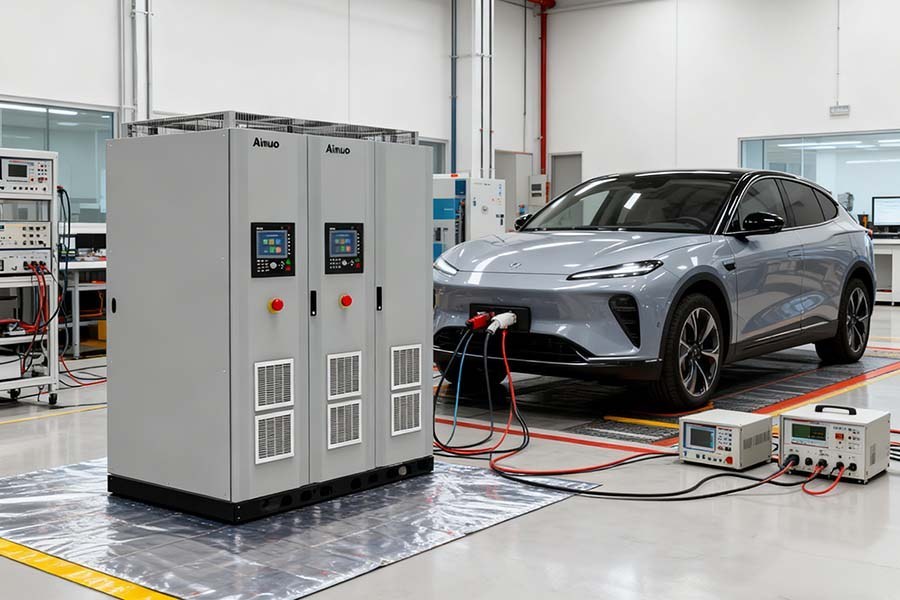
In electric-vehicle work, bidirectional DC power supply technology is associated with vehicle-to-grid operation, vehicle-to-load use, and component testing. It can support controlled charge-discharge cycles and the evaluation of systems that exchange energy with a vehicle battery.
How does it support V2G and V2L functions?
Vehicle-to-grid, or V2G, describes the use of stored vehicle energy as a resource that can be sent back to the grid when conditions permit. The source information also describes aggregation of V2G-capable vehicles as a virtual power plant for peak-shaving capacity.
Vehicle-to-load, or V2L, uses battery energy through a vehicle charging port for loads such as camping equipment, outdoor work tools, or household emergency power. These applications depend on a vehicle and charging system designed to support the required bidirectional energy flow.
Which EV components can be tested?
A bidirectional DC power supply can simulate charge-discharge cycles for battery-pack testing, including assessment of battery capacity, lifespan, and battery-management-system performance. It can also help test on-board chargers (OBCs), DC-DC converters, and motor controllers by simulating varying grid and battery states.
| EV testing area | Role of bidirectional operation |
|---|---|
| Battery pack and BMS | Simulates charging and discharging cycles while absorbing returned energy. |
| OBC and DC-DC converter | Simulates different grid and battery conditions for verification. |
| Motor controller | Supports rigorous testing alongside other core EV components. |
Why is a bidirectional DC power supply relevant to renewable energy storage?
Solar and wind generation can vary with weather and operating conditions. In an energy-storage arrangement, a bidirectional DC power supply can charge a battery with surplus energy and release stored energy when available generation falls, helping smooth the supply delivered to a grid or load.
The same charge-at-one-time and discharge-at-another principle is described for peak shaving and valley filling. This approach can reduce pressure on the grid by shifting when stored energy is charged or supplied.
What role can it play in a microgrid?
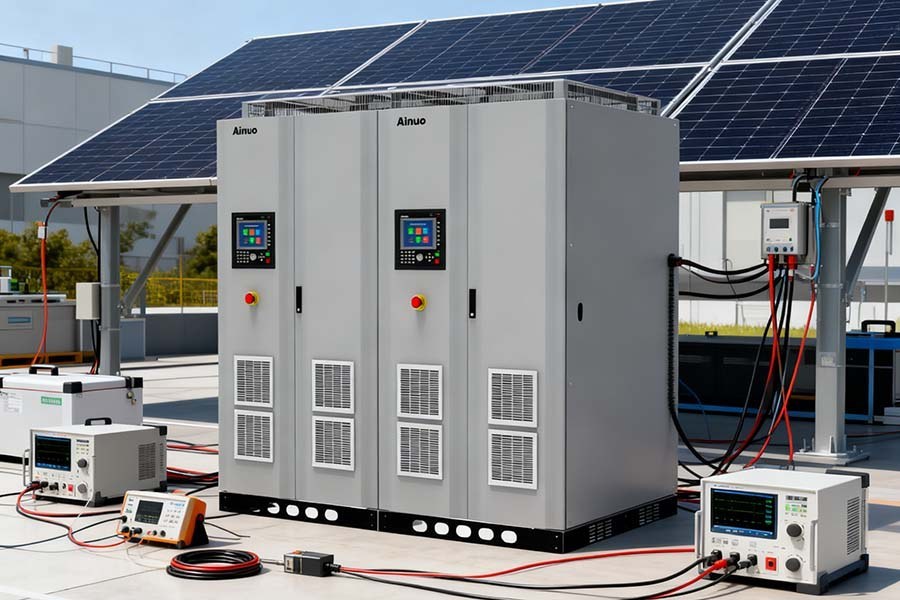
In an independent microgrid, a bidirectional DC power supply can coordinate energy flow among photovoltaic generation, wind turbines, storage batteries, and loads. The available information identifies use cases including islands, remote areas, and specific factory areas.
Its role is to manage the balance between real-time supply and demand so the microgrid can operate steadily while making use of renewable energy. The precise control strategy depends on the overall microgrid design and connected equipment.
When is a bidirectional DC power supply used for research and testing?
It is used where a test setup needs precise input power as well as the ability to absorb energy produced by the device under test. The source information cites power electronics, semiconductor work, aerospace, and power-equipment validation as relevant testing environments.
How does it help test power devices and modules?
For devices and modules such as IGBTs, silicon carbide (SiC), and gallium nitride (GaN) devices, the supply can provide controlled power input and absorb output energy. This supports testing under changing or demanding operating conditions and can assist with characteristic and reliability evaluation.
What is energy recovery in aging tests?
During aging tests of products such as server and communication power supplies, the device under test may output DC energy. An energy-recovery test system centered on bidirectional DC power technology can recover that output and feed it back to the grid rather than converting it primarily into heat.
Note: The source states that such an energy-recovery aging-test system can achieve energy efficiency of 95% or more. Actual results depend on the complete test system and operating conditions.
How should users determine whether bidirectional operation is needed?
Regenerative Power System is appropriate when an application requires both controlled power delivery and controlled absorption of returned energy. Typical examples in the available information are EV charge-discharge testing, battery energy storage, microgrid energy coordination, and regenerative testing of power equipment.
If the application only needs one-way DC output and does not involve discharge simulation, returned energy, or energy recovery, a conventional one-direction power supply may address a different set of requirements. The decision should be based on the expected energy flow and the test or system scenario.