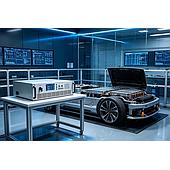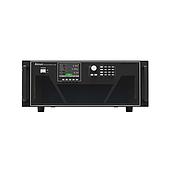
A bidirectional DC power supply for OBC testing can both deliver DC power to a device under test and absorb power returned by it. This dual role helps test an on-board charger (OBC) across charging and discharge-related operating conditions without relying on an actual vehicle battery.
For bidirectional on-board chargers, the instrument can emulate battery-side behavior while supporting reverse-power-flow tests associated with V2G, V2L, and V2H functions. It can also reduce the need to combine a separate DC supply and electronic load in one test setup.
Summary: A bidirectional DC power supply sources and sinks DC power. It supports battery emulation, charging and reverse-flow verification, and dynamic OBC test conditions. A regenerative design may return absorbed energy to the AC grid.
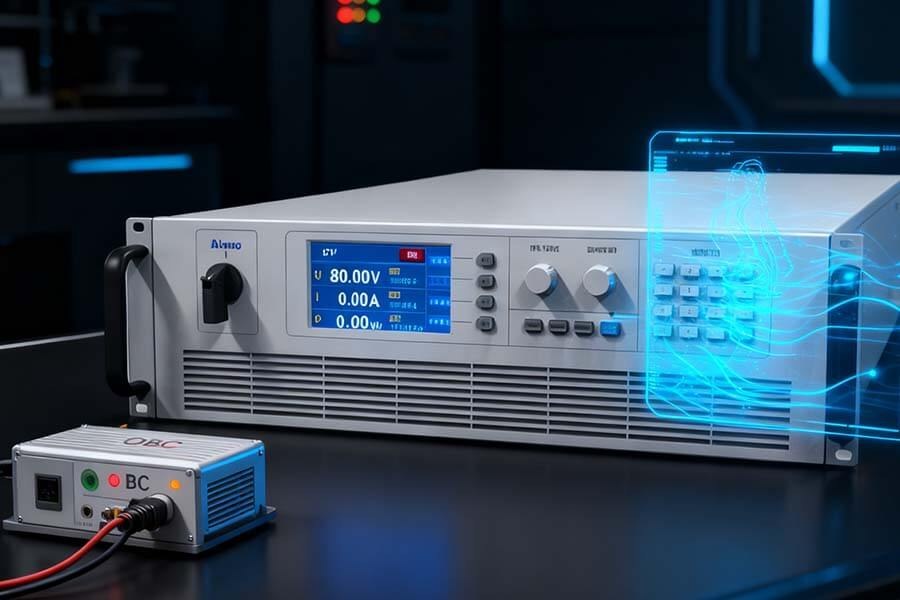
What does a bidirectional DC power supply do in OBC testing?
A bidirectional DC power supply acts as either a controlled DC source or an electronic load, depending on the test sequence. In source mode, it injects energy into the device under test; in sink mode, it absorbs energy delivered back from that device.
This flexibility is relevant because an OBC converts AC input power into DC power suitable for a high-voltage vehicle battery. A bidirectional OBC can also support power flow out of the battery for applications such as vehicle-to-grid, vehicle-to-load, or vehicle-to-home operation.
| Operating mode | Role in an OBC test |
|---|---|
| Source mode | Provides controlled DC voltage and current to emulate battery-side conditions during charging-related testing. |
| Sink mode | Absorbs DC power from the OBC during discharge or reverse-power-flow testing. |
Why is battery simulation useful when testing an on-board charger?
Battery simulation provides a controlled, repeatable alternative to connecting a physical battery pack during OBC development and validation. It allows engineers to emulate charging curves, voltage changes, and battery-related operating profiles without dedicating an entire vehicle or battery pack to the test.
An OBC must manage charging in relation to factors including battery voltage, current, state of charge, and temperature. A programmable bidirectional supply can support dynamic battery profiles and load transients so these conditions can be evaluated in a laboratory setup.
How does bidirectional equipment support V2G, V2L, and V2H testing?
Bidirectional equipment supports these tests by switching from a power-source role to a power-absorbing role when the OBC returns energy toward the grid or an auxiliary load. This lets engineers examine reverse power flow using one instrument rather than separately coordinating a DC supply and an electronic load.
For example, the test system can source DC power while evaluating one operating direction, then sink DC power for discharge testing. This approach is suited to validating whether the charger control logic and hardware handle changes in power direction without instability.
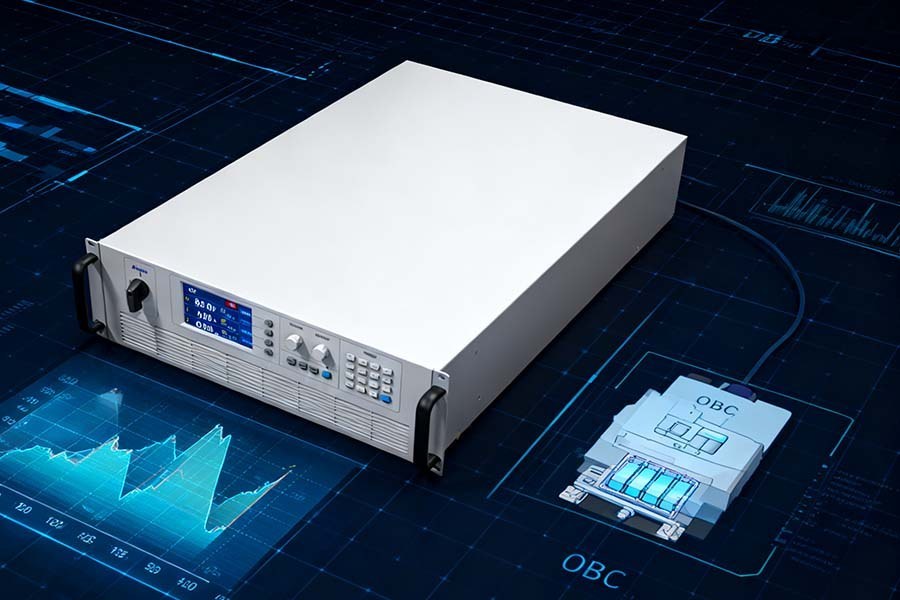
Which OBC test scenarios can use a bidirectional DC power supply?
A bidirectional DC power supply can be used for charging-mode verification, reverse-flow testing, transient testing, and repeated charge-discharge stress cycles. The exact test procedure depends on the charger function and the conditions being evaluated.
- Charging-mode verification: The supply acts as a battery emulator with controlled voltage and current while the OBC charging behavior is monitored.
- Discharge or reverse-flow testing: The supply operates as a load to absorb power from the OBC during bidirectional operation.
- Transient testing: Programmable changes can represent abrupt load changes, grid-voltage variation, or battery state transitions.
- Thermal and stress testing: Repeated charge and discharge cycles can be evaluated on one test platform.
Why are transient and dynamic tests important for bidirectional OBCs?
Bidirectional OBCs must respond to changing power-flow and system-demand conditions, so static testing alone may not reveal all behavior. A bidirectional DC supply can make rapid changes between sourcing and sinking, helping emulate changes associated with battery packs or grid conditions.
Programmable voltage and current ramps, modulation, and waveform shaping can be used to reproduce dynamic conditions described by the test plan. These capabilities help assess charger response beyond slow power transitions or fixed loads.
Can a bidirectional DC power supply simplify the OBC test bench?
Yes. A single bidirectional instrument can replace the separate functions of a DC power supply and an electronic load for tests that require both sourcing and sinking. This can reduce cabling, control coordination, and hardware changes between charging and reverse-flow test steps.
Programmable control and mode transitions can also support consistent test sequences and repeatable conditions. When a model is regenerative, absorbed energy may be returned to the AC grid or reused internally, which can improve energy use in high-volume laboratory testing.
Note: Grid energy return is a capability of regenerative bidirectional test solutions, not a feature of every bidirectional DC power supply. Verify the operating modes and energy-handling method required for a specific OBC test setup.
What should engineers evaluate when selecting equipment for OBC testing?
Engineers should first determine whether the OBC test requires only charging verification or both charging and discharge operation. Bidirectional power supply is particularly relevant when battery emulation, reverse power flow, V2X-related scenarios, or rapid dynamic changes must be represented.
The selection should also align with the intended test conditions, including programmable voltage and current behavior, transient requirements, waveform needs, and whether regenerative energy handling is required. Matching these needs to the test plan helps keep the setup focused on the OBC functions being validated.