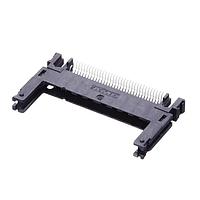
Memory Connectors
Reliable board-level data storage and removable media interfaces still depend on one small but critical detail: the right connector. In embedded systems, industrial controllers, communication hardware, and compact electronics, memory interfaces must deliver stable contact performance, practical mounting options, and a form factor that fits the overall design. That is why choosing Memory Connectors is not just about matching a card type, but also about assembly method, serviceability, and long-term use conditions.
This category brings together connector solutions used for memory cards, memory modules, and related card-based interfaces. It is relevant for engineers building products around SD, microSD, SIM-style, PCMCIA, and DDR memory architectures, as well as buyers looking for dependable sourcing across established connector manufacturers.
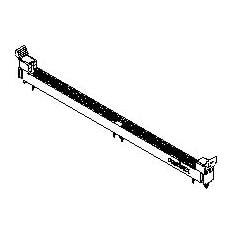
Where memory connectors fit in electronic design
Memory connectors are used wherever a system needs removable storage, replaceable modules, or board-to-card interfacing. In many designs, they act as the mechanical and electrical bridge between the PCB and the memory medium, helping maintain signal continuity while also supporting insertion and extraction cycles.
Compared with general-purpose interconnects, these parts are usually selected with tighter attention to card format compatibility, mounting orientation, contact layout, and user access. For example, a compact product may need a right-angle surface-mount microSD socket, while a larger computing or industrial platform may require a vertical memory module socket for board-level RAM integration.
Common memory connector formats in this category
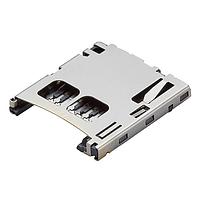
The category covers several well-known interface styles. SD and microSD connectors remain common in embedded logging, HMI panels, gateways, and portable devices because they provide removable storage in a compact footprint. As an example, the Amphenol 114-00841-68 is a microSD socket with an 8-position layout and 1.1 mm pitch, while the Alps Alpine SCDA3A0202 is an SD card connector with a 10-position format and 1.6 mm pitch.
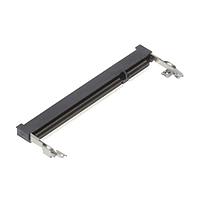
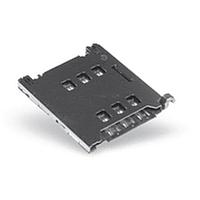
Other formats in the selection illustrate the broader scope of memory interconnect design. You can also find solutions related to SIM-style or smart media housing concepts, PCMCIA receptacles such as the Amphenol FCI 95622-003, and DDR memory module sockets like the Amphenol FCI 10145891-1631J13LF and DDR4288V0413TF for DDR4 applications. This range matters because memory connectivity is not limited to removable storage cards; it also includes module-level memory interfaces used directly on the board.
How to choose the right connector for your application
The first step is to match the connector to the actual memory standard used in the design. Card type, number of positions, and pitch must align with the target device. A connector intended for microSD should not be treated interchangeably with a full-size SD format, and DDR module sockets have completely different mechanical and electrical requirements from card-based connectors.
Next, review installation constraints. Mounting style is often decisive, especially in compact products or automated production lines. Surface-mount options can support dense PCB layouts and low-profile assemblies, while through-hole designs may be preferred in applications where additional mechanical retention is important. Orientation also affects usability: vertical and right-angle styles can change both enclosure design and card access.
It is also worth considering insertion style, plating, operating temperature range, and expected mating cycles. These factors influence reliability in applications where cards may be replaced regularly or where the assembly works in demanding environments. If the design also includes broader interconnect requirements, related categories such as cable assemblies or contacts may help complete the overall connection strategy.
Examples from leading manufacturers
Several established brands appear prominently in this category, including Amphenol, Alps Alpine, Amphenol Commercial Products, and Amphenol FCI. These manufacturers are widely used in electronics design because they offer connector families for different memory formats, PCB mounting styles, and application priorities.
Representative products in the range include the Amphenol C70710M0065002A and Amphenol C707 10M006 522 2 A for memory card connectivity, the Amphenol SCE2MSDZN76A121SN for compact card-based designs, and the Amphenol Commercial Products 101009586802 SD push-push connector for applications where user-friendly insertion and retention are important. On the module side, DDR4 sockets such as 10145891-1631J13LF and DDR4288V0413TF show how this category also supports board memory expansion in computing-oriented hardware.
Design considerations beyond basic compatibility
In practical engineering work, connector selection often involves more than matching a datasheet card type. Designers may need to evaluate enclosure clearance, card accessibility after assembly, solder process compatibility, and whether the application is intended for occasional service or frequent field replacement. A connector that fits electrically can still become a poor choice if the card cannot be accessed easily or if the retention method is unsuitable for the product’s usage pattern.
Signal integrity and mechanical stability are also relevant, especially in denser PCB designs or systems exposed to movement and vibration. Contact material, plating, insulation properties, and housing construction all contribute to long-term performance. For board designs that combine storage interfaces with additional panel or service interconnects, categories like keystone connectors can be useful points of comparison when planning the wider connector ecosystem.
Typical applications for memory connector solutions
These connectors are commonly used in industrial embedded systems, data acquisition equipment, control panels, portable electronics, communication devices, and development platforms. SD and microSD sockets are often selected for logging, firmware transfer, or removable storage. DDR sockets support memory expansion in processing platforms, while specialized card interfaces may still appear in legacy or application-specific equipment.
From a procurement perspective, this category is useful for both new product development and replacement sourcing. Engineers can compare connector formats and mounting options during design, while purchasing teams can identify parts that align with approved manufacturers and known board requirements.
Finding a suitable part in this category
When narrowing down options, start with the memory format and mechanical envelope, then verify key details such as orientation, termination style, position count, and space constraints on the PCB. After that, it becomes easier to compare alternatives within the same family or across manufacturers without losing sight of the actual application need.
A well-selected memory connector supports both reliable operation and smoother manufacturing. Whether the project calls for a compact microSD socket, an SD push-push connector, a PCMCIA receptacle, or a DDR4 module socket, this category helps connect storage and memory devices to the board in a way that matches real design requirements rather than generic part descriptions.
Get exclusive volume discounts, bulk pricing updates, and new product alerts delivered directly to your inbox.
By subscribing, you agree to our Terms of Service and Privacy Policy.
Direct access to our certified experts