Current Sensor Development Tools
When engineers validate current measurement early in a design, having the right hardware shortens both prototype time and debug cycles. Current Sensor Development Tools help teams evaluate sensing principles, verify signal behavior, and integrate current measurement into power electronics, industrial control, battery systems, and embedded platforms with less guesswork.
On this page, you can explore evaluation boards, demo boards, adapter boards, and utility tools built for testing current sensor devices in realistic development workflows. These tools are useful whether you are comparing isolated and non-isolated sensing approaches, checking analog or digital interfaces, or preparing a design for laboratory validation before moving toward production.
Why current sensor development tools matter
Current sensing is a core function in many electronic and industrial systems. It supports protection, control, efficiency monitoring, load analysis, and closed-loop feedback. In practice, development tools make it easier to understand how a sensor behaves under changing loads, supply conditions, and interface requirements before committing to a full PCB design.
Compared with building a test setup from scratch, a dedicated evaluation board gives engineers a faster path to measurement validation. It can also reduce uncertainty when working with Hall-effect current sensor devices, isolated sensing architectures, or contact and contactless measurement concepts that need to be assessed in a controlled way.
What you will typically find in this category
This category includes several types of hardware used during sensor evaluation. Some boards are designed around a specific device, while others act as adapters or utility platforms for connecting a sensor to a broader test environment. The goal is not only to power the sensor, but also to simplify signal access, interface testing, and application-level experimentation.
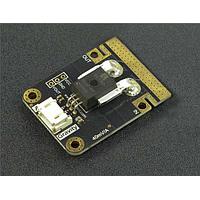
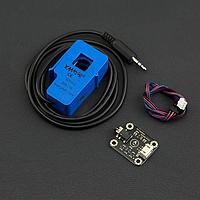
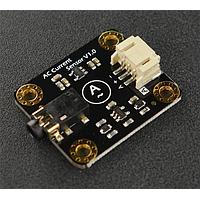
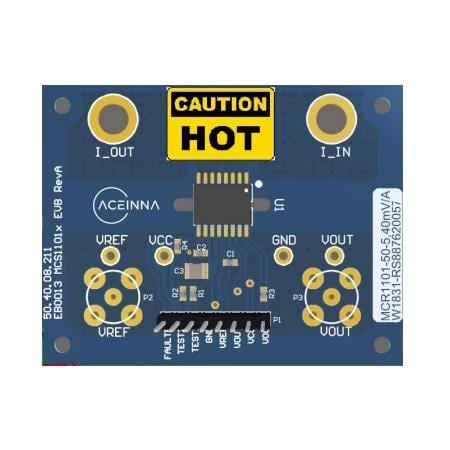
Examples from this range include the ACEINNA EVB MCA2101-50-3 evaluation board, the ACEINNA EVB MCA1101-50-5 for isolated current sensor testing, and the Allegro MicroSystems ACSEVB-LC8-LZ6 for evaluating LZ/LC package current sensors. You will also find application-oriented platforms such as the Infineon CURSENSORPROGGEN2TOBO1 utility board for interfacing TLE4973 Hall current sensors, as well as compact development options like the Mikroe MIKROE-4798 Hall Current 12 Click.
If your project spans other sensing functions alongside current monitoring, it can be useful to compare related platforms such as magnetic sensor development tools or multi-function sensor development tools where signal conditioning and embedded evaluation workflows may overlap.
Common sensing approaches covered by evaluation boards
A large share of current sensor development hardware is built around magnetic sensing techniques, especially Hall-effect based devices. These solutions are widely used because they support non-intrusive current measurement and are often well suited to applications where galvanic isolation, compact integration, or simplified board-level implementation are important.
Within this category, you may also encounter boards intended for contact current sensing or contactless measurement demonstrations, depending on the sensor family being evaluated. Products such as the Allegro MicroSystems CTD426-20AC and CTD221-5.0 illustrate how demo boards can help engineers compare different installation styles, conductor arrangements, and measurement concepts during the design phase.
Some tools are also optimized around interface evaluation rather than only sensing performance. For example, the Mikroe Hall Current 12 Click references an I2C interface, while other boards emphasize analog output behavior. This matters when selecting hardware for MCU-based systems, data acquisition platforms, or mixed-signal control designs.
How to choose the right development tool
The best starting point is to match the tool to the exact sensor or sensor family under consideration. A board designed specifically for a target IC generally provides the clearest path for testing offsets, sensitivity behavior, output scaling, and integration constraints. If you already know the sensor you want to evaluate, device-specific kits such as the Melexis DVK91206 IMC or the Texas Instruments TMCS-A-ADAPTER-EVM can streamline setup.
Next, consider the electrical environment of your application. Supply voltage, operating temperature range, output type, and isolation requirements all influence board suitability. An industrial design may benefit from evaluating tools associated with parts intended for wider temperature conditions or isolated measurement, while lower-voltage embedded systems may place more importance on interface compatibility and logic-level integration.
It is also worth checking whether you need a full evaluation board, a demo board for concept validation, or a compact add-on format for rapid prototyping. Teams working across broader motion and sensing projects may also browse acceleration sensor development tools to align their hardware evaluation process across multiple sensing domains.
Representative manufacturers and platforms
Several well-known suppliers appear frequently in this category. Allegro MicroSystems is strongly represented with evaluation and demo hardware covering different current sensing approaches, including boards such as ACSEVB-LC8-LZ6, CTD456-BB-06B5, ASEK31100/2/2S-SUBKIT-T, CTD426-20AC, CTD221-5.0, and ASEK-ACS-DEMO. This makes Allegro a practical reference point for engineers comparing multiple current sensor implementations within one ecosystem.
Other notable options in the category include ACEINNA evaluation boards for MCA2101-50-3 and MCA1101-50-5, the Melexis DVK91206 IMC, the Infineon CURSENSORPROGGEN2TOBO1 utility board, the Texas Instruments TMCS-A-ADAPTER-EVM, and Mikroe’s Click-format solution. Each platform supports a different stage of development, from quick bench testing to deeper device characterization.
Brand choice should usually follow the target application and sensor architecture rather than preference alone. In some projects, the deciding factor is isolation; in others, it is interface type, board form factor, or how quickly the tool can be connected into an existing test setup.
Typical application scenarios
These tools are commonly used in motor drives, power supplies, battery management development, industrial automation, energy monitoring, and embedded control systems. During the evaluation stage, engineers may test current response under dynamic load conditions, inspect output linearity, validate fault thresholds, or confirm how the sensing path behaves across temperature and supply variations.
They are also useful for firmware teams and system integrators. A ready-made board can accelerate software bring-up, calibration routines, and communication testing before the final hardware is available. In this sense, development hardware is not only for component evaluation but also for reducing system-level integration risk.
Practical benefits during prototyping and validation
A good development platform helps isolate problems early. Instead of wondering whether an issue comes from the sensor, PCB layout, power stage, or firmware, engineers can begin with a known hardware platform and validate the measurement chain step by step. That improves troubleshooting efficiency and creates a clearer path toward design refinement.
These tools also support comparison work. If you are deciding between different sensing methods, output formats, or package styles, evaluation boards make side-by-side testing far more practical. For teams building sensing-heavy systems, this can reduce redesign effort and improve confidence before selecting production components.
Final considerations for sourcing
Choosing from a broad range of current sensor development tools is easier when you focus on the target device, required interface, isolation needs, and intended application environment. Whether you need a dedicated evaluation board, a utility interface board, or a compact development module, the right platform can help you move from concept to validated measurement faster and with better technical insight.
Explore the available tools in this category to identify a setup that fits your sensor evaluation workflow, bench testing method, and integration goals. A well-matched development board can save time not only during component selection, but throughout the entire prototype and verification process.
Get exclusive volume discounts, bulk pricing updates, and new product alerts delivered directly to your inbox.
By subscribing, you agree to our Terms of Service and Privacy Policy.
Direct access to our certified experts