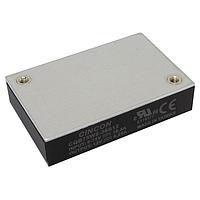
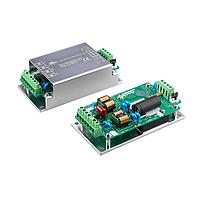
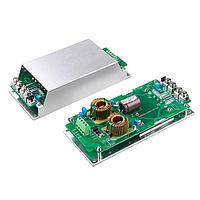
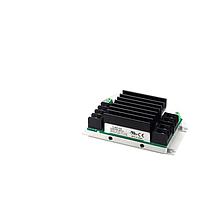
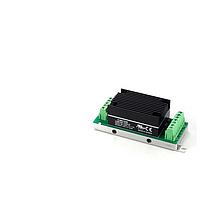
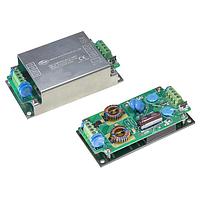
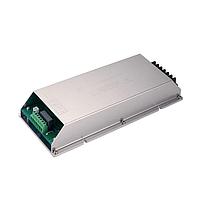
Chassis Mount Isolated DC/DC Converters
Reliable power conversion becomes especially important when equipment must keep running in electrically noisy, high-vibration, or safety-critical environments. In these cases, chassis mount isolated DC/DC converters are often selected to deliver stable DC output while maintaining galvanic isolation between input and output circuits. That combination helps support system protection, signal integrity, and broader power architecture flexibility across industrial, transport, and embedded platforms.
This category focuses on enclosed and chassis-mount designs used where mechanical robustness, thermal performance, and straightforward panel or frame installation matter. You will find solutions suited to railway, industrial, and ITE applications, with options that vary by input range, output voltage, output count, and power level.
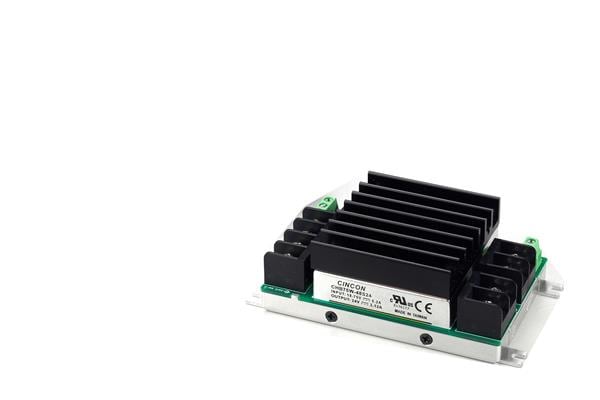
Why chassis mount design is used in isolated power systems
A chassis-mount format is typically chosen when a converter needs a more secure mechanical installation than board-level power modules. These units are designed to be mounted onto a panel, enclosure, or equipment frame, which can simplify integration in control cabinets, rail vehicles, communication systems, and industrial machines.
Compared with smaller PCB-mounted formats, this style is often better suited to higher power handling, improved heat dissipation, and field serviceability. If your project instead requires a compact board-level solution, it may be worth comparing with through-hole isolated DC/DC converters for traditional assembly or other mounting styles depending on the equipment layout.
Key selection points for the right converter
The most practical way to narrow down a converter is to start with the input voltage range and the required output rail or rails. In this category, available products include models designed around nominal 24 V, 48 V, and 110 V DC systems, with wide input ratios such as 3:1, 4:1, 5:1, 6:1, and 10:1 for installations where the source can vary significantly.
The next step is matching output power and load profile. Some applications only need a compact 20 W supply rail, while others need 150 W, 300 W, 360 W, or even 500 W class conversion. It is also important to decide between single-output and dual-output designs, and whether a fixed, adjustable, or programmable output approach fits the control strategy of the end system.
Application fit: railway, industrial, and ITE environments
This category includes several models positioned for railway applications, where converters are commonly expected to handle demanding temperature ranges, fluctuating input conditions, and long service life expectations. For example, Bel offers railway-oriented enclosed units such as the 24RCM300-12, 24RCM150-24, and 110RCM300-24, covering different DC bus and output combinations for onboard or trackside systems.
For industrial and mixed-use designs, Aimtec models such as the AM20EW-4805D-NZ-ST and AM20EW-4824S-NZ-ST illustrate lower-power isolated conversion in a chassis-mount form, while Delta Group products such as the B62SR24015DC and B70SP13736A show how higher-power conversion can support ITE and industrial equipment. If your design constraints point to another package style, you can also review other isolated DC/DC converters for a broader comparison.
Examples of product coverage in this range
The product mix here spans from compact low-power modules to larger enclosed converters for more demanding loads. At the lower end, Aimtec 20 W units provide isolated conversion for systems that need modest current and a practical chassis-mount footprint. These can be relevant where auxiliary rails, interface electronics, or smaller industrial subsystems need dependable isolated power.
Moving up in power, Bel and Delta Group examples highlight the broader capability of the category. Bel ERP2320-9RG and HRP2540-9RG represent railway-focused dual-output designs, while the Bel DK2660-9ERG adds a programmable angle for applications that benefit from greater output control. On the higher-power side, Delta Group B62SR24015C and B62SR24015DC provide 24 V output solutions in the 360 W class, and B70SP13736A extends into a 500 W industrial and ITE use case.
Isolation, regulation, and system protection considerations
The main function of an isolated DC/DC converter is not just voltage conversion, but also electrical separation between the source and the load. That galvanic isolation can help reduce ground loop issues, improve noise tolerance, and support safer power distribution across subsystems with different reference potentials.
Regulated output is equally important in real-world installations where the input supply may vary. Many products in this category are specified as regulated designs, helping maintain more stable output behavior under changing input and load conditions. Depending on the model, isolation ratings and wide-input capability can make a meaningful difference in demanding transport or industrial environments.
Manufacturer landscape in this category
This product area commonly involves established power brands with experience in industrial and embedded applications. Within the available context, Bel, Aimtec, and Delta Group are especially relevant because they are directly represented in the featured products shown for this category.
Broader sourcing requirements may also lead buyers to compare ranges from manufacturers such as Advanced Energy, MEAN WELL, Murata, or TDK-Lambda when aligning mechanical format, electrical performance, and approval strategy across a larger platform. In practice, the best choice often depends less on brand alone and more on how well the converter matches the DC bus, output architecture, installation constraints, and operating environment.
When to compare chassis mount with other package types
Not every isolated converter needs an enclosure-mounted format. If board space, assembly method, or power density drives the decision, a different package may be more suitable. For compact PCB integration, SMD isolated DC/DC converters can be relevant, especially in space-constrained electronics where automated assembly is important.
Chassis mount options are usually the better fit when the converter must be mechanically secured inside an equipment enclosure, handle higher power, or be integrated as a standalone power block. That makes them particularly useful in rail, industrial control, communications, and embedded system builds where installation robustness matters as much as electrical performance.
Choosing with confidence
Filtering this category by input bus, output voltage, output count, power level, and application is the most efficient way to identify a suitable part. It also helps to consider ambient temperature, isolation needs, and whether fixed, adjustable, or programmable output behavior is required by the end equipment.
For buyers working on transport, industrial, or ITE power architectures, this category provides a practical starting point for selecting enclosed isolated converters that balance mounting convenience with reliable DC power conversion. Reviewing a few representative options from Bel, Aimtec, and Delta Group can quickly clarify which form factor and electrical range best fit your system.
Get exclusive volume discounts, bulk pricing updates, and new product alerts delivered directly to your inbox.
By subscribing, you agree to our Terms of Service and Privacy Policy.
Direct access to our certified experts