Copper Wire for RTD, Thermistor
Reliable temperature measurement depends on more than the sensor itself. In many industrial and laboratory installations, the cable between the sensing point and the instrument has a direct effect on signal quality, noise resistance, routing flexibility, and long-term durability. That is why Copper Wire for RTD, Thermistor is a practical part of the measurement chain, especially where accurate low-level signal transmission matters.
This category is intended for RTD and thermistor applications that require copper extension wire with consistent construction, clear color identification, and insulation suited to the surrounding environment. Whether you are building a new temperature loop, replacing aging cable, or standardizing wiring across panels and field devices, selecting the right wire helps reduce installation issues and supports more stable readings over time.
Why copper extension wire matters in RTD and thermistor circuits
RTDs and thermistors are resistance-based temperature sensors, so the wiring used with them is an important part of the circuit. Copper is commonly used because it provides suitable conductivity for these sensor types and is widely accepted in instrumentation and control wiring. In practice, the cable must do more than simply connect two points; it must also withstand routing conditions, maintain conductor integrity, and support clean identification during installation and maintenance.
For many users, the key requirement is a wire that fits the sensor type and the thermal conditions around the process. This category focuses on copper extension wire designed for use with RTD and thermistor sensors, making it relevant for ovens, process skids, test benches, machinery, environmental chambers, and general industrial temperature monitoring.
Typical construction features in this category
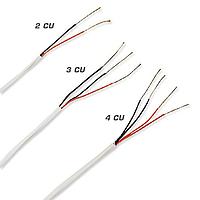
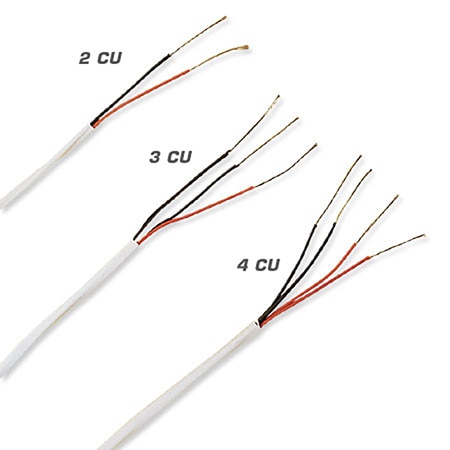
The products shown here are centered on stranded copper conductor designs for flexible installation. Several listed options use 26 AWG stranded conductors with ANSI color coding and red/black conductor identification, which can help technicians maintain consistency across sensor loops. Depending on the version, you will find insulation materials such as PFA insulation for higher temperature environments or PVC for more moderate operating conditions.
Available constructions also vary by outside size, cable length, and mechanical protection. Some versions include tinned copper overbraiding, while others use a simpler unbraided format for general routing. This makes the category useful for both compact instrument wiring and longer cable runs where handling, bundling, and environmental exposure may differ.
Examples available from OMEGA
This range includes products from OMEGA, a recognized manufacturer in temperature measurement and related wiring components. Representative examples include the OMEGA EXTT-2CU-26S-TCB-500, which combines copper conductors, PFA insulation, and tinned copper overbraiding for applications that may benefit from additional mechanical protection.
Other examples in the category include the OMEGA EXTT-4CU-26S-300M and OMEGA EXTT-3CU-26S-150M, both intended for RTD and thermistor use with copper conductors and higher-temperature PFA insulation. For lower temperature environments, the OMEGA EXPP-4CU-24S-300M provides a PVC-insulated alternative. These examples illustrate the practical differences buyers usually compare: insulation type, cable diameter, run length, and operating temperature range.
How to choose the right wire for your installation
A good starting point is the temperature rating of the cable relative to the installation area. If the wire will pass through hotter zones, a construction rated up to 260 °C may be more appropriate than a PVC option rated for lower temperatures. This is especially relevant when the sensor lead exits a heated enclosure, oven area, or process equipment where ambient cable temperature can rise above normal panel conditions.
Next, consider conductor size and cable dimensions in relation to routing path, termination space, and mechanical flexibility. Smaller nominal sizes may be easier to route through tight conduits or compact assemblies, while braided constructions may offer advantages where abrasion resistance or extra protection is preferred. Cable length also matters from a purchasing and installation perspective, with short lengths suitable for local connections and longer spools better matched to larger builds or repeated installations.
Color coding and sensor compatibility should not be overlooked. Products in this category are intended for use with RTD and thermistor sensors and follow ANSI color coding, which can simplify identification during commissioning and service work.
Common application environments
Copper extension wire for RTD and thermistor circuits is used across a wide range of industrial and technical settings. These include process temperature monitoring, machine OEM assemblies, lab instruments, thermal validation setups, HVAC-related control panels, packaging equipment, and food or pharmaceutical equipment where temperature feedback is part of routine operation.
In many of these systems, the wire must balance electrical performance with practical installation needs. Flexible stranded construction helps during routing, while insulation selection supports performance in either moderate or elevated temperatures. When combined with properly specified sensors and termination methods, the right cable helps create a more dependable measurement loop from the sensing point back to the controller, transmitter, or data acquisition device.
Related wiring categories worth comparing
Some projects call for a narrow, sensor-specific cable selection, while others may require a broader wiring mix for panels, harnesses, or custom assemblies. If your application extends beyond RTD and thermistor extension cable, you may also want to review hook-up wire options for general internal wiring tasks in control and instrumentation builds.
For buyers focused specifically on this sensor wiring family, this category remains the most direct place to compare copper constructions intended for RTD and thermistor use. That makes it easier to evaluate insulation type, size, and spool length without sorting through unrelated cable types.
What to review before ordering
Before selecting a product, it is useful to confirm the sensor type, required run length, installation temperature, and whether the cable will be exposed to abrasion or movement. You should also verify conductor count, insulation preference, and any plant standards tied to color coding or cable routing practices. These details often determine whether a high-temperature PFA design or a lower-temperature PVC design is the better fit.
Where multiple versions look similar, the final decision usually comes down to operating environment and installation method rather than headline product naming alone. Paying attention to cable diameter, spool format, and protective construction can help avoid rework once the cable reaches the field or production floor.
Find a suitable copper wire for stable temperature signal transmission
Choosing the right RTD and thermistor extension wire helps support accurate temperature measurement, cleaner installation, and easier long-term maintenance. This category brings together copper wire options tailored to resistance-based temperature sensing, with variations in insulation, dimensions, and cable length to suit different industrial and technical environments.
If you are comparing products for a new build or replacement job, focus on the real application conditions: temperature exposure, routing constraints, protection needs, and sensor compatibility. With those factors in mind, it becomes much easier to identify the most suitable copper extension wire for your system.
Get exclusive volume discounts, bulk pricing updates, and new product alerts delivered directly to your inbox.
By subscribing, you agree to our Terms of Service and Privacy Policy.
Direct access to our certified experts