Distance Sensors
Accurate object detection and position feedback are essential in automated machinery, material handling, mobile equipment, and safety-related monitoring. When a system needs to know how far away a target is, whether a zone is occupied, or how movement changes over time, Distance Sensors provide the measurement layer that helps turn raw machine motion into usable control data.
Within industrial sensing, this category covers a wide range of technologies, from compact laser distance devices for short-to-medium ranges to scanning solutions that build a broader picture of the surrounding area. The right choice depends on measuring distance alone, detecting presence across a defined field, or capturing 2D and 3D spatial information for more advanced applications.
Where distance sensors are used in industrial systems
Distance measurement is common anywhere machines interact with parts, pallets, vehicles, tools, or people. Typical use cases include checking object position on conveyors, monitoring approach distance in automated cells, verifying stack height or fill level, and supporting navigation or collision avoidance on mobile platforms.
In more demanding installations, distance sensing also supports protective functions and monitored fields. That is why this category can include both standard measurement devices and safety-oriented sensing solutions, depending on the application requirement, environmental conditions, and the expected level of integration with the wider control architecture.
Key sensor technologies in this category
Not all distance sensors work in the same way. Some devices focus on point-to-point measurement, where a laser-based sensor measures the distance to a natural object with high resolution. A good example is the SICK DT35S series, including models such as DT35S-B15251 and DT35S-B15551, which are designed for measured distance evaluation across several operating ranges.
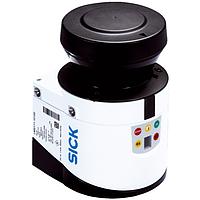
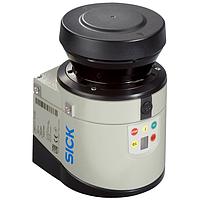
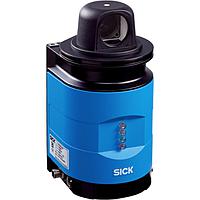
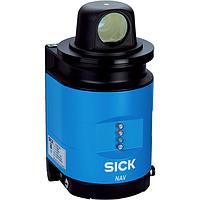
Other devices extend beyond single-point measurement. The SICK TIM310, TIM320, and TIM351 families use 2D LiDAR sensing to scan across a wide angle, making them suitable for area monitoring, contour detection, and spatial awareness in indoor or outdoor environments depending on the model. For applications requiring a richer environmental map, the SICK multiScan100 adds 3D LiDAR capability with multi-layer scanning and Ethernet connectivity.
Safety distance sensing and monitored protection fields
Some industrial applications are not only about measurement accuracy, but also about protecting operators and equipment. In these cases, the category may include devices built for safety functions, such as safety laser scanners, safety camera sensors, or safety distance sensors.
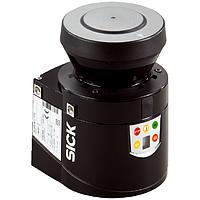
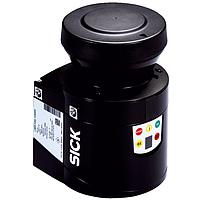
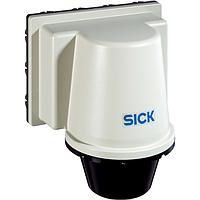
Examples from this range include the SICK MICS3-CCAZ90AN1P01 safety laser scanner and the SICK V200 Work Station Extended and V300 Work Station Extended safety camera sensors. These devices are intended for monitored zones and protective fields rather than simple spot distance measurement. If your project requires safe field switching, workstation protection, or access monitoring, it is important to evaluate the functional safety level alongside measuring range, response time, and installation geometry.
How to choose the right distance sensor
A practical selection process starts with the target itself. Surface reflectivity, object size, color, and movement all affect sensor performance. A sensor measuring a stable object at short range in a clean indoor environment can be very different from one used outdoors on darker targets, where scan range, ambient light tolerance, and enclosure robustness become more important.
You should also review the required field of view, update speed, mounting space, and interface type. For example, compact point-measurement sensors may be enough for linear positioning tasks, while scanning devices are often preferred when one sensor must cover a broader area. If the project is specifically about single-point measurement rather than scanning, it may also be useful to explore related distance sensor options across the full category.
Important specifications to compare
Several parameters have a direct impact on real-world performance. Measuring range is one of the most obvious, but it should always be read together with target conditions such as remission and environmental exposure. Resolution and response time matter when the application involves fine positioning, fast-moving objects, or closed-loop machine behavior.
For scanning sensors, the aperture angle, angular resolution, and scanning frequency help define how much spatial detail the device can capture. For example, the listed SICK LiDAR models include versions with 270° scanning and 15 Hz operation, while the multiScan100 extends into 3D sensing with a wider data set. In safety applications, it is equally important to review the stated safety level, protection field range, and relevant compliance framework rather than considering range alone.
Integration within a broader motion and position sensing system
Distance sensing often works best as part of a larger sensor strategy. A machine builder may combine distance sensors with motion feedback, tilt monitoring, or vibration sensing to improve machine awareness and diagnostics. In mobile equipment or dynamic automation, this layered approach can improve both control quality and system resilience.
Depending on the application, related technologies such as inclinometers for tilt feedback or industrial accelerometers for vibration and dynamic movement analysis may also be relevant. For compact embedded designs, board-mount motion and position sensors can support space-constrained electronics where sensor data needs to be processed directly on the device.
Featured manufacturer and representative products
SICK is the main manufacturer represented in this category context, with solutions that span measurement, scanning, and safety-focused detection. This breadth is helpful when an application moves from simple ranging to more advanced area monitoring, because the sensing approach can be selected according to the level of spatial information and functional safety required.
Representative products in this category include the DT35S safety distance sensors for point-based measurement, the TIM310/TIM320/TIM351 series for 2D LiDAR scanning, the multiScan100 for 3D LiDAR applications, and the V200, V300, and MICS3 families for safety-oriented monitoring. Rather than focusing only on model names, buyers should compare how each device fits the application environment, required range, interface expectations, and level of protective function.
Choosing with application fit in mind
The most effective way to narrow this category is to begin with the job the sensor needs to perform. If the goal is straightforward distance feedback to a target, a compact laser distance sensor may be the most efficient option. If the application requires area coverage, contour recognition, or navigation support, a 2D or 3D LiDAR sensor may be more appropriate. If personnel protection is part of the design, safety-rated sensing devices should be assessed separately from standard measurement sensors.
This category is therefore best viewed as an industrial toolkit for ranging, field monitoring, and spatial detection. By matching the sensing principle to the target, environment, and control objective, it becomes much easier to identify a distance sensor that supports reliable machine performance and a more robust automation system.
Get exclusive volume discounts, bulk pricing updates, and new product alerts delivered directly to your inbox.
By subscribing, you agree to our Terms of Service and Privacy Policy.
Direct access to our certified experts