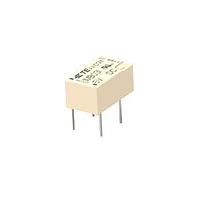
Low Signal Relay - PCB
When circuit designers need to switch small loads reliably without sacrificing board space, contact stability becomes just as important as basic electrical ratings. In these applications, Low Signal Relay - PCB products are widely used for compact switching on control boards, communication equipment, test systems, instrumentation, and other electronics where low-level signals must be handled with care.
Compared with larger power relays, this category focuses on relays designed for PCB integration, small signal paths, and precision switching behavior. That makes them relevant for engineers balancing contact form, coil voltage, mounting style, operating speed, and long-term performance in dense electronic assemblies.
Where PCB low signal relays fit in electronic design
A PCB low signal relay is typically chosen when the circuit must isolate and switch relatively small currents or voltages while preserving signal integrity. These relays are common in measurement interfaces, telecom hardware, industrial control boards, I/O modules, security systems, and automated test equipment, where clean switching and compact packaging matter.
They also help when designers want electromechanical isolation on a printed circuit board without moving to a much larger relay format. If the application involves higher-duty industrial load switching, a broader category such as industrial relays and accessories may be more suitable, while this category remains focused on smaller PCB-mounted signal switching tasks.
Typical configurations available in this category
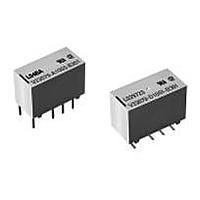
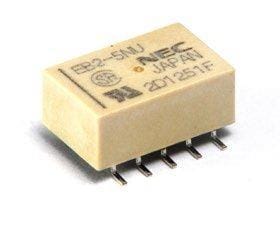
One of the main reasons engineers compare this category carefully is the variety of relay constructions. Many PCB signal relays use DPDT contact arrangements, giving designers more flexibility for routing, changeover functions, or switching paired signal lines. Through-hole and surface-mount options are both relevant depending on assembly method, mechanical stability, and board density requirements.
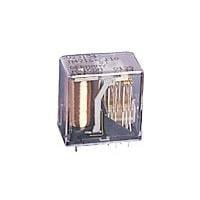
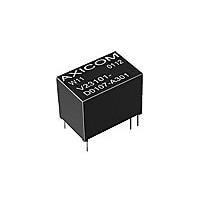
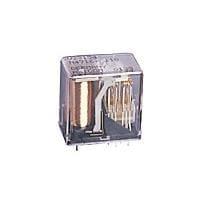
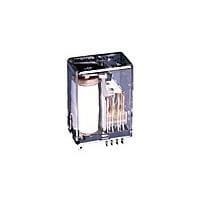
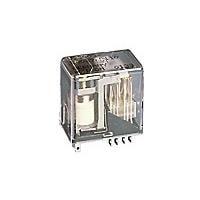
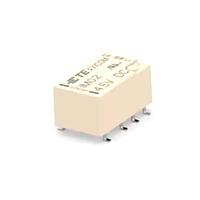
The featured products in this category illustrate that range clearly. Through-hole examples such as OMRON G6A274PSTUS5DC and OMRON G5V-2-DC24 are useful when strong board retention or traditional assembly is preferred, while compact surface-mount parts such as OMRON G6KU2FYDC5, OMRON G6K2GYDC24, and KEMET USRUB21200NU0L support space-sensitive designs and automated production lines.
Relay construction also varies between non-latching and latching types. Non-latching relays are often selected for straightforward control logic, while latching versions can help reduce coil power consumption in systems where the switched state must be retained between drive pulses.
Key selection factors for engineers and buyers
Choosing the right relay is rarely about one specification alone. Coil voltage should match the available drive circuit, whether that is 3 V, 5 V, 12 V, or 24 VDC. At the same time, contact arrangement, mounting style, pickup and dropout behavior, and the switching load all affect whether a relay fits the real operating conditions of the board.
Mounting style is another practical decision point. Through-hole relays can be attractive for mechanical robustness and prototyping, while SMD relays are often preferred for compact assemblies and high-volume manufacturing. In dense layouts, package dimensions and soldering constraints can be just as important as the electrical ratings.
Designers should also review operating time, temperature range, and contact material in relation to the signal being switched. For very sensitive circuits, users may also compare this category with reed relays or high frequency and RF relays when the application has stricter requirements around switching behavior or frequency performance.
Examples from OMRON and KEMET
OMRON is strongly represented in this category with widely recognized PCB signal relay series. Models such as G6A274PSTUS5DC, G5V-2-DC24, G5V2H13DC, and G6SU212DC show the diversity available across coil voltages, package sizes, latching options, and board mounting preferences. These parts are often considered in designs where compact size, fast operation, and established relay families are priorities.
KEMET also appears in the category with parts such as USRUB21200NU0L and UA2-3NU, offering additional options for engineers looking at compact electromechanical relay solutions for PCB use. Rather than treating all relays as interchangeable, it is useful to compare the package, relay construction, coil characteristics, and contact format in the context of the exact signal path and control circuit.
How to match relay type to the application
For interface boards, small automation controllers, and instrumentation modules, a compact non-latching relay is often the most direct choice. It provides familiar control behavior and can suit applications where the relay state only needs to be maintained while coil power is applied. Examples in this category include both through-hole and SMD formats, making it easier to align relay selection with board assembly strategy.
Where power efficiency matters, a latching relay may be worth considering. A part such as OMRON G6KU2FYDC5 or OMRON G6SU212DC can be relevant when the design benefits from maintaining the switched state with reduced continuous coil drive. This can be useful in battery-powered equipment, low-power control electronics, or systems with thermal constraints.
If the signal level is extremely low or contact sensitivity is especially critical, some buyers may also explore adjacent options such as automotive relays for vehicle-focused environments or more specialized relay categories for unique switching conditions. The right choice depends on the electrical load, environmental conditions, and board-level design priorities.
Practical buying considerations for B2B sourcing
In B2B procurement, relay selection usually involves more than matching a headline part number. Buyers often need to confirm coil voltage compatibility, contact form, mounting method, operating temperature range, and whether a relay is intended for general signal switching or a more specific use case. This is especially important when supporting maintenance, redesign, or second-source evaluation workflows.
For OEMs, panel builders, and contract manufacturers, consistency across a product family can simplify qualification and production. Looking at established relay series from manufacturers already used in the design can reduce integration risk, but it is still important to check the board footprint, drive circuit capability, and switching limits before standardizing a part.
Find the right PCB relay for compact signal switching
This category is built for applications where compact form factor, board-level integration, and reliable low-level switching all matter. From OMRON series such as G6A, G5V, G6K, and G6SU to selected KEMET relay options, the range supports different combinations of coil voltage, contact arrangement, latching behavior, and package style.
If you are narrowing down a relay for a new design or replacement requirement, focus on the actual switching duty, assembly process, and control voltage rather than selecting by size alone. A well-matched PCB signal relay helps maintain stable operation, cleaner board integration, and better long-term fit for the application.
Get exclusive volume discounts, bulk pricing updates, and new product alerts delivered directly to your inbox.
By subscribing, you agree to our Terms of Service and Privacy Policy.
Direct access to our certified experts