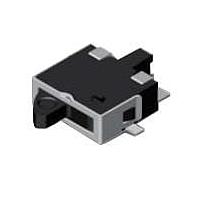
Detector Switches
Compact position detection is a small detail that often has a big impact on product reliability. In enclosures, consumer electronics, industrial assemblies, and electromechanical devices, a well-chosen Detector Switches solution helps confirm whether a cover is closed, a lever has moved, or a mechanism has reached its intended position.
This category brings together detector switches designed for low-current signal detection as well as more robust mechanical sensing tasks. Depending on the application, engineers may be looking for miniature surface-mount parts for PCB integration, panel or chassis mounted versions for equipment design, or sealed options for harsher environments.

Where detector switches are typically used
Detector switches are commonly selected when a system needs a simple and dependable way to sense presence, position, or mechanical travel. Typical examples include door and lid detection, cartridge or tray insertion, cam or lever position feedback, and mechanism end-of-travel confirmation.
In compact electronic products, low-profile detector switches can be mounted directly on the PCB to monitor access panels, moving parts, or user-operated mechanisms. In larger equipment, lever-actuated or snap-action styles may be used where stronger mechanical interaction and clearer switching feedback are required.
Main detector switch formats in this category
The product mix in this category covers several practical formats. Surface-mount detector switches are useful when board space is limited and assembly needs to align with automated PCB production. Right-angle and gull-wing terminal styles are often chosen for slim devices, side actuation, or compact packaging constraints.
There are also panel, chassis, and screw-mount options for equipment builders who need a switch to interact directly with a moving door, bracket, or mechanical assembly. For applications exposed to dust, splash, or outdoor conditions, a sealed or water-proof version may be more appropriate than a standard open construction.
Examples in this range illustrate that variety clearly. The OMRON D3SK-B0L Right Angle and PANASONIC ESE-11MH8T Detector Switch suit compact PCB-based sensing, while the OMRON V-103-1A5 Switch Snap Action and Alps Alpine SPVQ111700 Water-Proof point to applications that need stronger mechanical actuation or improved environmental resistance.
How to choose the right detector switch
The first selection step is usually the actuation method. Some detector switches use a plunger-style actuator, while others use a lever, hinge lever, or angle toggle arrangement. The right choice depends on how the target part moves, how much tolerance exists in the mechanism, and whether the switch should trigger with light contact or firmer travel.
Electrical requirements matter as well, even when the switch is only handling a signal-level input. Circuit form such as SPST or SPDT, contact state, and rated current or voltage all influence suitability. For example, a PCB logic-detection design may only require very low DC current, while a larger electromechanical assembly may need a more robust contact arrangement.
Mechanical factors are just as important: mounting style, pre-travel, overtravel, actuating force, service life, and operating temperature range all affect long-term performance. If the application involves shock, repeated opening and closing, or uncertain alignment, it is usually worth prioritizing adequate travel margin and a switch geometry that tolerates real-world variation.
Representative products and application fit
Several products in this category help illustrate common design scenarios. The OMRON D2D-3103 Detector Switch and OMRON D3D-111 Detector Switch are examples of position-detection parts intended for compact sensing tasks, where a mechanism or movable component needs to be monitored without adding unnecessary complexity.
For very small electronic assemblies, PANASONIC ABC1112P61 and PANASONIC ESE-24CMV9T show the kind of detector switch often considered for low-current PCB integration. The Littelfuse HDT0004 Detector Switch and Littelfuse HADS0002 Detector Switch also reflect the compact end of the category, where board-level detection and mechanical packaging constraints typically drive selection.
When the design calls for a different actuation feel or mounting approach, Alps Alpine offers useful alternatives. The Alps Alpine SPVQ811000 Detector Switch and SPVT110201 Two-way operation demonstrate how detector switches can be tailored for specific motion paths and assembly requirements rather than treated as interchangeable parts.
Manufacturer coverage and design considerations
This category includes detector switches from established component manufacturers used widely in electronic and industrial design. Among the commonly referenced names are OMRON, PANASONIC, Alps Alpine, and Littelfuse, each associated with different packaging styles, operating characteristics, and integration preferences.
In practice, engineers often shortlist parts by balancing three things: electrical interface, mechanical fit, and lifetime expectation. A detector switch that looks similar on paper may behave very differently once actuator direction, mounting orientation, and real actuation force are considered. Reviewing these factors early can reduce redesign work later in the project.
Detector switches in a broader switching system
Detector switches are often only one part of a larger switching and control architecture. They may provide status input to a controller, interlock feedback in a machine, or presence detection in a user-access panel. In some systems, they work alongside heavier-duty switching devices that handle power isolation or safety-related functions rather than low-level signal detection.
If the application involves machine guarding or interlock functions, it may be useful to review related safety switching options separately from standard detector switch selection. Likewise, detector switches should not be confused with disconnect devices intended for power isolation, because the design intent and electrical duty are very different.
What to review before ordering
Before finalizing a part, it helps to confirm the expected operating motion, available mounting space, required terminal style, and the electrical load seen by the contacts. For board-mounted designs, assembly process compatibility is also important, especially where reflow or compact right-angle installation is involved.
Environmental exposure should be checked early as well. Temperature range, contamination risk, moisture, and repetitive operation cycles can all influence the choice between a standard miniature detector switch and a more durable sealed design. If the mechanism has loose tolerances, selecting an actuator style with better travel allowance can improve consistency in the finished product.
Finding a suitable detector switch for your design
A good detector switch is usually the one that fits the motion of the mechanism as naturally as possible while meeting the electrical and environmental demands of the application. Whether the need is a miniature PCB detector, a snap-action lever switch, or a water-resistant option for more exposed equipment, this category supports a range of design approaches without forcing a one-style-fits-all choice.
By comparing actuator type, mounting method, circuit configuration, and expected operating conditions, buyers and engineers can narrow the selection more efficiently and choose a part that supports reliable position detection over the product’s intended service life.
Get exclusive volume discounts, bulk pricing updates, and new product alerts delivered directly to your inbox.
By subscribing, you agree to our Terms of Service and Privacy Policy.
Direct access to our certified experts