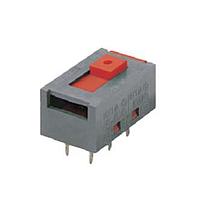
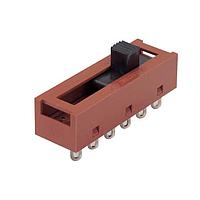
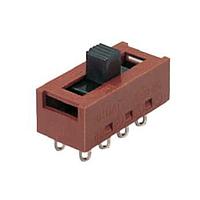
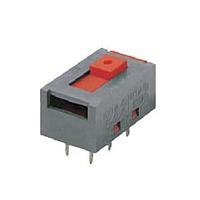
Slide Switches
When a design needs a simple, tactile way to change operating states, a compact mechanical switch is often still the most practical choice. Slide switches remain widely used in control panels, portable electronics, embedded devices, and compact assemblies where a clear manual position is important for power, mode, or signal selection.
On this category page, you can explore slide switch options for different circuit configurations, mounting styles, and current levels. The range includes miniature PCB types for dense electronic layouts as well as more robust panel-mount versions for equipment that requires a more deliberate user-operated interface.
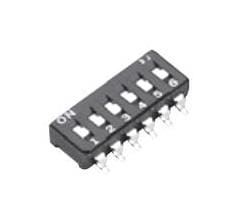
Where slide switches fit in real designs
A slide switch is typically chosen when the user needs a visible and repeatable mechanical position, such as ON/OFF, ON/OFF/ON, or multi-throw selection. Compared with other actuator styles, the sliding motion can be intuitive in handheld products, operator interfaces, test fixtures, and compact control modules.
In B2B and OEM environments, these switches are often specified for functions like enabling power rails, selecting communication modes, changing measurement ranges, or setting configuration states during assembly and service. For applications that require a different switching concept, related categories such as solid state switching devices or safety switches may be more appropriate depending on the load and protection requirements.
Common configurations and selection logic
One of the first selection points is the pole and throw configuration. Typical options include SPDT, DPDT, and multi-position variants, each suited to a different level of circuit routing complexity. A simple low-power selector may only need a compact SPDT part, while a more advanced control function may require a 4P3T device or a multi-position signal-routing switch.
Actuator style also matters. Top-slide designs are common when the switch is accessed directly from the front or top of the enclosure, while screwdriver-operated versions can help prevent accidental changes and are useful for configuration settings. The intended user interaction, service access, and enclosure cutout should all be considered early in the design stage.
Electrical and mechanical factors that matter
Not all slide switches are interchangeable. The required load type, switching frequency, and expected service life should guide the selection process. Some models in this category are intended for low-level signal switching, while others are built for higher current handling in AC or DC circuits.
Engineers should review the rated current, voltage level, contact arrangement, and mounting approach together rather than in isolation. For example, low-power PCB-mounted switches may be ideal for logic selection or user settings, whereas a panel-mount version with solder lugs can be a better fit for equipment that demands a more durable external control point.
Mechanical integration is equally important. Dimensions, actuator height, terminal style, and mounting method all affect assembly efficiency and final product usability. If the application also needs supporting hardware or related parts, it can be useful to review other switch accessories alongside the switch itself.
Representative products in this category
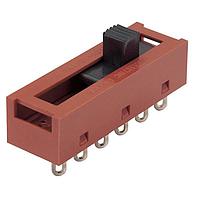
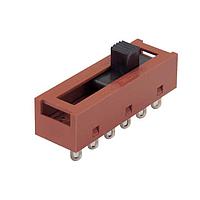
The available portfolio includes a wide spread of formats and ratings. For compact electronics, parts such as the Littelfuse SK42D05G6NS Slide Switch, Littelfuse OS203011MV9QN1 Slide Switch, and Alps Alpine SSAJ120100-BLK Slide Switch illustrate the kind of small-form mechanical selectors commonly used on boards and compact assemblies.
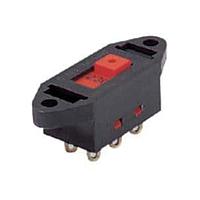
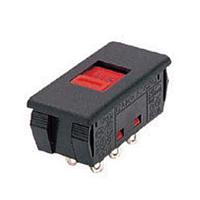
For designs requiring more defined switching states or broader contact arrangements, the TE Connectivity MSSA4350G04 Switch Slide 4P3T Extended Top Slide and the Littelfuse ES01MCKE Switch Slide ON None ON SPDT provide examples of multi-position functionality. Where a higher load capability is needed, the Littelfuse 1203M1S3ZQE2 Switch Slide ON OFF ON DPDT Top Slide and Littelfuse L202121MS02Q Switch Slide DPDT Screwdriver show how slide switches can also support more demanding manual control tasks.
Additional examples such as the TE Connectivity SL55004 Slide Switch, Littelfuse SK23D07G4PAGR Slide Switch, and Littelfuse SS-22F02-AC11 V2 (U) Slide Switch reflect the breadth of options available for engineers balancing footprint, mounting style, and switching behavior.
Brands commonly specified for slide switches
This category features products from established manufacturers used across electronics and industrial supply chains. Littelfuse appears prominently in the range and is represented here by multiple slide switch formats suited to both compact and more robust control requirements.
Design teams may also consider options from TE Connectivity and Alps Alpine, depending on the required actuator style, circuit arrangement, and mechanical integration priorities. At a broader category level, well-known switch-related manufacturers in the portfolio also include names such as Alcoswitch - TE Connectivity, C&K, Mitsumi, and PANASONIC.
How to choose the right slide switch for your application
A practical selection process starts with the function the switch must perform in the system. If it will only change a low-current signal state, a compact through-hole or PCB style may be sufficient. If it will be operated frequently by end users or exposed on an equipment panel, then actuator accessibility, retention, and mechanical durability become more important.
It is also helpful to define whether the switch is intended for user control, installer setup, or factory configuration. That decision often determines whether a visible top-slide actuator, a recessed screwdriver style, or a bracket-mount arrangement makes the most sense. In systems with power isolation or maintenance lockout requirements, a dedicated category such as disconnect switches may be a better fit than a standard slide switch.
Mounting style, contact form, and environmental exposure should be checked against the final enclosure and operating conditions. Even when the electrical requirement seems simple, selecting the right actuator geometry and termination style can reduce assembly issues and improve long-term reliability.
Why this category is useful for sourcing and engineering teams
For procurement teams, slide switches are often small components that have an outsized impact on usability and final assembly. Having access to multiple form factors and switching arrangements in one category makes it easier to compare alternatives during new product development, cost review, or second-source planning.
For engineers, this category supports faster filtering by function rather than forcing a search across unrelated switch types. Whether the project calls for a miniature board-level selector or a more substantial manual control, the available range helps narrow down parts aligned with the intended electrical load and mechanical design.
Final considerations
Choosing the right slide switch is less about finding a generic part and more about matching the switch to the actual operating context. Circuit configuration, current level, mounting method, actuator access, and expected use pattern all influence whether a given model will fit the design well.
By reviewing the available options in this slide switch category, buyers and engineers can identify components that align with both electrical requirements and product ergonomics. If you are refining a new design or updating an existing assembly, this range provides a practical starting point for comparing compact signal selectors, multi-position switches, and more robust manual switching solutions.
Get exclusive volume discounts, bulk pricing updates, and new product alerts delivered directly to your inbox.
By subscribing, you agree to our Terms of Service and Privacy Policy.
Direct access to our certified experts