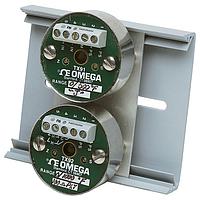
Head Mount Signal Conditioners
When temperature or low-level sensor signals need to travel reliably to a controller, PLC, or monitoring system, compact signal conversion at the sensor head can simplify the entire installation. Head Mount Signal Conditioners are designed for exactly that role: they sit close to the sensing point, convert raw inputs into a stable process signal, and help reduce noise, wiring complexity, and scaling issues in industrial measurement systems.
On this page, you can explore head mount transmitters and conditioners used for thermocouples, RTDs, thermistors, and voltage inputs. These devices are commonly selected for process plants, OEM equipment, utility systems, and machine-level temperature monitoring where a 4 to 20 mA loop remains a practical and widely accepted output standard.

Why head mount signal conditioners are used
A head mount design places the conditioning electronics close to the sensor connection point, typically inside or near a connection head. This arrangement helps convert fragile low-level sensor signals into a more robust 4 to 20 mA output before the signal travels through longer cable runs. In many industrial environments, that improves signal integrity and makes integration with standard control hardware more straightforward.
These products are especially useful when working with thermocouples or RTDs, where raw signals can be affected by electrical noise, lead resistance, or installation constraints. Compared with panel-based approaches, head mount units can support a cleaner field layout and reduce the need for separate external conversion hardware.
Typical input types in this category
This category includes models intended for several common sensor technologies. Thermocouple transmitters are widely used for furnace, heater, process vessel, and general temperature monitoring applications. Depending on the model, supported thermocouple types may include J, K, T, E, R, and S, which allows users to match the conditioner to the sensing element and required temperature range.
RTD-based options are also represented, including Pt100-compatible models for applications that need stable and repeatable temperature measurement. For more specialized requirements, thermistor and voltage-input transmitters are available as well, making the category relevant not only for classic temperature loops but also for selected low-level analog signal conversion tasks.
If your installation requires a different mounting style, you may also want to compare with DIN rail signal conditioners for control cabinet installations.
Common form factors and installation considerations
In practice, head mount conditioners are chosen not only by input type but also by their mechanical format. Many models in this category use a compact round housing suited to sensor heads, while others are miniature transmitters intended for space-constrained mounting points. Screw terminal connections are common, supporting practical field wiring and maintenance.
Loop-powered two-wire designs are particularly attractive in industrial plants because they simplify wiring and work well with standard process instrumentation architectures. Supply ranges in the listed products commonly support typical DC control power, and several devices provide adjustable setup via trimpots, switches, DIP settings, pushbuttons, or software depending on the model family.
Representative product examples from OMEGA
OMEGA is a key manufacturer represented in this category, with multiple head mount and miniature transmitter options for different sensor inputs. For thermocouple applications, examples include the TX31-J and TX31-K head mount transmitters, both designed to convert thermocouple inputs into a process output suitable for industrial control systems.
For broader thermocouple type coverage, the TX901 and TX903 series offer field-rangeable options supporting several common thermocouple types. In RTD applications, the TX904-1 and TX904-2 models illustrate how a compact transmitter can be matched to Pt100 measurement tasks across different temperature spans. The category also includes the TX206TH for thermistor input and voltage-input models such as TX905 and TX906-V1 where sensor output conversion is required at the field level.
These examples show the range of signal types addressed here, from conventional temperature sensing to low-level voltage transmission. Rather than focusing only on one technology, the category supports users who need compact, field-oriented conditioning close to the sensor itself.
How to choose the right head mount unit
The first step is to confirm the input signal: thermocouple, RTD, thermistor, or voltage. After that, check the required measurement span, output type, available loop power, and whether isolation is needed. In some applications, a non-isolated transmitter is sufficient; in others, input-to-output isolation can help reduce interference or address grounding concerns.
It is also important to consider the installation environment. Operating temperature, available mounting space, and access for calibration or configuration can all influence product selection. Some users prefer fixed-range simplicity, while others need field-rangeable models that can be trimmed or adjusted during commissioning.
Where the application is unusual or requires more tailored conversion behavior, it can be useful to review specialty conditioners alongside the head mount range.
Benefits in process control and machine monitoring
A properly selected conditioner helps turn raw sensor data into a signal that is easier for downstream devices to interpret. That can improve measurement consistency at the PLC or recorder level, simplify scaling in the control system, and reduce troubleshooting time when compared with long runs of direct sensor wiring.
In machine monitoring, skid systems, and retrofit projects, compact head mount solutions can be particularly helpful because they avoid adding larger cabinet-mounted hardware where space is limited. They also support cleaner segregation between sensor-level wiring and the main control loop, which is often beneficial in maintenance-heavy industrial environments.
For applications already standardized around sensor-head installation, browsing the full range of head mount signal conditioners makes it easier to compare sensor compatibility, output format, and adjustability in one place.
Where these devices fit in a broader instrumentation system
Head mount products are one part of a larger signal conditioning strategy. In many systems, they serve as the first conversion stage between the sensing element and the control architecture. That makes them relevant in process heating, environmental chambers, OEM thermal systems, utilities, and general industrial automation projects where dependable analog transmission still matters.
They are often chosen when the sensor is remote from the control cabinet, when low-level signals need early conversion, or when plant engineers want a compact field solution instead of relocating all signal treatment to the panel. The result is a measurement chain that can be simpler to install and easier to maintain over time.
Final considerations
Selecting a head mount conditioner is usually less about finding a generic transmitter and more about matching the device to the sensor, span, wiring method, and installation environment. This category brings together compact solutions for thermocouple, RTD, thermistor, and voltage applications, including field-rangeable and loop-powered options from OMEGA.
If you are comparing products for a new installation or a retrofit, focus on sensor compatibility, output requirements, adjustment method, and mounting constraints first. That approach will help narrow the options quickly and lead to a head mount signal conditioner that fits the measurement task as well as the physical realities of the application.
Get exclusive volume discounts, bulk pricing updates, and new product alerts delivered directly to your inbox.
By subscribing, you agree to our Terms of Service and Privacy Policy.
Direct access to our certified experts