LCR Meter
Accurate impedance measurement is essential when validating capacitors, inductors, coils, filters, and many other passive components used in electronics design and production. A well-chosen LCR Meter helps engineers and technicians evaluate component behavior across frequency, compare series and parallel models, and check quality before a part reaches assembly or final test.
This category brings together benchtop and handheld instruments for capacitance, inductance, resistance, and related impedance parameters. It also includes practical accessories such as SMD fixtures and test tweezers, which are often just as important as the meter itself when repeatability and contact quality matter.
Where LCR meters are used in real testing workflows
In laboratory, service, and production environments, LCR measurement is used for much more than checking a nominal capacitance or inductance value. Engineers rely on these instruments to examine impedance behavior over frequency, observe dissipation or quality factor, and verify whether a component performs as expected under a defined test signal.
Typical use cases include incoming inspection of passive parts, R&D characterization, repair and maintenance, and automated quality control. In broader electronic troubleshooting, an LCR meter often works alongside a multimeter for basic electrical checks, while more advanced device evaluation may also involve SMU semiconductor test equipment for source-and-measure tasks.
Benchtop precision instruments for component characterization
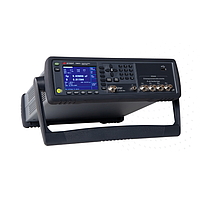
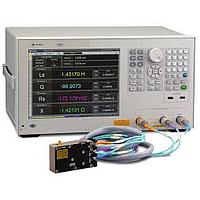
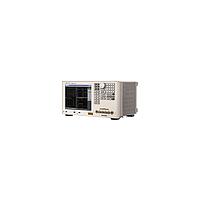
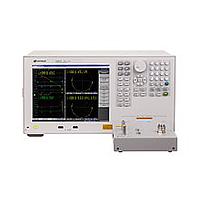
When test accuracy, frequency coverage, and interface capability are priorities, benchtop models are usually the preferred choice. Products such as the KEYSIGHT E4980A Precision LCR Meter and the KEYSIGHT E4980B family are designed for detailed impedance analysis across broad frequency ranges, with support for common parameter sets such as Cp-D, Cs-Rs, Lp-Q, Z-θ, and related representations.
These instruments are a strong fit for design verification, material or component evaluation, and manufacturing environments where consistency matters. Models in the E4980BL series extend the range of application choices with variants covering 20 Hz to 300 kHz, 500 kHz, or 1 MHz, while the E4980B reaches up to 2 MHz for more demanding measurement tasks.
Benchtop LCR meters also tend to offer better connectivity and integration into test systems. For users building a larger measurement workflow, this matters when data logging, remote control, or handler-based sorting are part of the process.
Handheld options for maintenance, field work, and quick checks
Not every task requires a full laboratory setup. A handheld instrument can be the practical choice for maintenance teams, incoming inspection stations, or technicians who need fast verification at the bench or on the move. The GW INSTEK LCR-1100 Handheld LCR Meter is an example of a portable unit with selectable test frequencies and common LCR parameter support for day-to-day measurement work.
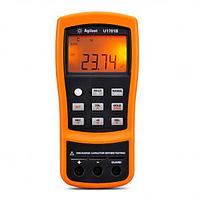
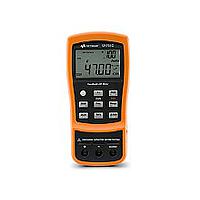
For capacitance-focused checks, handheld meters such as the BKPRECISION 890C and KEYSIGHT U1701B are useful where portability and straightforward operation are more important than wide frequency sweeps or deep automation features. These tools are often selected for service applications, capacitor sorting, and general troubleshooting in electronics maintenance.
If the requirement is simply to confirm electrical values during repair or inspection, a portable LCR or capacitance meter may be sufficient. For applications involving tighter tolerances, broader parameter analysis, or fixture-based SMD measurement, a benchtop solution is usually more appropriate.
Why fixtures matter as much as the meter
Measurement quality depends heavily on the connection between the instrument and the device under test. For small components, especially chip parts and SMD packages, the right test fixture improves repeatability, reduces handling variation, and helps maintain stable contact during measurement.
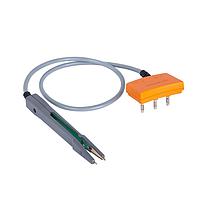
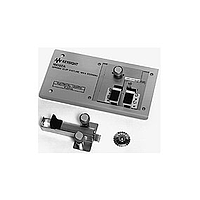
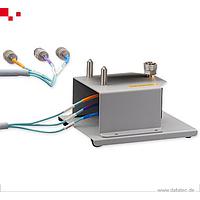
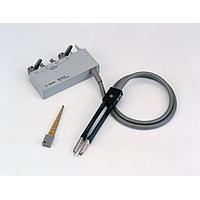
The KEYSIGHT 16192A Parallel Electrode SMD Test Fixture is intended for high-frequency impedance evaluation and supports compatible instruments in setups extending to GHz-class applications. For compact component handling, the KEYSIGHT 16334A Test Fixture uses tweezer-style contacts that simplify measurement of small SMD devices. The GW INSTEK LCR-09 Test Fixture serves a similar practical role for supported GW INSTEK instruments, especially when measuring chip components in routine test work.
In short, choosing an LCR meter without considering fixtures can limit real-world performance. Contact geometry, DUT size, frequency range, and voltage capability all influence whether the final setup is suitable for the intended task.
How to choose the right LCR meter
The best selection process starts with the actual DUT and the test objective. If you mainly check standard capacitors or inductors at a few fixed points, a simpler handheld unit may be enough. If you need to compare behavior over a wider frequency range, measure multiple equivalent circuit models, or integrate into a production environment, a precision benchtop meter is the better fit.
Important factors to compare include frequency range, supported measurement parameters, basic accuracy, test signal level, and whether DCR or DC bias related functions are needed. Users working with high-frequency parts, low-impedance devices, or specialized fixtures should also confirm compatibility between the instrument and accessories.
It is also useful to think about workflow, not just specifications. A service technician may value portability and battery operation, while a manufacturing engineer may prioritize interface options, test speed, display clarity, and repeatable fixture-based setup. For broader electrical diagnostics, some teams also combine LCR testing with tools from the earth resistance and resistivity tester category when working on facility-level maintenance, although the measurement purpose is very different.
Representative brands in this category
This category includes instruments and accessories from established test and measurement manufacturers such as HIOKI, CHROMA, KEYSIGHT, Rohde & Schwarz, BKPRECISION, EXTECH, GW INSTEK, KIKUSUI, NF, and Promax. Each brand may address different priorities, from portable maintenance tools to precision laboratory systems and production-oriented measurement platforms.
Within the listed products here, KEYSIGHT and GW INSTEK are especially visible through both benchtop meters and fixtures, while BKPRECISION and EXTECH represent practical options for capacitance-related work. The EXTECH 380405 Capacitance Decade Box, for example, is not an LCR meter itself, but it can still be useful in calibration, simulation, or test setup support where known capacitance values are required.
Common questions about LCR meter selection
Do I need a handheld or benchtop LCR meter?
Choose handheld for portability, routine maintenance, and quick verification. Choose benchtop when you need higher precision, broader frequency coverage, fixture support, or system integration.
Can an LCR meter measure more than capacitance?
Yes. Depending on the model, it can measure inductance, resistance, impedance, reactance, phase angle, dissipation factor, quality factor, and related equivalent circuit parameters.
Are fixtures necessary for SMD components?
For consistent results, they are often highly recommended. Proper fixtures improve contact stability and reduce variation caused by manual probing, especially for small chip components.
Find the right setup for your application
Choosing an LCR meter is really about matching the instrument, fixture, and workflow to the component or assembly you need to evaluate. From portable capacitance meters to precision benchtop systems and dedicated SMD fixtures, this category supports a wide range of passive component testing needs.
If you are comparing models, focus first on measurement range, parameter support, fixture compatibility, and how the instrument will be used in practice. That approach usually leads to a more reliable and efficient test setup than choosing by headline specifications alone.
Get exclusive volume discounts, bulk pricing updates, and new product alerts delivered directly to your inbox.
By subscribing, you agree to our Terms of Service and Privacy Policy.
Direct access to our certified experts