Function/Arbitrary Waveform Generators
Accurate signal creation is a basic requirement in electronics design, validation, education, and troubleshooting. When engineers need to generate sine, square, pulse, ramp, noise, or custom test patterns with controlled amplitude and frequency, Function/Arbitrary Waveform Generators become one of the most practical instruments on the bench.
These generators are widely used in laboratories, production environments, and training settings because they help simulate real operating conditions for circuits, sensors, control boards, and communication interfaces. Compared with a simple fixed-source signal tool, a modern waveform generator gives much more flexibility for waveform shape, timing, modulation, triggering, and repeatable test setups.
What this category is designed for
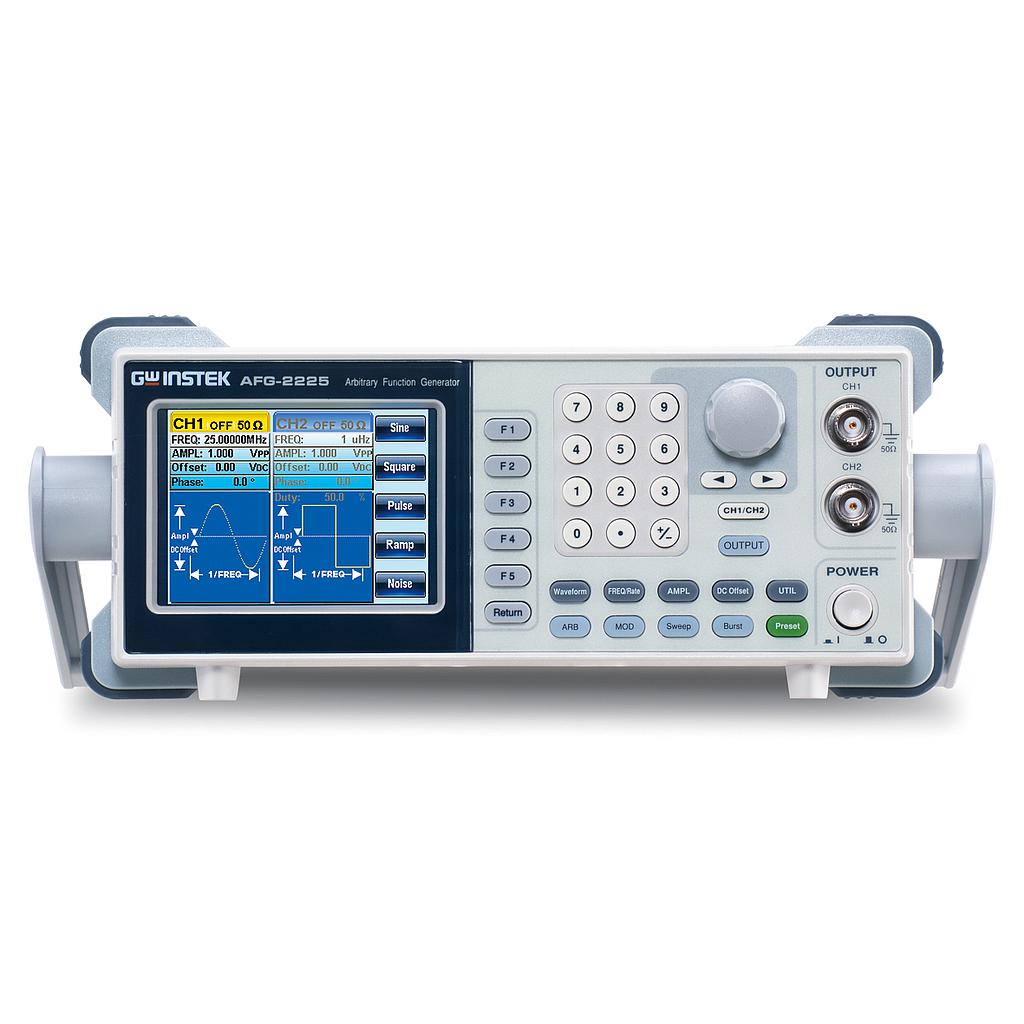
A function generator is typically selected when standard waveforms such as sine, square, triangle, ramp, pulse, noise, or DC output are needed for everyday electronic testing. An arbitrary waveform generator goes further by allowing users to create or load custom waveforms, which is useful for simulating non-ideal signals, transient behavior, sensor outputs, or application-specific patterns.
In practice, the line between these two types is often blended in modern instruments. Many models in this category support both standard waveform generation and arbitrary output capability, making them suitable for R&D work, embedded development, academic labs, and general-purpose bench testing.
Common applications in labs, development, and production
These instruments are used anywhere a controlled test signal is needed. Typical tasks include amplifier and filter testing, clock and pulse simulation, digital interface stimulation, sensor emulation, and educational demonstrations of waveform behavior. They are also useful for checking how a circuit responds to modulation, burst signals, frequency sweeps, or changing duty cycle.
For more demanding high-frequency wireless work, users may need a dedicated RF signal generator instead of a general-purpose waveform source. Likewise, applications involving broader microwave ranges may be better served by RF & Microwave Generators. This category is most relevant when the goal is flexible low-to-mid frequency electronic signal generation for bench and system testing.
Key selection criteria before choosing a model
The first parameter most buyers look at is frequency range, but it should not be the only one. A suitable generator should also be matched to the required number of channels, waveform memory depth, sample rate, output quality, modulation options, and triggering modes. For pulse-oriented work, rise time and jitter can be just as important as headline frequency.
Channel count matters when you need synchronized outputs, differential signal simulation, or simultaneous carrier and modulation signals. Memory depth becomes more relevant when generating long or highly detailed custom waveforms. In many projects, the best choice is not simply the highest-frequency model, but the one that fits the test method and repeatability requirements.
- Frequency range for the target signal and harmonics
- 1-channel or 2-channel output depending on the test setup
- Sample rate and waveform memory for arbitrary signal fidelity
- Modulation and sweep functions for dynamic testing
- Jitter, distortion, and edge performance for timing-sensitive work
- Interface and integration options for automated benches
Examples from KEYSIGHT and BKPRECISION
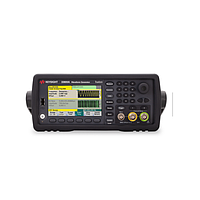
Within this category, KEYSIGHT offers a broad range of bench waveform generators covering educational use through more advanced lab requirements. Models such as the KEYSIGHT 33622A and 33621A provide up to 120 MHz output, with 2-channel and 1-channel options respectively, along with high sample rate and long arbitrary waveform memory. For users who need 100 MHz class instruments, the FG33532A and FG33531A present practical alternatives with built-in standard and arbitrary waveform support.
For teaching labs and entry-level engineering work, the KEYSIGHT EDU33212A and EDU33211A provide 20 MHz capability with common modulation modes and standard waveform coverage. KEYSIGHT also includes ecosystem-oriented options such as the 335ARB1U upgrade for adding arbitrary waveform capability to selected 33500B Series units, and the 10834A GPIB to GPIB Adapter for installations where instrument connectivity and limited panel space matter.
BKPRECISION is represented here by models such as the 4079C, 4079C-GPIB, and 4078C. These units are relevant for users looking for arbitrary waveform generation in the 30 MHz to 50 MHz range, with support for standard waveforms, user-defined arbitrary signals, and operating modes such as continuous, triggered, burst, gated, and phase-related testing. The GPIB-equipped version is especially useful in automated or legacy instrument-control environments.
Understanding waveform capability in real use
On paper, many instruments list similar waveform names, but real usability depends on how flexibly those waveforms can be edited and delivered. Standard outputs such as sine and square are important for routine work, while pulse, PRBS, and noise can be useful in digital, communication, and robustness testing. Built-in arbitrary waveforms save setup time when common application shapes are already available in the instrument.
Custom waveform support becomes more valuable when testing non-linear systems, simulating sensor behavior, or reproducing captured events. A deeper memory and higher sample rate generally help preserve detail in the generated signal. If your work involves recreating specific transient events, this aspect is often more important than broad waveform menus alone.
Why interfaces and accessories can matter
In many B2B environments, the generator is not used as a standalone bench tool. It may be part of a repeatable validation station, production fixture, or educational lab setup. That is why communication interfaces, trigger behavior, and remote control compatibility should be reviewed early in the buying process.
Products such as the KEYSIGHT 10834A GPIB To GPIB Adapter illustrate how accessories can support system integration rather than direct signal generation. Similarly, upgrade options like the KEYSIGHT 335ARB1U can extend the useful life of an installed base by adding arbitrary waveform capability without replacing the full instrument. For many teams, these details affect long-term operating efficiency just as much as the generator’s frequency rating.
Choosing the right fit for your application
If your work is mainly educational, circuit debugging, or general bench verification, a 20 MHz to 50 MHz class instrument may already be sufficient. If you need cleaner high-speed edges, dual-channel synchronization, longer arbitrary memory, or better performance for more advanced validation, stepping up to 80 MHz, 100 MHz, or 120 MHz models can make sense.
It is also useful to think in terms of the signal behavior you need to reproduce rather than the product label alone. A team testing analog stages may focus on distortion and waveform purity, while embedded developers may prioritize pulse control, burst modes, and modulation. The right selection usually comes from aligning the generator’s output architecture with the actual test workflow.
Final considerations
This category brings together instruments built for flexible, repeatable signal generation across a wide range of electronic test tasks. Whether the requirement is a straightforward bench function generator or a more capable arbitrary waveform platform, the most effective choice depends on frequency range, channel configuration, waveform depth, modulation features, and system integration needs.
By comparing practical factors instead of only headline specifications, buyers can select a generator that supports current projects while leaving room for future test expansion. For laboratories, manufacturers, schools, and engineering teams, that approach usually delivers better long-term value and a more reliable measurement workflow.
Get exclusive volume discounts, bulk pricing updates, and new product alerts delivered directly to your inbox.
By subscribing, you agree to our Terms of Service and Privacy Policy.
Direct access to our certified experts