How to Convert RPM to RCF?
RPM and RCF are two parameters found on most laboratory centrifuges. Many people are familiar with RPM because it's the value displayed directly on the device's screen. However, in SOPs, research papers, or test manuals, RCF is the parameter commonly used to describe centrifugation conditions.
Formula for converting RPM to RCF
The standard formula for converting RPM to RCF is:
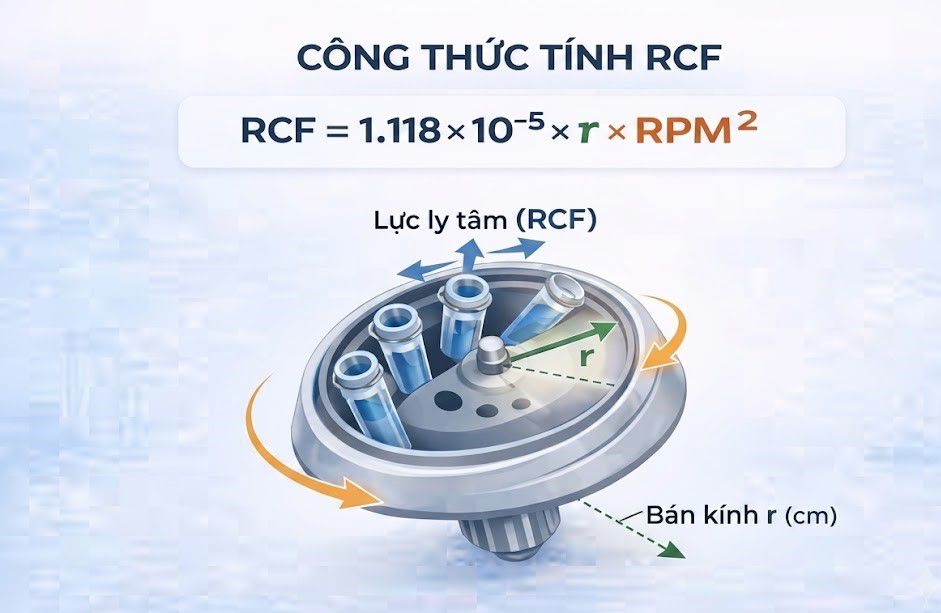
Where:
RCF is the relative centrifugal force, in g units.
r is the rotor radius, in cm.
RPM is the number of revolutions per minute.
To calculate the RCF value, in addition to RPM, you also need to know the rotor radius being used, a factor that can cause two centrifuges with the same rotation speed to produce different centrifugal forces.
What is RPM?
RPM (Revolutions Per Minute) is the number of revolutions of the rotor in one minute.
If the machine is operating at 4,000 RPM, the rotor will complete 4,000 revolutions in 60 seconds. This parameter helps users visualize the speed of rotation of the device.
RPM is very convenient for daily operation but does not fully reflect the force exerted on the sample. Two rotors of different sizes can rotate at the same speed but generate completely different centrifugal forces.
What is RCF?
RCF (Relative Centrifugal Force) is the relative centrifugal force acting on a sample during centrifugation.
RCF is expressed as a multiple of Earth's gravity, for example:
- 500 × g
- 1,500 × g
- 5,000 × g
In laboratory, molecular biology, or scientific research applications, RCF is often considered a more important parameter because it directly reflects the force the sample actually experiences.
Therefore, many international SOPs and test methods only list the RCF value instead of RPM.
Why do RCFs differ even with the same RPM?
This is the most confusing point for new centrifuge users. Centrifugal force depends simultaneously on the rotation speed and the distance from the sample to the center of rotation. The larger the rotor, the further the sample is from the center of rotation, and the stronger the force generated.
For example:
An 8 cm radius rotor running at 4,000 RPM
A 15 cm radius rotor running at 4,000 RPM
Both have the same rotation speed, but the 15 cm rotor will generate significantly greater centrifugal force.
Therefore, focusing solely on RPM while ignoring rotor size can lead to discrepancies when transferring methods between different devices.
Example of calculating RCF from RPM
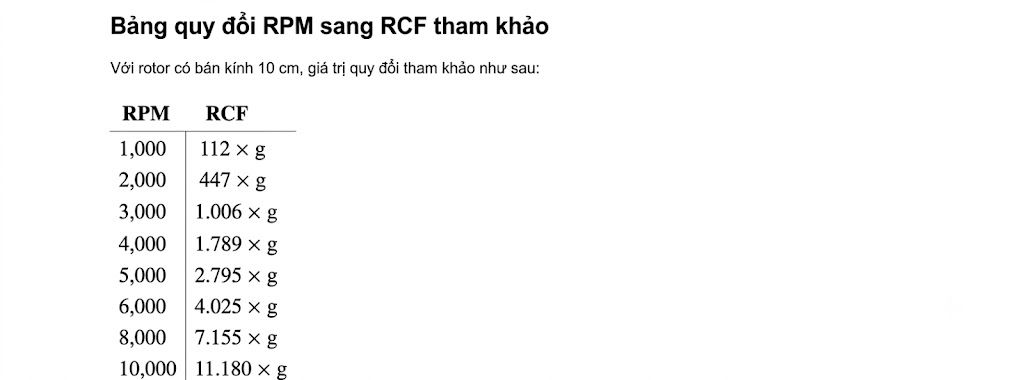
Assuming the rotor has a radius of 10 cm and the set speed is 4,000 RPM.
Applying the formula:
RCF = 1.118 × 10⁻⁵ × 10 × 4000²
Result obtained:
RCF ≈ 1.789 × g
This means the sample is subjected to a centrifugal force approximately 1.789 times the Earth's gravitational force. If the RPM remains at 4,000 but the rotor radius is replaced with a 15 cm rotor, the RCF value will increase to approximately 2.684 × g. This difference is large enough to affect sample separation efficiency in many laboratory applications.
RPM to RCF conversion table for reference
The SOP states 1,500 × g, but the machine only displays RPM. What should I do?
This is a very common situation in laboratories, universities, or units that are newly adopting testing methods from external sources.
For example, the SOP (Standard Operating Procedure) requires centrifugation at 1,500 × g for 10 minutes, but the machine's display only allows input of RPM.
In this case, you need to use the conversion formula or conversion tool provided by the manufacturer to determine the RPM corresponding to the rotor being used.
You should not randomly select an approximate RPM value because centrifugal force errors can affect sample separation quality, especially in applications involving blood, serum, or molecular biology.
How to determine rotor radius to calculate RCF
A common mistake is measuring the distance from the center of rotation to the outer edge of the rotor.
In reality, the radius used in the formula should be calculated from the center of rotation to the final position of the sample inside the centrifuge tube.
This parameter is usually published in the technical catalog or rotor documentation included with the equipment.
Many modern centrifuges from Hettich, Hermle, DLAB, or Benchmark also support direct display of the RCF value corresponding to the rotor being used, significantly reducing calculation time for the operator.
Should you use RPM or RCF?
If the entire process is built on the same centrifuge and the same rotor, RPM is perfectly adequate for daily operation.
Conversely, in laboratories requiring method transfer, result comparison, or working with multiple different equipment types, RCF is always a more reliable choice.
RCF helps standardize centrifugal force between systems, minimizing errors arising from rotor differences and ensuring the repeatability of analytical results.