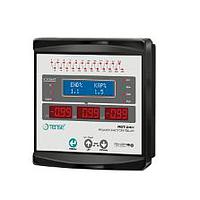
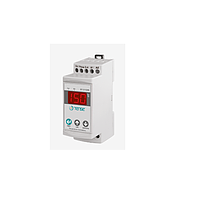
Power factor regulator
Stable power quality is a practical requirement in many industrial electrical systems, especially where motors, transformers, and variable loads can cause the power factor to drift. A well-selected power factor regulator helps automatic capacitor bank control respond to these changes, improving compensation behavior and supporting more efficient panel operation.
On this category page, you can explore regulators used in reactive power compensation systems for low-voltage switchboards and capacitor bank panels. These devices are commonly chosen for factories, commercial buildings, utilities, and infrastructure projects where monitoring voltage, current, cosφ, and switching stages is part of everyday power management.
What a power factor regulator does in a compensation panel
A power factor regulator measures electrical conditions and decides when capacitor steps should be connected or disconnected. Its main role is to keep the installation closer to the target power factor by reacting to changing reactive power demand across the system.
In practice, the regulator works with current transformers, capacitor contactors, and the capacitor bank itself. More advanced units can also display parameters such as active power, reactive power, voltage, current, and cosφ, giving maintenance teams better visibility into how the panel is performing over time.
Typical applications and operating environments
These controllers are widely used in manufacturing plants, pump stations, HVAC systems, commercial buildings, and distribution panels with fluctuating inductive loads. When the load profile changes throughout the day, automatic stage control becomes more useful than fixed compensation because it helps avoid under-compensation or excessive capacitor switching.
For facilities that manage broader electrical loads, a power factor regulator often sits alongside other panel-mounted control products such as power controllers. In more process-driven systems, it may also be part of a wider control architecture that includes programmable controllers for monitoring, alarms, and automation logic.
Key features to compare before selecting a model
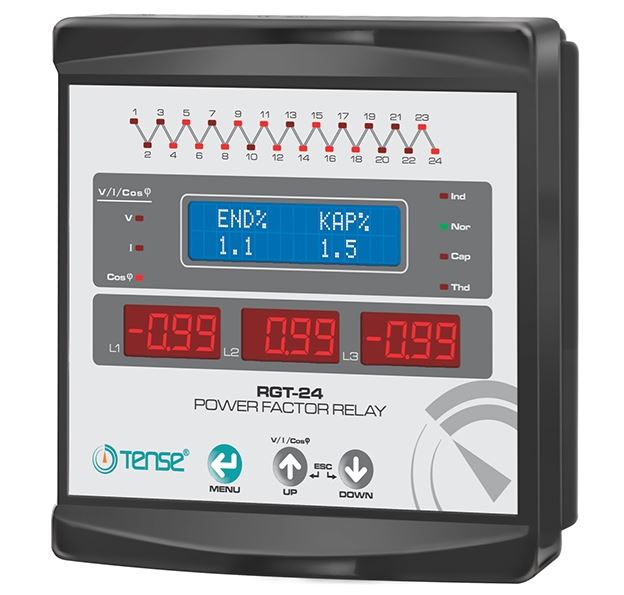
One of the first points to review is the number of control steps. Smaller capacitor banks may only need 6 stages, while larger or more dynamic systems can benefit from 8, 12, or even 24 levels. The right step count depends on how finely the compensation bank needs to respond to changing load conditions.
Display type and operator visibility also matter. Some models use LED displays for clear status indication, while others use LCD screens to show more operating data. Communication capability, especially RS485 communication, can be valuable when the regulator must integrate with a supervisory system or when electrical teams want easier access to panel data.
It is also important to check supply voltage range, panel size, CT compatibility, and protection-related indicators. Features such as over/low voltage alerts, cosφ monitoring, manual step setting, and password protection can be helpful in real operating environments where reliability and controlled access are priorities.
Examples from leading brands in this category
This category includes solutions from manufacturers such as SELEC, Mikro, TENSE, and Light Star. Each brand supports common capacitor bank applications, but the most suitable choice depends on panel design, required number of stages, preferred display style, and whether communication is needed.
For example, the Selec APFC 147-108 and APFC 147-112 RTU Protocol models are relevant where users need multi-step automatic control with communication support. For applications that require a higher number of switching levels and a wider set of displayed electrical values, the TENSE RGT-24H is a notable option in this range.
Light Star models such as KCP-06, KCP-12, KCP-SM, KCP-06C, KCP-12C, and KCP-SMC illustrate how this category covers both basic and communication-ready versions across different step counts. Mikro options including PFR80-220-50, PFR80-415-50, and PFR120-415-50 are also suitable references when selecting regulators for standard 144 x 144 panel layouts.
How to choose the right regulator for your panel
Start with the structure of the capacitor bank: the number of capacitor steps, the expected load variation, and whether the installation is single-phase, two-phase, or three-phase. A regulator with too few stages may limit compensation accuracy, while an oversized unit may add complexity that is not necessary for the application.
Next, think about panel operation and maintenance. If technicians need quick visual feedback, LED-based units can be a practical choice. If the project requires more detailed parameter display or remote access, models with LCD interfaces and communication functions may be easier to manage in the long term.
It is also worth considering how the device fits into the broader control environment. Facilities that already use dedicated PID Controllers or other industrial controllers may prefer a regulator that aligns with existing panel standards, communication preferences, and maintenance practices.
Benefits of using an automatic regulator instead of fixed compensation
Load conditions in real installations are rarely constant. An automatic regulator helps capacitor banks respond step by step as demand changes, which supports more accurate compensation and reduces the risk of leaving unnecessary stages connected when the reactive load drops.
This approach can also improve panel usability by giving operators a clearer view of measured values and switching status. In systems where reactive power behavior changes frequently, automatic regulation offers a more flexible solution than static arrangements, especially when monitoring and adjustment are needed as part of routine electrical maintenance.
Points to review before ordering
Before selecting a unit, confirm the number of stages required, panel cutout compatibility, control supply range, and whether the project needs communication. If your panel design includes remote supervision or data logging, a communication-capable model may be the better fit than a basic standalone regulator.
It is also useful to match the regulator to the compensation strategy already defined for the project. Reviewing display preference, wiring method, CT arrangement, and operating environment in advance can help narrow the options and reduce commissioning issues later.
Choosing the right power factor regulator is ultimately about matching the controller to the behavior of the electrical load and the design of the capacitor bank. This category brings together practical options for standard and communication-enabled compensation panels, making it easier to compare stage count, interface type, and brand preference before final selection.
Get exclusive volume discounts, bulk pricing updates, and new product alerts delivered directly to your inbox.
By subscribing, you agree to our Terms of Service and Privacy Policy.
Direct access to our certified experts