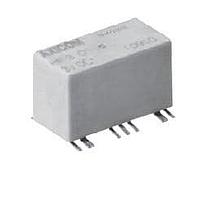
High Frequency Relay / RF Relay
Signal routing at high frequencies places very different demands on a relay than general-purpose switching. In RF paths, engineers need stable impedance behavior, low insertion loss, good isolation, and repeatable switching performance across test, communications, and instrumentation environments. That is why selecting the right High Frequency Relay / RF Relay is often a system-level decision rather than a simple component purchase.
On this category page, you can explore RF relays used where signal integrity matters, from automated test setups to switching networks inside communication and measurement equipment. The goal is not only to compare parts, but also to understand how relay construction, signal level, mounting style, and switching duty affect long-term performance in real applications.
Where RF relays are commonly used
A high frequency relay is typically chosen when a circuit must switch RF or other sensitive high-speed signals without introducing excessive distortion or leakage. These relays appear in test and measurement racks, antenna switching assemblies, wireless infrastructure, lab instrumentation, aerospace electronics, and other systems where the signal path must remain predictable after repeated switching cycles.
Compared with standard power or control relays, RF relays are selected with closer attention to electrical path characteristics. Engineers often evaluate not only contact arrangement and coil voltage, but also how the relay contributes to the overall signal chain. In many designs, the relay is part of a broader switching architecture that may also include low signal PCB relays for adjacent low-level control or measurement paths.
What makes an RF relay different
The main role of an RF relay is to switch signals while preserving signal quality as much as possible. In practice, this means designers care about factors such as contact design, internal geometry, shielding, actuation consistency, and the relay’s suitability for the frequency range used by the equipment. Even when two relays look similar mechanically, their behavior in a high-frequency path can be very different.
Another key difference is application sensitivity. A relay used in an RF front end or automated test system may influence measurement accuracy, channel isolation, and repeatability. For that reason, buyers often look beyond simple electrical ratings and review the relay’s intended use in instrumentation, telecom, defense, or precision switching assemblies.
Key selection factors for engineers and buyers
Choosing the right device usually starts with the switching requirement: signal type, expected frequency range, number of paths, and how often the relay will actuate. From there, practical details matter, including package style, board or panel integration, available space, and whether the design prioritizes compactness, low loss, or high isolation.
It is also important to consider the surrounding hardware. In some assemblies, relay mounting and replacement strategy are just as important as the relay itself, especially in maintenance-heavy systems. If the installation calls for supporting accessories, related options such as relay sockets and hardware may help simplify integration and serviceability where appropriate.
For systems that combine different switching technologies, the decision may also involve whether an electromechanical RF relay is the best fit for the signal path, or whether another category is better suited elsewhere in the control architecture. In mixed designs, it is common to pair RF relays with solid state relays for non-RF loads that benefit from silent, high-speed, or wear-free switching.
Manufacturer landscape in this category
This category includes solutions associated with well-known relay and interconnect manufacturers used in industrial, communications, and test applications. Buyers frequently evaluate offerings from TE Connectivity, Omron Electronics, Panasonic Industrial Devices, FCL Components, P&B, and Radiall, depending on the design objective and the level of specialization required.
Within the broader TE Connectivity ecosystem, brands such as Axicom and CII are often relevant when engineers are looking for compact signal switching solutions or application-focused relay families. Manufacturer choice usually depends less on brand familiarity alone and more on fit for the required switching topology, environmental demands, lifecycle expectations, and qualification process of the end equipment.
How RF relays fit into a broader relay strategy
In many industrial and electronic systems, RF relays are only one part of the switching layer. A platform may include power relays for load handling, low signal relays for instrumentation-level circuits, safety-oriented relays for protective functions, and RF relays for the signal paths that need careful impedance and isolation control. Understanding that ecosystem helps purchasing teams avoid comparing unlike devices.
For example, an engineer building a communications test fixture may use RF relays for coaxial or high-frequency signal routing, while using standard low signal devices for logic-level measurement switching. In machine or process environments, these products may sit alongside a safety relay used for protective control circuits, even though the electrical purpose is completely different.
Practical considerations before ordering
Before shortlisting parts, it helps to review the intended operating environment and maintenance plan. Switching frequency, expected service life, mounting constraints, available drive circuitry, and replacement access can all influence which relay family is most practical. In high-value equipment, relay selection is often tied directly to uptime, calibration stability, and ease of field support.
Procurement teams should also align relay selection with the documentation needs of the project. For OEM, lab, telecom, and automation buyers, part traceability, manufacturer consistency, and lifecycle planning are often as important as immediate availability. This is particularly true when the relay is designed into test platforms or communication hardware with long service periods.
Choosing the right category for your application
If your requirement centers on switching sensitive high-frequency or RF signals, this category is the right place to start. It is especially relevant when signal integrity, isolation, and controlled switching behavior matter more than simple load switching. Reviewing the broader switching context can also help narrow down whether an RF relay is needed throughout the design or only in the critical signal sections.
A well-matched relay category saves time later in integration, testing, and maintenance. By focusing on application needs first and then comparing suitable manufacturers and relay types, engineering and sourcing teams can identify high frequency relay options that fit the electrical path, the mechanical design, and the long-term support needs of the system.
Get exclusive volume discounts, bulk pricing updates, and new product alerts delivered directly to your inbox.
By subscribing, you agree to our Terms of Service and Privacy Policy.
Direct access to our certified experts