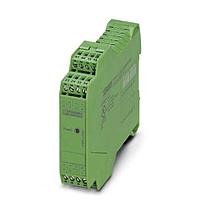
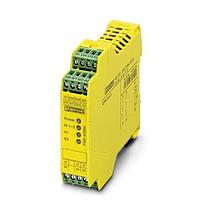
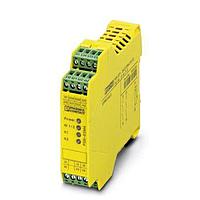
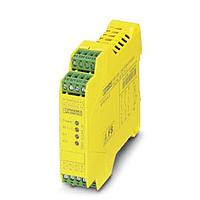
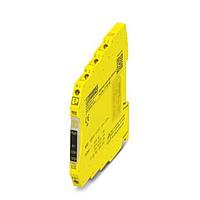
Safety relay
Protecting personnel and machinery often depends on one small but critical part of the control system: the ability to detect a fault and move equipment to a safe state without delay. In many industrial applications, that role is handled by a safety relay, used to monitor emergency stops, safety gates, light curtains, and other protective devices within a machine safety circuit.
On this page, you can explore safety relays for industrial automation projects where reliable stop functions, input monitoring, and safety logic are required. These devices are commonly selected for machine builders, panel integrators, and maintenance teams that need practical solutions for improving functional safety in production lines, packaging systems, assembly equipment, and material handling applications.
Where safety relays are typically used
A safety relay is commonly installed anywhere a machine must respond predictably when a hazardous condition is detected. Typical examples include emergency stop circuits, guard door monitoring, two-hand control stations, safety mats, interlock switches, and operator access points around moving equipment.
In a basic architecture, the relay evaluates the state of one or more safety inputs and controls outputs that can remove power to hazardous motion or trigger a controlled stop. This helps create a clear separation between standard control functions and safety-related control functions, which is especially important in environments where downtime, operator exposure, and machine restart behavior must be managed carefully.
Why safety relays remain important in industrial control panels
Although programmable safety controllers and integrated safety PLC platforms are increasingly used in complex systems, safety relays still play an important role in many machines. They are often chosen for dedicated safety functions that do not require extensive programming, networked logic, or a large number of inputs and outputs.
For compact machines and straightforward safety circuits, a relay-based design can simplify panel layout, commissioning, and troubleshooting. It can also be a practical fit when the requirement is focused on one specific function, such as monitoring an E-stop loop or a guard switch. In broader machine safety architectures, safety relays are also frequently used alongside devices such as safety light curtains and interlocking solutions to build layered protection.
Common selection factors for a safety relay
Choosing the right device starts with the application, not just the relay format. Engineers typically review the type of safety input, the number of channels, the required output contacts, reset behavior, diagnostic expectations, and how the relay will interact with contactors or downstream switching elements.
It is also important to consider the machine’s operating logic. Some systems need automatic restart restrictions, while others require manual reset and monitored reset behavior. In many projects, the relay must also align with the overall design approach used for risk reduction, especially when the circuit includes external contact monitoring, fault detection, or coordinated shutdown across multiple zones.
Integration with safety devices and supporting components
Safety relays rarely operate alone. They are usually part of a wider protective circuit that includes input devices, switching elements, indicators, and operator procedures. For example, a relay may monitor an emergency stop pushbutton, a gate switch, or a light curtain, then drive contactors that isolate hazardous motion or energy sources.
Just as important are the supporting measures around the machine. Clear operator communication through industrial warning signs and labels can help reinforce safe operation, while lockout procedures and service isolation are often supported by PPE safety equipment and lockout tagout products. Looking at the relay as one part of a broader safety system usually leads to better design decisions than selecting it in isolation.
Typical manufacturers found in this category
This category may include products from established industrial suppliers such as OMRON, Banner Engineering, Honeywell, Eaton, Delta, Littelfuse, and Panasonic Industrial Devices. These manufacturers are widely recognized in automation and machine safety applications, where relay-based safety functions are often used as part of standard panel designs or OEM equipment.
Availability and product mix can vary depending on stock, series, and application focus. For that reason, many buyers compare not only brand preference but also compatibility with the existing control panel, required safety function, wiring approach, and maintenance expectations over the life of the equipment.
When to use a safety relay instead of another safety solution
A relay-based approach is often suitable when the safety function is clearly defined and relatively contained. If the machine needs a dedicated stop circuit, a simple gate monitoring function, or a compact hardwired safety architecture, a safety relay can be an efficient choice. It offers a focused solution without adding unnecessary configuration complexity.
On the other hand, systems with multiple zones, advanced sequencing, distributed I/O, or a need for broader diagnostics may require a different approach. In those cases, buyers sometimes review adjacent solutions or supplementary components in other industrial safety products to build a more complete protection strategy around the machine.
What to review before ordering
Before selecting a part, it is useful to confirm the intended safety function, input device type, output arrangement, mounting requirements, and the expected behavior during reset and fault conditions. Panel space, control voltage, wiring method, and compatibility with existing contactors or machine interfaces should also be checked early in the design process.
For retrofit projects, reviewing the current machine circuit is especially important. A replacement relay should fit the application logic and safety concept already in place, rather than being chosen only by physical similarity. This helps reduce commissioning issues and supports a more predictable maintenance process later on.
Supporting safer machine design
A well-chosen safety relay can help create a more dependable response to emergency conditions, guard violations, and operator access events. Whether the goal is updating an existing control panel or specifying a new machine, the right selection depends on how the relay fits into the full safety circuit, not just the device itself.
Use this category to compare options for your application, then evaluate the required inputs, outputs, reset logic, and integration needs across the entire machine safety system. A careful selection process will make it easier to match the relay to the actual operating risk, panel design, and maintenance environment.
Get exclusive volume discounts, bulk pricing updates, and new product alerts delivered directly to your inbox.
By subscribing, you agree to our Terms of Service and Privacy Policy.
Direct access to our certified experts