Condensers
Efficient vapor cooling is a basic requirement in many laboratory workflows, especially when distillation, reflux, solvent recovery, or reactor-based synthesis is involved. Choosing the right Condensers helps stabilize the process, improve solvent collection, and support safer operation in glassware assemblies ranging from compact bench setups to larger pilot-scale systems.
On this category page, you can explore laboratory condensers used in chemical processing and glass reactor applications, including jacketed coil and Dimroth-style designs in borosilicate glass. The range highlighted here also reflects practical compatibility needs such as joint size, hose connection style, and condenser length for different vessel capacities.
Where laboratory condensers are typically used
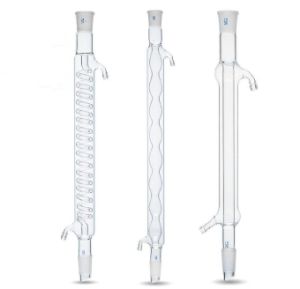
In a lab or process environment, a condenser is installed to cool vapor and return it to liquid form. This is essential in reflux operations where condensed solvent is returned to the system, as well as in distillation setups where vapor is collected after separation. In glass reactor systems, the condenser also plays a major role in managing solvent loss and maintaining process consistency.
These components are commonly selected as part of a broader glassware and reactor ecosystem. If your workflow also involves handling or transferring aggressive liquids, related lab accessories such as a bottle top solvent pump may be useful in adjacent preparation steps.
Common condenser types in this category
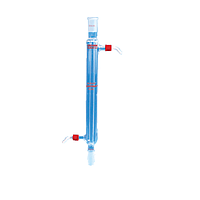
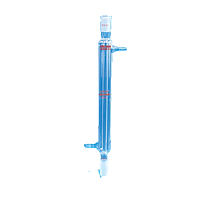
This category includes several glass condenser formats used across laboratory and pilot-scale setups. Jacketed coil condensers are designed to circulate coolant around the vapor path, helping improve heat exchange in compact or standardized assemblies. They are often chosen when users need clear dimensional options for integration into existing glassware.
Another common design is the Dimroth condenser, which uses an internal cooling coil and is widely used in reflux and evaporation-related applications. Dimroth-style models are often preferred when efficient vapor condensation is needed within a vertical glass setup, particularly in chemical synthesis and solvent handling processes.
Examples from DaiHan and SciLab
The selection on this page includes products from DaiHan and SciLab, two manufacturers represented in this category with laboratory glass condenser options for different configurations and vessel sizes.
For larger reactor systems, examples such as the DaiHan SL.Con2113 Glass Condenser for GR-20L, GR-30L, and GR-50L, as well as the DaiHan SL.Con2116 Glass Condenser for 100 Lit., illustrate how condenser dimensions and connection formats are matched to reactor capacity. On the SciLab side, the SL.Con2051, SL.Con2052, and SL.Con2053 jacketed coil condensers show a progression in length that can help users align cooling performance with setup geometry.
SciLab Dimroth models in this category also cover multiple sizes and joint formats, including SL.Con2046.1, SL.Con2047.1, SL.Con2048.1, and SL.Con2049.1, as well as corresponding 24/29 joint variants. These examples are useful for buyers who need to compare glass dimensions and connection standards rather than simply choosing by brand alone.
How to choose the right condenser
Selection usually starts with the process itself. Reflux applications often prioritize efficient heat transfer and stable return of condensed liquid, while distillation may require a condenser that fits a specific downstream receiving arrangement. In reactor systems, vessel volume and expected vapor load become especially important when deciding on condenser length and diameter.
It is also important to verify joint compatibility and hose connection details before ordering. The products listed in this category include formats such as 24/29, 29/32, 24/40, 34/35, and 45/40, and these interface details directly affect whether the condenser will integrate correctly with existing laboratory glassware.
Material is another practical consideration. Several SciLab models listed here specify borosilicate glass 3.3, a common choice in laboratories because it is suitable for chemical glassware applications and supports visibility of internal flow during operation. Buyers should still match the condenser not only to chemical compatibility, but also to thermal conditions and the mechanical layout of the full assembly.
Why dimensions matter in real installations
Condenser length, outer diameter, and internal structure all influence how the unit performs in use. A shorter model may be suitable for light-duty reflux or compact glass assemblies, while longer versions can provide more cooling surface area where vapor generation is higher. This is why product ranges often include several length options within the same design family.
For example, the SciLab SL.Con2051, SL.Con2052, and SL.Con2053 jacketed coil condensers differ mainly by length, making them relevant for users who already know the required connection format but need to fine-tune cooling capacity. Similarly, the Dimroth range offers multiple size options that can better align with small-scale or more demanding laboratory processes.
Integration with broader labware workflows
Condensers are rarely selected in isolation. They usually form part of a broader labware setup that may include flasks, reactors, transfer accessories, receiving vessels, and sample handling components. In some workflows, supporting items such as ampoule products or laboratory bags may also be relevant depending on how samples, reagents, or collected fractions are prepared and stored.
Because of this, procurement teams and technical buyers often compare condensers not just by dimensions, but by how easily they fit into the full process chain. A well-matched condenser can reduce rework during setup and help maintain reliable condensation behavior throughout repeated lab runs.
Practical buying considerations for B2B users
For engineering teams, laboratories, and industrial buyers, the key decision factors are usually compatibility, process fit, and replacement planning. If you are purchasing for an existing reactor or glass assembly, it is often more efficient to begin with the required joint standard, condenser type, and overall size envelope before comparing individual part numbers.
It can also be useful to standardize on one manufacturer for certain systems when maintenance, spare planning, or repeat purchasing is a priority. However, cross-checking the exact condenser structure and dimensions remains essential, since even similar-looking glass parts may differ in fit and intended application.
Find a condenser that matches your setup
This category brings together glass condensers for reflux, distillation, and reactor-based laboratory use, with options from DaiHan and SciLab covering multiple joint standards, lengths, and condenser designs. Whether you are replacing a damaged part or specifying components for a new glass system, the most effective choice is the one that fits both the thermal demands of the process and the physical layout of your equipment.
Use the product listings to compare connection style, dimensions, and intended system compatibility, then narrow the range to the condenser format that best supports your laboratory workflow.
Get exclusive volume discounts, bulk pricing updates, and new product alerts delivered directly to your inbox.
By subscribing, you agree to our Terms of Service and Privacy Policy.
Direct access to our certified experts