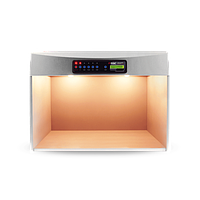
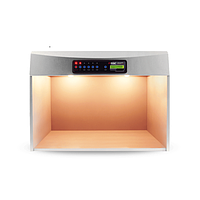
Color Assessment Cabinet
Consistent color evaluation is difficult when the viewing environment changes from one room, shift, or customer site to another. A Color Assessment Cabinet creates a controlled lighting space so operators can compare samples under standardized light sources instead of relying on ambient conditions that often lead to mismatched judgments.
These cabinets are commonly used wherever product appearance matters, including printing, textiles, plastics, paint, packaging, and general quality control. For purchasing teams, lab users, and production engineers, the main value is simple: more repeatable visual inspection and better alignment between internal checks and customer expectations.
Why controlled lighting matters in color inspection
Human color perception depends on the light reflected from the sample and the conditions in which it is viewed. The same part, print, coating, or textile can look acceptable in one environment and noticeably different in another. This is why visual approval under office lighting or daylight alone is often unreliable.
A color assessment cabinet helps reduce that variability by reproducing specific viewing conditions such as D65, D50, TL84, A/F, or UV, depending on the model. In practice, this makes it easier to detect metamerism, compare incoming and approved samples, and establish a more stable inspection process alongside tools such as a light meter or color sensors where instrumental verification is also needed.
Where color assessment cabinets are used
Standardized viewing cabinets are widely applied in industries where visual color consistency affects product quality, acceptance, or brand appearance. Typical use cases include checking printed packaging, matching dyed fabric lots, reviewing painted or coated panels, comparing molded plastic parts, and validating graphic proofs before release.
They are also useful in supplier qualification and incoming inspection. When multiple factories or vendors work against the same visual target, a controlled booth reduces interpretation differences and supports a clearer pass/fail process. This is especially important when products are later examined under retail, daylight, or UV-related conditions.
- Printing and packaging: compare proofs, labels, cartons, and finished print runs.
- Textiles and garments: verify shade consistency across batches and trims.
- Paint, ink, and coatings: assess visual match before release or shipment.
- Plastics and consumer goods: inspect molded or assembled parts with color-critical surfaces.
- Automotive and industrial finishing: review coated components under defined light sources.
Common light sources and what they help reveal
One of the key selection points is the set of installed light sources. Different standards simulate different real-world environments. D65 is often used to represent daylight-like inspection conditions, while D50 is common in some printing and color review workflows. TL84 helps simulate retail store lighting, A/F approximates warm domestic lighting, and UV can be useful when fluorescent effects or optical brighteners need to be checked.
Several products in this category illustrate these differences well. The PCE range includes models such as the PCE CIC 5-LED Color Matching Cabinet, which combines D65, TL84, A/F, and UV, and the PCE CIC 11-LED Color Viewing Box, which extends the range with CWF for broader comparison scenarios. For applications centered around daylight simulation, the PCE CIC 20 offers D75, D65, and D50 in a larger inspection format.
How to choose the right cabinet size and configuration
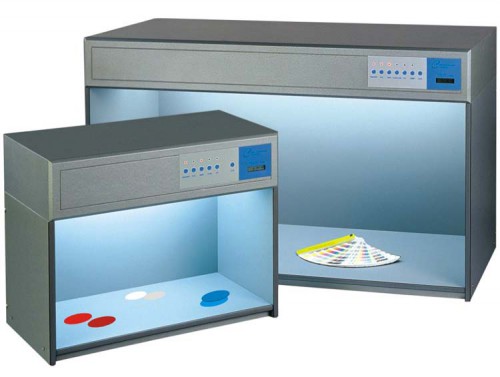
The right unit depends less on brand preference alone and more on sample size, workflow, and required light conditions. Small components, lab samples, and handheld comparisons may fit compact booths, while large sheets, cartons, textile panels, or multiple samples viewed together usually require a larger cabinet with a wider viewing area.
Compact options can be practical for bench use or space-limited QA stations. For example, smaller-format solutions such as the DOHO D60(2) Color Light Box or Karg CM mini series are suited to routine comparison tasks where footprint matters. For larger visual inspections, models like the Karg CM 20, CM 25, CM 30, or CM 35 provide more room for handling bigger samples and evaluating them in a more consistent geometry.
It is also worth checking the available power supply, cabinet dimensions, and whether the unit includes an operating-hours counter for each light source. That feature can help maintenance teams manage lamp usage and support more repeatable viewing conditions over time.
Representative product options in this category
This category includes a practical spread of configurations rather than a one-size-fits-all solution. The DOHO D60(2) Color Light Box is a straightforward option for standard color checks using D65 and F lighting. In the PCE lineup, the CIC 5-LED and CIC 11-LED models support multi-light evaluation for broader inspection requirements, while the PCE CIC 10-LED and CIC 20 address larger viewing needs.
For users comparing booth sizes across a single manufacturer family, Karg offers compact and larger models ranging from the CM mini 1, CM mini 2, and CM mini 4 to the CM 20, CM 25, CM 30, and CM 35. This kind of range is useful when a business wants to standardize inspection practice across different departments without forcing every workstation to use the same cabinet size.
What to review before buying
Before selecting a cabinet, it helps to define the actual inspection task. Start with the materials being checked, the reference standard used by your customers, and the lighting environments that most often cause disputes. If approvals are made across multiple locations, choosing the same light-source setup across sites is usually more important than simply choosing the largest cabinet available.
Buyers should also consider whether visual assessment will be supported by other optical tools. In some workflows, a cabinet is part of a broader control setup that may include a UV meter for ultraviolet verification or other measurement devices used to document lighting conditions and sample response more consistently.
Practical tips for better day-to-day use
Even a good cabinet performs best when the inspection process is consistent. Samples should be viewed with the same orientation, background, and distance whenever possible. Operators should also avoid mixing uncontrolled room light into the viewing area, since this can influence perceived differences and weaken the value of standardized illumination.
Routine maintenance matters as well. Keeping the interior clean, monitoring light-source operating hours, and replacing lamps according to the manufacturer’s guidance help preserve comparability over time. For organizations that rely on visual approval as part of shipment release or production sign-off, these small process controls can make a meaningful difference.
Short FAQ
Is a color assessment cabinet only useful for printing?
No. It is also widely used in textiles, plastics, paints, coatings, packaging, and any application where visual color consistency needs to be checked under controlled lighting.
What is the difference between a color light box and a larger viewing cabinet?
In practice, the distinction is often about size, viewing area, and the number of available light sources. Smaller units suit routine bench inspection, while larger cabinets support bigger samples and broader comparison tasks.
Do I need multiple light sources?
If your products are viewed in different real-world environments or if metamerism is a concern, multiple light sources are usually helpful. The right combination depends on your industry workflow and customer approval standards.
Choosing the right cabinet comes down to matching the viewing environment to your actual inspection process. A well-selected color assessment cabinet can improve visual consistency, reduce disagreement between teams, and support more reliable quality decisions across production, lab, and supplier workflows.
Get exclusive volume discounts, bulk pricing updates, and new product alerts delivered directly to your inbox.
By subscribing, you agree to our Terms of Service and Privacy Policy.
Direct access to our certified experts