Fittings-Filters-Mufflers
Reliable flow measurement systems depend on more than the primary instrument alone. The supporting components around the line often determine whether a setup stays stable, clean, and leak-free over time, especially in compressed gas, liquid handling, and industrial utility applications.
Fittings-Filters-Mufflers covers the practical accessories used to connect tubing, protect instruments from contamination, and reduce exhaust noise in pneumatic or flow-related installations. These parts are often small in size, but they play a major role in system integrity, maintenance intervals, and overall measurement consistency.
Why these accessories matter in flow systems
In many industrial environments, the weakest point in a flow loop is not the meter or sensor itself, but the connection and conditioning hardware around it. Poorly matched fittings can lead to leakage, vibration-related loosening, or installation errors. In the same way, inadequate filtration can allow particles, oil mist, or condensate to reach sensitive components.
Mufflers also have an important role where pneumatic exhaust is part of the process. They help reduce noise and can improve the working environment around valves, controllers, and other air-powered equipment. When these accessories are selected correctly, they support safer operation and help preserve the performance of the broader measurement or control system.
Typical product roles within this category
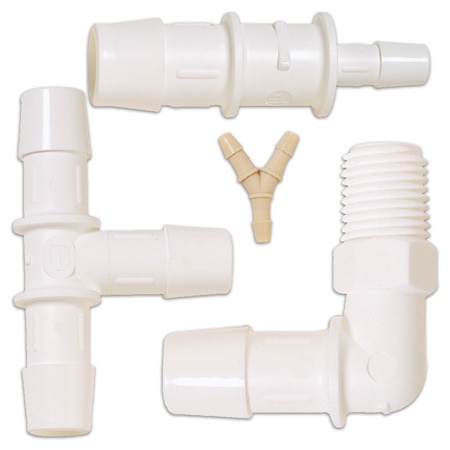
This category generally supports three core needs: connection, protection, and exhaust management. Fittings are used to join tubing, transition between tube and threaded connections, or route lines through panels and enclosures. Filters help remove unwanted contamination before it reaches meters, regulators, or downstream devices. Mufflers are commonly installed on exhaust ports to reduce sound and sometimes help limit debris discharge.
Within the fitting segment, common configurations include male connectors, female connectors, bulkhead unions, and ferrule-based components. These are especially relevant in systems that use rigid tubing and threaded process connections. If your application also involves related accessories such as flow tubes or line protection devices, it is useful to review those product groups alongside fitting selection.
Examples of fitting types used in industrial installations
Several representative products in this category show the range of connection styles used in practice. For example, Dwyer A-1002-28 and Dwyer A-1002-27 are male connector fittings designed for tube-to-thread transitions, while Dwyer A-1011-19 and Dwyer A-1011-13 are female connector fittings that support other assembly layouts. For panel or enclosure pass-through points, a bulkhead union such as Dwyer A-1010-10 can be relevant.
Ferrule-based parts also appear in this category, including components such as Dwyer A-1006-14, which illustrates the role of sealing hardware in compression-style tube fitting assemblies. These products are not interchangeable by name alone; the correct choice depends on tube outer diameter, wall thickness, connection type, pressure range, and media compatibility.
Material and operating considerations
Many of the listed fitting examples use 316 stainless steel wetted materials, which makes them suitable for a broad range of industrial media such as water, steam, inert gases, oils, and solvents where chemical compatibility and corrosion resistance are important. In demanding service, material selection should always be checked against both the process fluid and the surrounding environment.
Temperature and pressure ratings also matter. Some examples in this category are intended for relatively high-pressure service, with ratings that vary by fitting style and size. As tubing diameter and wall thickness change, the allowable pressure can change as well. This is why accessory selection should be treated as an engineering decision rather than a simple mechanical add-on.
How to choose the right fitting, filter, or muffler
A good starting point is to define the line conditions clearly: media, working pressure, temperature, tube size, and the type of process connection required. From there, confirm whether the installation needs a straight connector, a union, a bulkhead style, or ferrule components for a complete assembly. For systems with contamination risk, a filter may be necessary upstream to protect the device and reduce maintenance.
It is also helpful to think about the surrounding pneumatic hardware. If your system includes compressed air preparation, you may want to review related options such as air line lubricators. Where pulsation or transient spikes are a concern, a pressure surge protector may be worth considering as part of the same installation strategy.
Manufacturer context and product ecosystem
Dwyer is prominently represented in this category through a range of leak-free tube fitting configurations suited to industrial process and instrumentation use. The examples shown here reflect practical connection needs across different tube diameters and NPT male thread sizes, making them useful reference points when building or maintaining a tubing assembly.
Depending on the broader project, buyers may also compare accessory ecosystems across other instrumentation-oriented manufacturers listed on the site, including OMEGA, Sterling Sensors, and TSI Flowmeters. The best fit will depend less on brand preference alone and more on matching the accessory to the operating conditions, connection standard, and maintenance expectations of the application.
Where these accessories are commonly used
Fittings, filters, and mufflers are widely used in gas distribution panels, pneumatic control cabinets, process skids, laboratory utility lines, and OEM equipment. They are also common in installations where flow devices must be protected from contamination or where tubing connections need to remain stable under repeated thermal and pressure cycling.
In these environments, attention to accessory details can reduce unplanned downtime and simplify servicing. A properly selected fitting helps maintain seal integrity, a suitable filter helps keep internals clean, and a correctly chosen muffler can make pneumatic exhaust more manageable without overcomplicating the system layout.
Final considerations
Choosing the right accessories for a flow system is often about reducing small problems before they become large ones. Connection quality, contamination control, and exhaust handling all influence how reliably the overall installation performs.
This category brings together the kinds of supporting components that help complete a practical, maintainable setup. If you are comparing options, focus on connection geometry, media compatibility, and pressure-temperature suitability so the selected fitting, filter, or muffler aligns with the real operating conditions of your application.
Get exclusive volume discounts, bulk pricing updates, and new product alerts delivered directly to your inbox.
By subscribing, you agree to our Terms of Service and Privacy Policy.
Direct access to our certified experts