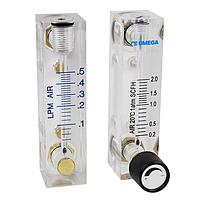
Variable Area Flow Meters
When a process line needs a simple, visual way to confirm liquid flow without adding complex electronics, a clear mechanical indicator is often the most practical choice. Variable Area Flow Meters remain widely used in industrial systems because they are easy to read, straightforward to install, and well suited to many utility, chemical, water, and high-purity fluid applications.
In this category, buyers typically compare connection size, valve configuration, flow range, wetted materials, and installation constraints rather than looking for one universal solution. That is why this page focuses on how these meters fit into real process requirements, and how to narrow down the right model for your line.

Why variable area meters are still relevant in modern flow measurement
A variable area meter provides a direct visual indication of flow by balancing fluid force against a float inside a tapered tube. As flow increases, the float rises until it reaches a position that corresponds to the actual rate. This makes the device especially useful where operators need a quick local reading without relying on a separate transmitter or control interface.
Compared with more instrument-heavy technologies, these meters are often chosen for their simple operating principle, low maintenance requirements, and immediate readability at the point of use. For applications that need other measurement methods, such as conductive liquid monitoring, it may also be helpful to review electromagnetic flow meters as part of a broader selection process.
Typical applications for high-purity and process liquid service
The products highlighted in this category show a strong focus on liquid measurement, including high-purity service where material compatibility matters. In these environments, the choice of wetted materials is often just as important as the flow range itself, especially when the process fluid must be protected from contamination or when aggressive media are involved.
Several featured models in the Dwyer Series VAT use fluoropolymer-related wetted materials and are intended for vertical in-line installation. This makes them relevant for skids, dosing lines, water treatment branches, chemical handling systems, and clean liquid processes where operators want local indication together with compact installation.
How to choose the right meter for your process
The first step is to define the required flow range under actual operating conditions. Within this category, available examples span relatively low liquid rates in gallons per hour as well as higher capacities in gallons per minute, so a meter should be selected around the normal operating window rather than only the maximum possible flow.
Connection size is another practical filter. The listed examples include 3/8 in, 1/2 in, and 3/4 in NPT female connections, which can significantly affect integration time and fitting compatibility. Buyers should also confirm pressure limits, mounting orientation, and temperature exposure before finalizing a model.
Valve configuration matters too. Some versions include a built-in 6-turn valve for finer local adjustment, while others are supplied without a valve for installations where flow control is handled elsewhere in the system. If separate regulation hardware is needed, related flow valves may help complete the assembly.
Examples from the Dwyer Series VAT range
Among the featured products, Dwyer appears prominently with multiple Series VAT configurations for high-purity liquids. Models such as the VAT-6110 and VAT-6111 cover lower to mid liquid capacities with 1/2 in connections and integrated valves, while VAT-6112, VAT-6113, and VAT-6114 move into higher ranges with 3/4 in connections.
For lower-range service, examples such as the VAT-317, VAT-318, and VAT-319 provide smaller-capacity options with 3/8 in NPT female connections. The category also includes no-valve versions such as VAT-6010 through VAT-6013, which can be a better fit when the meter is used primarily for indication and an upstream or downstream valve already exists in the process design.
Although Dwyer is well represented here, buyers comparing broader sourcing options may also evaluate manufacturers such as Brooks Instrument and OMEGA depending on system standards, plant preferences, and required form factor.
Key specification points to review before ordering
Accuracy should always be interpreted in context. Many listed models are rated at ±5% of full scale, which is often suitable for visual process confirmation, line balancing, and general-purpose indication, but may not be ideal for applications requiring tighter control or custody-level precision.
Material compatibility deserves careful attention, especially in specialty liquid service. The featured products indicate specific wetted materials and note that media compatibility should be confirmed, which is an important reminder that chemical suitability cannot be assumed from connection size or range alone.
It is also worth checking whether the meter is meant for local indication only or part of a wider flow monitoring setup. In some systems, users combine local indicators with other devices, and in those cases flow measurement accessories can support mounting, integration, or maintenance needs.
When an indicating flow meter is the better fit
Variable area meters are often selected because they provide a clear reading with minimal setup, but they are not the only format available for local flow display. Depending on fluid type, installation space, or readability needs, some users may prefer other styles of indicating flow meters within the same measurement ecosystem.
The right choice depends on what matters most in the application: simplicity, material compatibility, line size, integrated valve control, or measurement technology. A compact variable area meter is usually a strong option when the goal is dependable local indication for a known operating range without unnecessary system complexity.
Practical buying considerations for B2B users
For OEMs, panel builders, and maintenance teams, repeatability in purchasing is often just as important as the meter itself. Standardizing on a connection type, mounting orientation, and valve/no-valve configuration can reduce installation errors and simplify replacement planning across multiple machines or process lines.
It is also useful to think beyond the meter body. Service access, calibration expectations, fluid cleanliness, and operator visibility can all affect long-term usability. In many plants, the best selection is not the most advanced device, but the one that aligns cleanly with the process, maintenance routine, and operator workflow.
Final thoughts
This category brings together variable area meters suited to practical liquid flow indication, including options for high-purity applications and different connection and control preferences. By focusing on flow range, wetted materials, orientation, and whether a built-in valve is required, buyers can narrow the selection more efficiently and choose a model that fits the process instead of forcing the process to fit the instrument.
If you are comparing meter styles for a new installation or replacement project, use this category as a starting point to identify the most suitable mechanical flow indication approach, then review related measurement and control products where needed for a complete solution.
Get exclusive volume discounts, bulk pricing updates, and new product alerts delivered directly to your inbox.
By subscribing, you agree to our Terms of Service and Privacy Policy.
Direct access to our certified experts