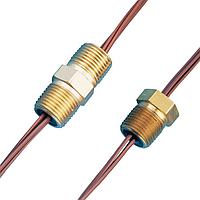
Feedthroughs
Maintaining a reliable seal where temperature probes pass through a chamber wall is a common challenge in laboratory systems, pilot plants, and industrial process setups. In applications involving vacuum, pressure, or controlled atmospheres, the right feedthroughs help route sensors into the process while protecting measurement integrity and reducing the risk of leakage around probe entry points.
This category focuses on temperature-probe sealing components designed for installations where multiple probes must pass through a threaded connection. These products are especially relevant when engineers need a practical way to bring several metric temperature sensors into a vessel, line, or enclosure without sacrificing sealing performance or serviceability.
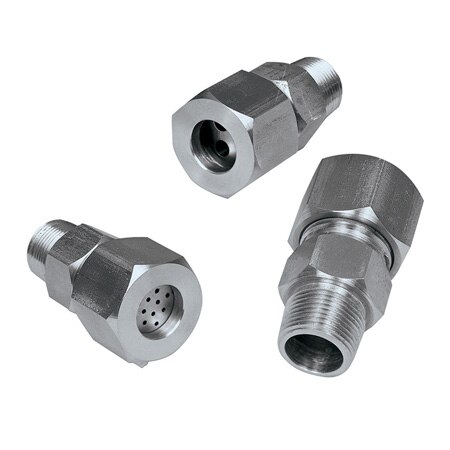
Where feedthroughs fit in temperature measurement systems
In many thermal monitoring systems, the sensing element is only one part of the measurement path. Once a probe needs to enter a pressurized or evacuated space, the mechanical interface becomes just as important as the sensor itself. A properly selected vacuum and pressure feedthrough creates that interface, allowing probes to pass through a process connection while supporting a controlled seal.
This makes feedthroughs useful in reactors, ovens, test chambers, environmental setups, and custom instrumentation where several measurement points are required inside the same process boundary. They are often chosen to simplify installation compared with designing a custom sealed entry for each individual probe.
Typical configuration in this category
The products highlighted here are centered on BSPT male process connections sized at 3/4 in and are intended for sealing metric temperature probes. Across the range, configurations vary by supported probe diameter and by the number of probes that can pass through a single assembly, giving users flexibility when building compact multi-point measurement arrangements.
Several models in this category use PTFE as the sealing material, which is commonly selected in instrumentation environments because it offers chemical compatibility advantages and supports clean, precise sealing in many setups. The available examples include versions for 1 mm, 1.5 mm, and 3 mm probe diameters, with capacities ranging from a few probes up to higher-density configurations for more complex sensing layouts.
Examples from OMEGA for multi-probe sealing
OMEGA is the featured manufacturer in this category, with a selection of feedthroughs tailored to metric temperature probes in vacuum and pressure applications. For users working with very small probe diameters, models such as the OMEGA MFT-M10-5-PTFE, MFT-M10-8-PTFE, MFT-M10-12-PTFE, and MFT-M10-16-PTFE illustrate how one platform can support different probe counts while keeping the same general sealing concept.
Where slightly larger probes are required, options such as the MFT-M15-3-PTFE, MFT-M15-5-PTFE, and MFT-M15-6-PTFE provide a similar approach for 1.5 mm probes. For larger 3 mm probe installations, models including the MFT-M30-3-PTFE, MFT-M30-4-PTFE, and MFT-M30-6-PTFE show how feedthrough selection can be matched to both the physical sensor size and the number of measuring points needed inside the process.
How to choose the right feedthrough
The first selection factor is usually probe diameter. A feedthrough intended for 1 mm probes should not be treated as interchangeable with one designed for 1.5 mm or 3 mm probes, because the sealing performance depends on the mechanical match between the probe and the sealing interface. In practical terms, confirming the exact metric probe size is one of the fastest ways to narrow down suitable options.
The second factor is probe count. Some systems only need three or four measurement points, while others may require dense multi-point sensing across a vessel wall or test fixture. Choosing a feedthrough with the right number of probe positions can reduce installation complexity and help keep the overall assembly more compact than using multiple separate entries.
Connection style also matters. In this category, the listed examples use a 3/4 in BSPT male process connection, so compatibility with the receiving port or threaded interface should be checked early in the design stage. It is also worth considering maintenance access, wrench clearance, and the space needed for routing probe leads outside the process boundary.
Application considerations in vacuum and pressure service
When feedthroughs are used in vacuum or pressure conditions, selection should be based not only on fit but also on the overall operating environment. Temperature cycling, chemical exposure, chamber design, and cable or probe movement can all influence long-term sealing performance. In many systems, a stable installation with good strain management is just as important as the sealing component itself.
It is also good practice to think about the complete sensor assembly rather than the pass-through alone. Probe sheath dimensions, lead routing, mounting depth, and service access all affect how well the solution performs over time. If your setup includes fine thermocouple construction or junction preparation, related tools such as a fine wire and thermocouple welder may be relevant elsewhere in the build process.
Related accessories that support installation
Although feedthroughs solve the sealed entry point, many temperature measurement projects also require supporting accessories during assembly or maintenance. Depending on the probe type and wiring method, a crimping tool can be useful for termination work, while adhesives and pastes may be used in parts of the wider temperature measurement setup where thermal contact or sensor mounting needs to be improved.
Looking at the system as a whole often leads to better reliability than selecting parts in isolation. This is particularly true in custom test rigs and process instrumentation, where the sealing hardware, the probe geometry, and the installation method all need to work together.
Why this category matters for engineered thermal systems
Multi-probe sealed entries are often a small part of the bill of materials, but they play a major role in making temperature data usable in real operating conditions. A well-matched temperature probe feedthrough supports safer routing into vacuum or pressure zones and helps keep the measurement point where it belongs: inside the process, not compromised at the wall penetration.
For engineers comparing options, the key is to focus on the mechanical basics first: probe diameter, number of probes, connection type, and the environment the assembly must withstand. With those factors defined, it becomes much easier to identify a feedthrough that fits the application and integrates cleanly with the rest of the temperature measurement system.
If you are selecting components for a new build or replacing an existing sealed entry, this category provides a practical starting point for comparing metric probe feedthrough configurations. Reviewing the available OMEGA models by probe size and probe count can help streamline specification and support a more reliable installation in demanding vacuum and pressure measurement environments.
Get exclusive volume discounts, bulk pricing updates, and new product alerts delivered directly to your inbox.
By subscribing, you agree to our Terms of Service and Privacy Policy.
Direct access to our certified experts