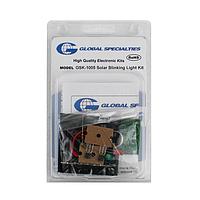
Component Kits
When engineers need to evaluate parts quickly, compare values on the bench, or move from concept to prototype without sourcing every item one by one, a well-selected kit can save meaningful time. Component Kits are especially useful in development, lab testing, RF tuning, power conditioning work, and early-stage product validation where flexibility matters as much as part availability.
Instead of treating kits as simple assortments, many teams use them as practical engineering tools. They help reduce delays during design iteration, support faster troubleshooting, and make it easier to test multiple approaches before committing to a finalized bill of materials.
Where component kits fit in engineering and prototyping
In technical B2B environments, component kits are often used during design verification, proof-of-concept builds, and lab evaluation. They give engineers immediate access to a useful range of parts so they can test electrical behavior, optimize circuit performance, and shorten the gap between simulation and physical implementation.
This is particularly relevant in workflows involving RF design, power conversion, energy harvesting, embedded development, and interface testing. For buyers supporting R&D teams, maintenance groups, or product engineering departments, a kit-based approach can also simplify stock planning for frequently used lab materials.
Common types of component kits in this category
This category covers more than one use case. Some kits are centered on passive and interconnect elements, while others are assembled for a specific design domain such as RF matching, energy harvesting, or circuit conditioning. That makes the category useful for both broad prototyping needs and targeted technical evaluation.
For example, the KYOCERA AVX KIT-ENERGY HARVEST is positioned around energy harvesting design, while several Johanson Technology kits focus on RF ceramic components, capacitors, and inductors for high-frequency development work. There are also prototype-oriented kits and boards from IDEC, along with selected component kit solutions from TE Connectivity and circuit conditioning lab kits from Bourns.
Examples of kits used for specialized design tasks
For RF engineers, part selection often requires testing multiple combinations to reach the desired impedance behavior, bandwidth, or filtering response. In that context, kits such as the Johanson Technology 5500L/C402D, 5500L/C603D, L/C-603DS, and L/C-805DS can support practical bench evaluation for Bluetooth, ISM, WLAN, and broader RF prototyping activities. Rather than sourcing individual values separately, teams can work through options more efficiently during tuning and refinement.
In power electronics and protection-related applications, Bourns options such as the CCAUTO-LAB1 and CC-LAB2 are relevant for circuit conditioning studies. These types of kits can be useful when reviewing overcurrent protection, overvoltage protection, inrush current limiting, rectification, filtering, and step-up or step-down inductor selection in a lab environment.
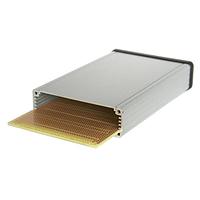
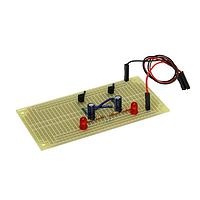
For development teams working on control panels, switching concepts, or board-level trials, IDEC prototype kits such as DEVELOP-COST-HT4P-SLSPL-INF01, DEMO-BTBH-H-SAMPLE, and DGSC-4 illustrate how some kits extend beyond loose components into practical prototyping platforms or sample sets.
How to choose the right component kit
A good starting point is the intended engineering task. If the goal is broad bench inventory, a more general assortment may be suitable. If the project is highly application-specific, such as RF optimization or energy harvesting, a focused kit usually provides better value because the included parts are aligned with the design problem being solved.
It also helps to look at the functional scope of the kit rather than just the number of parts. Some kits are designed to support concept development, while others are aimed at comparative testing, educational lab work, or early prototyping. In many cases, the right choice depends on whether your team needs a reusable lab resource, a one-project design aid, or a fast method for validating a particular circuit approach.
Procurement teams should also consider how the kit will be used after initial evaluation. In some organizations, kits are consumed during repeated engineering cycles, while in others they serve as reference material before transitioning to volume component selection. If your use case is more narrowly focused on passive values, it may also be worth reviewing resistor kits for complementary bench coverage.
Why kits are useful for faster lab iteration
The main advantage of a kit is not only convenience, but faster iteration. Engineers can compare alternatives immediately, identify suitable values sooner, and reduce interruptions caused by waiting for individual line items. This is especially important in prototype labs where schedules are tight and multiple revisions are common.
Kits can also improve communication between engineering and purchasing. Once a preferred component range or circuit approach is identified using a kit, teams can move to more precise sourcing decisions with better confidence. For organizations balancing development speed with purchasing control, this makes kits a practical bridge between experimentation and formal product selection.
Leading manufacturers represented in this category
Several established manufacturers appear in this category, each aligning with different engineering needs. Johanson Technology is relevant for RF-oriented design kits, while Bourns supports circuit conditioning and protection-related lab work. KYOCERA AVX contributes energy harvesting design support, and TE Connectivity appears in component kit applications where structured development and evaluation materials are needed.
There are also starter and project-oriented options from Adafruit, including the 4504 Bluefruit + TFT Gizmo Project Pack, which may be suitable in embedded or educational prototyping contexts. Depending on the project scope, buyers may also compare this category with adjacent assortments such as EMI kits when filtering and interference control are part of the design challenge.
Typical users and buying scenarios
Component kits are commonly purchased by R&D engineers, electronics labs, OEM design teams, university technical departments, and maintenance or repair groups that need immediate access to representative part selections. They are also relevant for contract manufacturers and test teams building fixture prototypes or validating subcircuits before production release.
From a purchasing perspective, these kits are often selected to support new product introduction, engineering change activity, pilot builds, or internal training. Because the category includes both general and application-focused kits, it can serve organizations ranging from small development teams to larger industrial design environments.
Finding a practical kit for your application
The most effective way to browse this category is to match the kit to the design task, not just the product name. RF tuning, circuit conditioning, energy harvesting, embedded experimentation, and prototype evaluation all call for different part mixes and workflows. Looking at the intended function of the kit will usually lead to a better choice than comparing part counts alone.
Whether you are equipping a lab, supporting a new development program, or creating a faster path for engineering evaluation, component kits can be a useful and efficient resource. A focused selection from this category can help your team test ideas sooner, reduce sourcing friction, and move more smoothly from bench work to final component selection.
Get exclusive volume discounts, bulk pricing updates, and new product alerts delivered directly to your inbox.
By subscribing, you agree to our Terms of Service and Privacy Policy.
Direct access to our certified experts