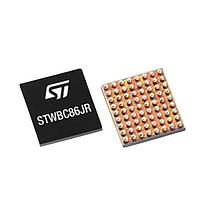
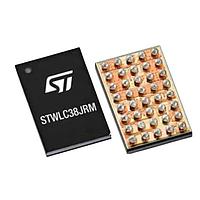
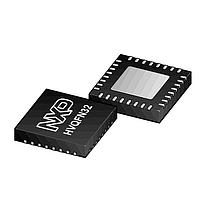
Wireless Charging
As cable-free power transfer moves from convenience features into mainstream product design, engineers need components that support stable charging performance, compact layouts, and reliable interoperability. In embedded systems, consumer electronics, industrial handhelds, and smart devices, the right wireless power architecture can simplify connectors, improve sealing, and reduce mechanical wear over time.
Wireless Charging components in this category are intended for designers building or sourcing wireless power solutions within the broader RF and wireless ecosystem. Rather than treating wireless power as a standalone feature, it helps to evaluate it as part of the full signal and power path, where control, coupling, thermal behavior, PCB constraints, and communication requirements all affect final system performance.
Where wireless charging fits in modern electronic design
Wireless power transfer is commonly selected when products need easier docking, improved user convenience, or fewer exposed electrical contacts. This is especially relevant in portable devices, compact terminals, medical-adjacent equipment, sealed enclosures, and products that benefit from repeated charging cycles without connector fatigue.
From a design perspective, wireless charging is not only about delivering energy across a short air gap. It also involves power management, foreign object considerations, alignment tolerance, thermal control, and often communication between transmitter and receiver sections. That is why developers frequently review wireless charging alongside related building blocks such as RF integrated circuits when planning connected or power-aware wireless devices.
Typical component scope in this category
This category is relevant for projects centered on wireless power transfer hardware, including device-side and system-level components used to implement charging functions. Depending on the application, that may involve controller devices, supporting circuitry, and related elements that help manage power transfer efficiency, charging negotiation, and protection behavior.
For more focused device selection, users may also explore the dedicated area for wireless charging ICs. That subcategory is especially useful when the design task is centered on the semiconductor control layer rather than the broader wireless charging solution stack.
Key design considerations before selecting parts
Choosing components for a wireless charging design usually starts with the target power level, available space, charging distance, and expected user behavior. A compact wearable, for example, may prioritize board area and thermal limits, while a docked industrial handheld may place more emphasis on charging robustness, enclosure thickness, and repeatable alignment.
Engineers should also look at system efficiency across the full power path rather than focusing on a single headline parameter. Coil matching, shielding choices, control strategy, and input power quality can all influence charging speed and heat generation. In many designs, supporting passives such as inductors also play an important role in filtering, matching, and power conditioning around the charging stage.
Applications and integration scenarios
Wireless charging is widely used in devices that benefit from simplified daily charging or environmental protection. Consumer products often adopt it for convenience and cleaner industrial design, while commercial and industrial devices may use it to reduce connector exposure to dust, vibration, or repeated insertion cycles.
Another common use case is in products that combine wireless power with short-range communication or identification functions. In these systems, engineers may need to consider coexistence with nearby wireless technologies, especially where compact form factors place multiple subsystems close together. For that reason, related categories such as NFC/RFID components can be relevant when evaluating integrated user interaction, pairing, authentication, or data exchange around the charging experience.
Leading manufacturers commonly considered for wireless charging projects
Supplier choice matters in wireless power design because documentation quality, reference designs, long-term availability, and ecosystem support can strongly influence development time. Well-known semiconductor manufacturers in this space include Analog Devices, Infineon, Maxim Integrated, NXP, Renesas Electronics, ROHM Semiconductor, Semtech, STMicroelectronics, Texas Instruments, and Toshiba.
Each vendor may be considered for different reasons depending on the project, such as power management integration, interface support, design resources, or compatibility with broader system architectures. For B2B buyers and engineering teams, comparing manufacturers at the platform level is often more useful than comparing parts only by category name, especially when the final product has strict electrical, mechanical, or certification targets.
How to narrow down the right wireless charging solution
A practical selection process usually begins with a few core questions: What is the required charging power? Is the receiver fixed in a known position or placed freely by the user? How much board area is available? What are the thermal constraints of the enclosure? These factors help determine whether a design should prioritize compact integration, control flexibility, or easier implementation.
It is also helpful to review whether the wireless charging stage must coexist with other RF functions nearby, including antennas, identification technologies, or wireless communication circuits. Mechanical structure, shielding materials, and distance between coils can all affect performance, so early coordination between electrical and mechanical teams often reduces redesign cycles later in development.
Supporting procurement and engineering evaluation
For technical sourcing teams, category-level review is often the first step before moving into detailed component comparison. A well-structured wireless charging portfolio helps buyers and engineers quickly identify whether they need a broad system overview, a chipset-focused path, or adjacent RF and wireless components that support complete product development.
When evaluating options, it is worth balancing immediate design needs with long-term supply strategy, documentation depth, and compatibility with the rest of the hardware platform. That approach is especially important in B2B environments, where product lifecycle, maintainability, and qualification effort can matter as much as raw electrical performance.
Wireless charging can deliver clear advantages in usability, durability, and product integration when the underlying components are chosen with the full system in mind. By reviewing power requirements, mechanical constraints, and related RF building blocks together, buyers and engineers can make more confident decisions and move toward a charging design that fits both technical and commercial goals.
Get exclusive volume discounts, bulk pricing updates, and new product alerts delivered directly to your inbox.
By subscribing, you agree to our Terms of Service and Privacy Policy.
Direct access to our certified experts