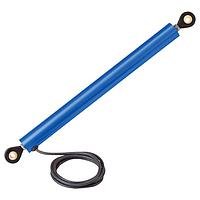
Displacement Transducers
Precise movement feedback is essential in machine building, rotating equipment monitoring, dimensional inspection, and automated production. When a system needs to detect linear travel, shaft position, vibration-related displacement, or fine mechanical variation without relying on visual inspection, Displacement Transducers provide the signal needed for control, monitoring, and quality assurance.
On this page, you can explore displacement sensing solutions used for both industrial measurement and machine condition monitoring. The range includes technologies suited to contact and non-contact measurement, helping engineers match sensor type, output format, environmental protection, and measuring range to the actual application rather than choosing on price or form factor alone.
Where displacement transducers are used
Displacement transducers are selected wherever physical movement must be converted into a reliable electrical signal. Typical use cases include monitoring shaft displacement on rotating machinery, checking axial position, verifying component travel, and measuring dimensional changes in gauging stations. In these environments, stable output and repeatable response are often more important than a long feature list.
They are also widely used alongside broader motion and position sensing solutions in automation systems. Depending on the measurement principle, a transducer may be better suited to high-resolution linear travel, dynamic vibration behavior, or repetitive contact-based gauging tasks in production lines.
Main measurement approaches in this category
This category covers more than one sensing method, which is important because the right technology depends on the target, installation space, and signal requirements. Non-contact displacement measurement is often chosen for rotating shafts and surfaces where mechanical contact is undesirable. Eddy current based devices, for example, can be used for relative shaft displacement or axial position monitoring in machinery that operates continuously or at elevated speed.
Another common approach is LVDT linear position sensing, which is well suited to accurate linear travel measurement. LVDT sensors are valued in applications that need fine repeatability and stable analog output over a defined stroke. For dimensional inspection and close-tolerance measurement, analog gauging probes can also be used where direct contact with the workpiece is acceptable and controlled movement is part of the process.
Representative products in the range
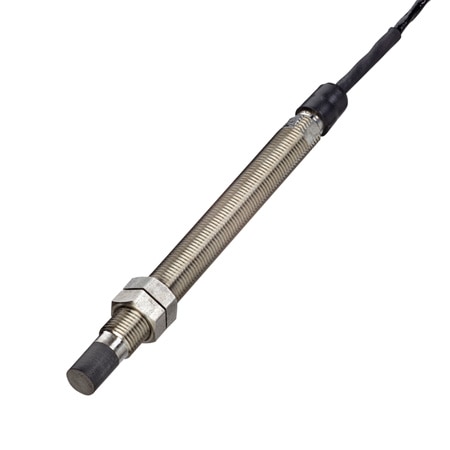
Several OMEGA products in this category illustrate the variety of displacement measurement tasks. The OMEGA IN-081/4/070/50/0 is a non-contacting integrated displacement sensor intended for shaft displacement and shaft vibration related measurement. It is relevant where compact installation and continuous monitoring of machine movement are required.
For transmitter-style devices with process-friendly outputs, the OMEGA DT-121 series provides examples of non-contacting displacement transmitters for axial shaft position and vibration-related applications. In a different measurement style, the OMEGA LD320A-2.5 and LD320A-7.5 show how LVDT linear position sensors can support precise linear travel measurement, while GP911 series analog gauging probes are aimed at repeatable contact measurement over short ranges.
How to choose the right displacement transducer
The first step is defining what kind of displacement you need to measure. A moving shaft, a machine slide, and a precision-machined part do not create the same measurement problem. For rotating equipment, non-contact sensors are often preferred to avoid wear and to support continuous monitoring. For short-stroke linear measurement in fixtures or test rigs, an LVDT or analog probe may be more practical.
Next, check the required measuring range, mounting style, and output signal. Some applications need voltage output for integration with signal conditioning electronics, while others are better served by 4 to 20 mA output for longer cable runs and industrial control systems. Environmental conditions also matter: temperature range, enclosure protection, and cable construction can be just as important as resolution or linearity when the sensor is installed in a demanding plant environment.
If your project spans sensing and actuation together, it may also be useful to review related actuators and positioners to ensure the feedback device matches the mechanical movement being controlled.
Comparing contact and non-contact solutions
Contact probes are often used in gauging, inspection, and controlled linear measurement points where the target is accessible and repeatability is critical. Spring return and pneumatic probe options can support different mechanical setups, depending on how the contact force should be managed. These devices are commonly considered when measuring part dimensions, surface variation, or fixture-controlled displacement in production.
Non-contact transducers, by contrast, are preferred when the target moves at speed, operates in a harsh environment, or should not be touched during measurement. This makes them suitable for shaft monitoring, vibration-related displacement, and installations where minimizing mechanical interaction improves sensor life or measurement stability. If the application is centered specifically on this type of sensing, you can also browse related displacement transducer options across the full category.
Why signal quality and installation details matter
Even a capable transducer can perform poorly if the installation is not aligned with the measurement objective. Mounting geometry, cable routing, target material, stroke alignment, and electrical grounding all influence signal behavior. In practice, many measurement issues that appear to be “sensor problems” are actually caused by mechanical misalignment, unsuitable mounting hardware, or output mismatch with the receiving instrument.
For that reason, engineers typically evaluate the complete measurement chain: sensor, mounting method, cable, power supply, and controller or monitoring system. When displacement feedback is used in conjunction with drives or machine motion, related equipment such as AC and DC motors may also affect the broader control architecture and sensor selection criteria.
OMEGA displacement transducers for industrial applications
OMEGA is the key manufacturer represented in this category, with solutions covering non-contact shaft monitoring, LVDT-based linear sensing, and analog gauging probes. This makes the range relevant to both machine condition monitoring and dimensional measurement tasks, rather than serving only one narrow use case.
Examples in the current selection include transmitter-style models for axial shaft position, integrated sensors for relative vibration or displacement monitoring, and compact probes designed for fine repeatability over short measurement ranges. That variety helps buyers compare sensing principles based on application logic instead of trying to force one technology to fit every installation.
Finding a practical fit for your application
The best choice usually comes from a few clear questions: what is moving, how far does it move, does the sensor touch the target, and what output does the control or monitoring system expect? Once those points are clear, it becomes much easier to narrow the range between non-contact sensors, LVDTs, and analog gauging probes.
This category is designed to support that selection process with displacement transducers for industrial measurement, machine monitoring, and precision positioning tasks. If you are comparing options for shaft displacement, linear travel, or high-repeatability gauging, reviewing the sensing method and installation requirements first will lead to a more reliable long-term result.
Get exclusive volume discounts, bulk pricing updates, and new product alerts delivered directly to your inbox.
By subscribing, you agree to our Terms of Service and Privacy Policy.
Direct access to our certified experts