Relay Sockets & Hardware
Reliable relay installations depend on more than the relay itself. In control panels, protection systems, and maintenance-heavy equipment, the supporting interface around the relay often determines how easy the assembly is to wire, replace, identify, and secure over time. That is where Relay Sockets & Hardware become especially important for both new designs and field service work.
This category brings together the practical components used to mount, connect, adapt, and support relay-based systems. Depending on the application, that may include relay sockets, mounting hardware, clips, adapter plates, grounding or input modules, and related accessories used to complete a functional installation with better serviceability and safer handling.
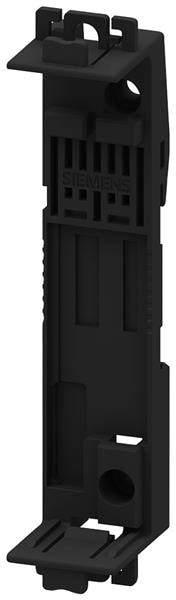
Why relay sockets and mounting hardware matter
In many industrial and equipment-level applications, the relay is a replaceable element, while the wiring and mechanical interface remain in place. A properly selected socket helps simplify installation, reduce wiring errors, and shorten replacement time during maintenance. Hardware such as hold-down clips, ID clips, and mounting frames can also improve mechanical stability and identification inside dense panels.
These parts are especially valuable where uptime matters. Instead of treating accessories as secondary items, engineers often use them as part of the overall relay architecture, particularly when vibration, limited panel space, repeated servicing, or standardized wiring practices are involved.
What you can typically find in this category
This range includes products that support relay integration in different ways. Some items act as the electrical interface between the relay and the system wiring, while others are intended for mounting, labeling, adaptation, or signal conditioning around a relay-based protection scheme.
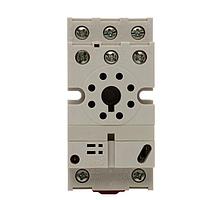
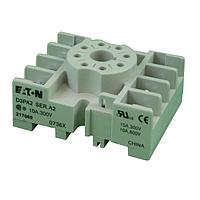
- Relay sockets for mounting and terminating relay connections
- Mechanical retention parts such as hold-down clips and spring clips
- ID and marking accessories for easier maintenance and panel identification
- Mounting frames and adapter plates for installation compatibility
- Support modules used in protection or monitoring systems
- Associated cabling and connection hardware for system integration
If your project is centered on complete electromechanical relay assemblies rather than accessories, it may also be useful to review industrial relay solutions and accessories for a broader view of relay-based control components.
Representative product types in this range
Several products in this category illustrate how varied relay support hardware can be. For example, the Amphenol RSE116693 low-profile relay socket is designed for use with specific relay families and shows how socket selection is tied closely to relay format, pole arrangement, and mounting constraints. Products such as the Amphenol RSL116141 further reflect the role of dedicated interfaces in relay integration.
Other parts are clearly focused on installation support. Eaton PQC-1332 is a hold-down clip intended to secure compatible sockets, while Eaton PMC-1783 is an ID marking clip that helps with panel organization and maintenance traceability. In protection-oriented systems, components such as Littelfuse AC6000-MNT-00, PGK-0006, SE-GRM400, MPU-CIM-00-00, and SE-VS50010K show that this category can extend beyond basic sockets into supporting modules and mounting elements for more specialized relay ecosystems.
How to choose the right relay socket or accessory
The first step is to confirm compatibility. Relay sockets and related hardware are often designed around specific relay series, footprints, pole counts, or associated protection platforms. Even if two parts appear mechanically similar, the correct choice depends on the relay family and the intended mounting and termination method.
Next, consider the installation environment. Panel-mounted assemblies may benefit from retention hardware, labeling clips, and mounting frames that improve accessibility and reduce service time. Where system wiring is fixed and replacement speed matters, socket-based installation can be more practical than direct soldering or hardwired relay replacement.
It is also worth checking whether the application needs only a socket or a more complete support set that includes clips, adapter plates, interface cables, or modules. In some protection and monitoring systems, accessories are not optional add-ons; they are part of the intended architecture and help the relay or monitoring element function correctly within the larger circuit.
Common application contexts
Relay Sockets & Hardware are commonly used in industrial control cabinets, machine panels, motor protection systems, and equipment that requires organized, serviceable relay replacement. They are also relevant where relays must be mechanically secured or clearly identified during commissioning and maintenance.
In more specialized systems, related hardware may support ground reference arrangements, sensing resistor systems, or motor protection unit interfaces. That is why this category is useful not only for straightforward relay mounting, but also for engineers building structured protection assemblies around dedicated relay or monitoring platforms.
Where the application instead involves compact signal switching on a board, users may also compare options in low signal PCB relays depending on switching level, form factor, and service approach.
Manufacturers commonly specified for this category
Among the brands represented here, Amphenol, Eaton, and Littelfuse are especially relevant based on the products shown in this range. Each appears in different roles: Amphenol with relay socket solutions, Eaton with socket accessories and mating hardware, and Littelfuse with mounting and module-based support elements used in protection-oriented applications.
Brand choice should usually follow system compatibility and application need rather than name alone. For buyers managing approved vendor lists or replacing installed parts, matching the relay family, accessory type, and mounting concept is generally more important than broad brand comparison.
Selection tips for maintenance, retrofit, and new builds
For maintenance teams, the priority is often rapid replacement and clear identification. Accessories like marking clips or retention clips can make a meaningful difference in service workflows, especially in crowded control panels or repeat installations. For retrofit work, adapter plates and mounting hardware can help bridge mechanical differences between legacy layouts and current components.
In new designs, it helps to think ahead about long-term accessibility. Choosing the right socket and associated hardware early can simplify commissioning, reduce wiring disruption during replacement, and create a cleaner relay interface for future troubleshooting. If the project involves other relay formats, related categories such as high frequency and RF relays may be relevant for signal-specific applications.
Final considerations
Choosing the right relay support components is ultimately about building a relay system that is easier to install, easier to maintain, and better aligned with the application. From basic sockets to retention clips, adapter hardware, and specialized support modules, these parts help turn a relay from a standalone component into a workable field-ready assembly.
If you are comparing options in this category, start with relay compatibility, mounting method, service requirements, and any associated protection-system needs. That approach usually leads to a more reliable fit than focusing on part type alone.
Get exclusive volume discounts, bulk pricing updates, and new product alerts delivered directly to your inbox.
By subscribing, you agree to our Terms of Service and Privacy Policy.
Direct access to our certified experts