Power controller
Stable heater output, smoother process response, and lower stress on electrical loads all depend on how power is delivered to the application. In many industrial systems, that job falls to the power controller: a device used to regulate electrical energy sent to heaters or other resistive loads with better precision than simple on/off switching.
On this page, you can explore power control solutions used in industrial automation, process heating, and control panels where reliable output adjustment matters. The category is especially relevant for engineers and buyers selecting equipment for temperature-driven processes, electrical resistance heating, or systems that need controlled startup behavior and analog input integration.
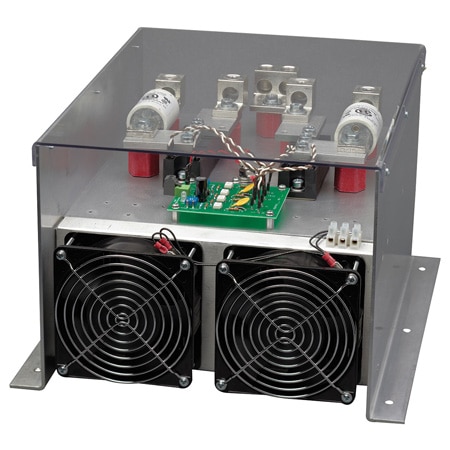
Where power controllers are commonly used
Power controllers are often chosen for applications where direct control of electrical load is part of process performance. Typical examples include ovens, furnaces, dryers, heat treatment equipment, plastic processing lines, and other systems built around electric heating elements. In these environments, controlling power smoothly can help reduce temperature overshoot and improve repeatability.
They are also useful where the upstream control system sends an analog command, such as a 4 to 20 mA signal, and the load needs proportional output rather than basic relay switching. In broader automation architectures, users may combine these devices with PID controllers when a process requires closed-loop temperature regulation and more refined power delivery.
How a power controller fits into an automation system
A power controller typically sits between the control signal and the electrical load. Its role is to modulate the energy delivered to the load according to the command signal and the switching method used. Depending on the design, this may support gentler startup, reduced thermal shock, and better matching between process demand and actual electrical output.
In a practical control panel, it may work alongside sensors, temperature logic, programmable control hardware, and protective devices. For applications that require sequence control, machine coordination, or communication with multiple I/O points, many users also evaluate related programmable controllers as part of the same system design.
Key selection points before choosing a model
The right choice starts with the electrical load. Buyers usually check phase configuration, supply voltage, load type, and required current output first. For heater applications, these parameters are critical because the controller must match both the electrical characteristics of the installation and the expected operating pattern of the process.
It is also important to review the switching method. Some applications benefit from zero-cross control, which is commonly used when simpler proportional switching is suitable and electrical noise reduction is a concern. Others need phase-angle firing, which can provide finer power adjustment and may be useful where tighter output modulation or softer startup behavior is required.
Additional considerations include cooling requirements, isolation, control signal type, startup profile, and available diagnostics. Features such as fault indication for open or shorted SCR conditions can be helpful in maintenance-heavy environments where downtime needs to be reduced through faster troubleshooting.
Examples from OMEGA and OMRON
This category includes representative products from established industrial suppliers such as OMEGA and OMRON. Within the available examples, OMEGA units illustrate several common selection paths, including 3-phase designs, different voltage ratings, and a range of current outputs for resistive loads.
For instance, models such as the OMEGA SCR39Z-H-48-125 and SCR39Z-H-48-250 reflect zero-cross control options for 3-phase heater applications, while products like the OMEGA SCR39P-H-48-125, SCR39P-H-48-200-S9, and SCR39P-H-48-125-V show phase-angle variants with different startup approaches. These examples are useful when comparing whether your process needs straightforward switching, soft start behavior, or a voltage-limiting profile.
On the automation side, OMRON C500-AP003 and OMRON C500-AD001 remote power controller products represent another use case: integrating power-related control functions into a broader industrial control environment. When reviewing these items, the main goal is not just to compare model names, but to understand how each device fits into panel architecture, signal handling, and the expected operating load.
Zero-cross vs phase-angle control
One of the most common buying questions in this category is the difference between zero-cross and phase-angle operation. Zero-cross control switches at the AC waveform crossing point, which is often preferred for resistive heating where stable cycling is acceptable and reduced electrical disturbance is desirable. It is a practical approach for many heater banks and general thermal processes.
Phase-angle firing, by contrast, adjusts the delivered power within the AC waveform. This method is often selected when the process needs faster response, finer adjustment, or controlled ramp-up behavior. In some heater systems, it can improve startup management and help reduce stress associated with abrupt full-power application, although the final choice always depends on the load and the overall installation design.
What to check for panel integration and operation
Beyond electrical ratings, successful implementation depends on installation details. Fan-cooled designs, control voltage requirements, ambient temperature limits, and panel ventilation all affect long-term reliability. Even when the process requirement looks straightforward, these practical factors can influence whether a controller performs consistently under real operating conditions.
Buyers should also confirm how the controller will receive commands and how status information will be monitored. Analog input compatibility, fault indication, and the way the device interacts with upstream logic all matter during commissioning. If your application also manages related process variables, nearby categories such as level controllers may be relevant in systems where power control is only one part of a wider process loop.
Choosing the right category for your application
Not every control task requires a dedicated power controller. If the main requirement is direct power modulation to heaters or resistive loads, this category is the right place to start. If the focus is process logic, sequencing, or algorithm-based temperature control, adjacent controller categories may be a better fit depending on the architecture of the machine or plant.
That is why evaluating the load, control signal, switching behavior, and panel environment together is more useful than comparing products on name alone. A well-matched controller can support better process stability, more predictable startup, and easier integration with the rest of the automation system.
Final considerations
Power controller selection is ultimately about matching the device to the behavior of the load and the control strategy of the application. Whether you are comparing 3-phase SCR solutions for electrical resistance heaters or reviewing remote power control options for an industrial control platform, the most important factors are electrical compatibility, switching mode, and installation context.
Use this category to narrow down suitable options, compare available product families, and identify models that align with your process requirements. For industrial heating and automation projects, taking a structured approach at the category level usually leads to faster product selection and fewer integration issues later on.
Get exclusive volume discounts, bulk pricing updates, and new product alerts delivered directly to your inbox.
By subscribing, you agree to our Terms of Service and Privacy Policy.
Direct access to our certified experts