Sewage pump
Handling wastewater, drainage water, and solids-laden liquid requires more than a general-purpose pump. In maintenance, construction support, facility drainage, and utility applications, the right pump must move water reliably while tolerating suspended particles, variable flow conditions, and demanding installation environments. This is where sewage pump selection becomes important.
On this category page, buyers can compare practical pump options for transferring dirty water or cleaner drainage water, with a focus on flow rate, head, solids handling, housing material, and installation conditions. The range includes models suited to sump emptying, flooded area drainage, dirty water removal, and general transfer tasks where submersible operation is preferred.
Where sewage pumps are typically used
In B2B settings, sewage and dirty water pumps are commonly used for dewatering pits, draining tanks, removing water from basements or shafts, and managing wastewater that may contain debris or suspended solids. A submersible design is often chosen because the pump can operate directly in the liquid, reducing priming issues and simplifying temporary or mobile deployment.
Application conditions vary widely. Some jobs involve relatively clean water with light contamination, while others require the pump to pass larger particles without clogging. For that reason, it is useful to distinguish between pumps intended for clear water transfer and those built for dirty water handling, especially when solids size and operating depth can affect long-term reliability.
Clear water vs. dirty water pump selection
Not every drainage task requires the same pump hydraulics. Clear water models are generally suitable for water with limited suspended matter, such as seepage water, rainwater collection, or relatively clean sump drainage. Dirty water models are better aligned with applications where sludge, debris, or larger particles may be present.
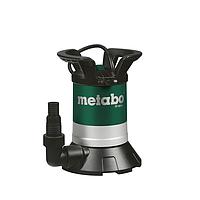
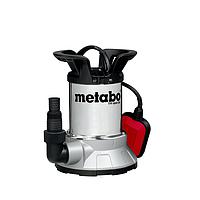
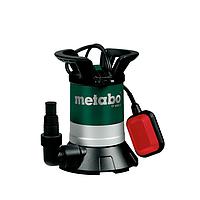
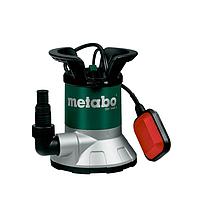
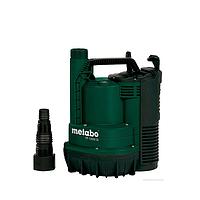
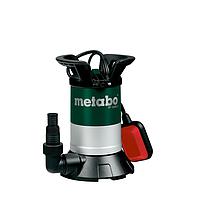
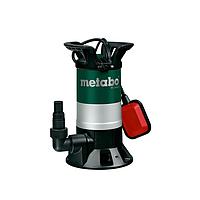
Within this category context, examples such as the METABO TP 13000 S, TP 12000 SI, or TP 8000 S illustrate clear-water submersible solutions for transfer duties where finer particle handling is acceptable. By contrast, models such as the METABO PS 15000 S and PS 18000 SN are more appropriate when the liquid contains larger solids, making them a better fit for tougher drainage and wastewater-related jobs.
If the project involves site drainage, excavation water, or temporary dewatering in harsher field conditions, it can also be useful to review construction pump solutions for a broader comparison of application-specific equipment.
Key specifications that matter in real operation
When evaluating a sewage pump, the first parameters most buyers review are flow rate and delivery head. Flow rate indicates how much liquid the pump can move over time, while delivery head reflects how high the pump can lift the water. A high nominal flow is helpful, but if the discharge path includes vertical lift, hose length, or friction losses, head becomes equally critical.
Another essential factor is maximum particle size. In the listed range, some models are intended for relatively clean water and handle only small particles, while dirty water models can accept much larger solids. This is often one of the most practical selection criteria because it directly affects clogging risk and maintenance frequency.
Ingress protection and immersion depth also matter in submersible service. Ratings such as IP X8 or IP 68 indicate that the pump is designed for submerged operation, but installation depth, cable length, and duty cycle still need to match the actual site conditions. Discharge connection type and thread size should also be checked early to avoid unnecessary adapter changes during installation.
Representative METABO pump options in this range
METABO is the main featured manufacturer in this category and offers several submersible pumps that cover both cleaner drainage and dirty water transfer tasks. The available models span compact units for moderate flow needs up to higher-capacity pumps intended for faster emptying of tanks, pits, or flooded areas.
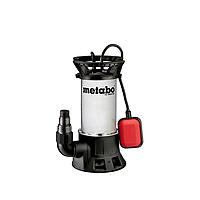
For heavier dirty water service, the METABO PS 18000 SN stands out with a high delivery rate and a larger permissible particle size, making it suitable for more challenging drainage work. The METABO PS 15000 S provides a similar application profile at a slightly lower performance level. On the clear water side, options such as the TP 13000 S, TP 7500 SI, and TP 6600 support a range of transfer requirements from lighter-duty pumping to higher-volume drainage where solids content is limited.
Housing material can also influence selection. Stainless steel construction, as seen on some models, may be preferred when buyers want added mechanical robustness or a different durability profile compared with plastic housings. The best choice depends on handling conditions, transport frequency, and the nature of the pumped liquid.
How to choose the right pump for your application
A practical starting point is to define the liquid itself: is it clean water, lightly contaminated water, or wastewater carrying larger debris? Once that is clear, the next step is to estimate the required throughput and vertical lift. This quickly narrows the field between lower-power portable pumps and higher-capacity units designed to move more liquid in less time.
It is also worth considering whether the pump will be used as a temporary mobile unit or part of a more structured installation. For installations that require switching logic, monitoring, or automated operation, a matching pump control panel may be relevant depending on the system design.
Buyers should also check practical details such as float switch inclusion, cable length, discharge connection, and the acceptable immersion depth. These features may appear secondary at first, but they often determine how quickly a pump can be deployed and how well it fits the intended working environment.
When a sewage pump is not the only option
Although this category focuses on wastewater and drainage-oriented pumping, some projects involve more specialized media or operating requirements. For example, corrosive fluids or process liquids may call for a chemical process pump rather than a general dirty water submersible unit.
Likewise, if the requirement is tied to fire protection systems, pressure boosting, or gas handling, a different pump category will be more appropriate. Choosing based on the actual fluid, solids content, control requirements, and operating environment helps avoid overspecification on one side and premature failure on the other.
What buyers often compare on a category page
For procurement teams, maintenance departments, and project engineers, comparison usually comes down to a few operational questions: how much water needs to be moved, how dirty is the liquid, how high does it need to be pumped, and how rugged does the housing need to be? In many cases, these criteria are more important than simply choosing the highest motor power.
This category supports that comparison process by bringing together submersible pump options across multiple flow and solids-handling levels. Whether the need is fast drainage of dirty water or dependable transfer of clearer water from tanks, pits, or flooded spaces, the available range provides a practical basis for shortlisting suitable models.
Final considerations before ordering
The most effective pump choice is usually the one that matches the real operating conditions rather than the broadest specification on paper. For sewage and drainage duties, that means paying close attention to solids size, required head, expected runtime, and the physical setup on site.
By reviewing the METABO options in this category and comparing them against your liquid type and installation requirements, it becomes easier to identify a pump that fits both performance needs and maintenance expectations. If your application extends into site dewatering, process liquids, or automated pump systems, the related categories linked above can help refine the selection further.
Get exclusive volume discounts, bulk pricing updates, and new product alerts delivered directly to your inbox.
By subscribing, you agree to our Terms of Service and Privacy Policy.
Direct access to our certified experts