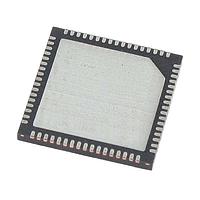
RF Receiver
Reliable wireless communication starts with the ability to capture weak signals accurately, reject interference, and hand clean data to the next stage of the system. In many embedded and RF designs, that role falls to the RF Receiver, a core building block used in remote controls, industrial telemetry, smart sensing, access systems, and short-range wireless links.
On this category page, buyers and engineers can explore RF receiver ICs for applications where signal sensitivity, selectivity, power consumption, and integration level all matter. Whether the priority is a compact consumer device or a more robust industrial design, the right receiver choice depends on how the full RF chain is expected to perform in real operating conditions.
Where RF receivers fit in a wireless design
An RF receiver is responsible for taking an incoming radio signal from the antenna path and processing it so the system can detect, recover, or interpret the transmitted information. Depending on the architecture, the receiver may include low-noise amplification, filtering, frequency conversion, channel selection, signal detection, and output stages that interface with digital control logic or downstream processing blocks.
In practical system design, the receiver is rarely selected in isolation. It must work alongside oscillators, matching networks, filters, and often supporting timing or frequency-management devices. For designs that also require frequency synthesis and local oscillator control, related components such as PLL devices may be part of the broader signal chain.
Common applications across industrial and embedded systems
RF receivers are used in a wide range of wireless products where stable signal acquisition is more important than headline transmit power. Typical examples include keyless entry systems, building automation nodes, wireless alarms, metering infrastructure, handheld controls, and low-data-rate telemetry links in industrial environments.
They are also relevant in designs that combine sensing, identification, and short-range communication. In some applications, receivers operate as part of a larger contactless ecosystem that may also involve NFC and RFID tag solutions, especially where detection, authentication, or data capture must coexist with compact hardware constraints.
Key selection criteria when comparing RF receiver ICs
The most suitable device is usually defined by the application environment rather than by a single specification. Engineers often start by looking at sensitivity, because weak-signal performance directly affects operating range and communication reliability. Just as important is selectivity, which helps the receiver reject nearby unwanted signals and maintain stable operation in electrically noisy environments.
Power consumption is another critical factor, particularly in battery-powered nodes and always-on listening applications. Designers also pay close attention to interface type, integration level, package constraints, and how much external circuitry is required. A highly integrated receiver can simplify layout and reduce bill-of-material complexity, while a more specialized part may offer better control over the RF front end.
Frequency stability and timing support should also be considered early. In architectures where frequency division or clock conditioning is relevant, related building blocks such as prescaler components may be useful in the surrounding design ecosystem.
Architectural considerations that affect performance
Not all RF receivers are built with the same internal approach. Some designs prioritize simplicity and low power for narrow, application-specific links, while others are intended for more flexible communication schemes. The expected modulation method, bandwidth, and channel conditions will influence how suitable a receiver is for a given system.
Interference handling is especially important in dense RF environments. Designers may need to think beyond the receiver alone and consider how modulation, demodulation, and frequency management are handled across the complete signal path. For projects that require companion signal-processing stages, browsing modulator and demodulator ICs can help clarify the broader implementation strategy.
Manufacturers commonly used in this category
This category may include devices from established semiconductor suppliers such as Analog Devices, Broadcom, Infineon, Maxim Integrated, Microchip, Murata, Nordic Semiconductor, and NXP. These manufacturers are widely recognized in wireless and embedded electronics, with portfolios that often support different design priorities such as low power, compact integration, signal robustness, or application-specific RF implementation.
Manufacturer selection typically depends on factors such as long-term availability, ecosystem support, familiarity with development tools, and compatibility with existing platform standards. For engineering teams managing product lifecycles over multiple revisions, vendor continuity can be just as important as the electrical characteristics of the receiver itself.
How to narrow down the right RF receiver for your project
A practical starting point is to define the operating environment clearly: expected range, antenna constraints, presence of interference, power budget, and required data behavior. From there, compare devices based on system-level fit rather than isolated headline figures. A part that looks strong on paper may still require extra filtering, matching, or control circuitry that changes the overall design tradeoff.
It is also helpful to check whether the receiver is intended for fixed-function wireless links or for a more configurable architecture. In many B2B and industrial projects, procurement teams and design engineers need parts that are not only technically suitable but also easier to source, qualify, and maintain through the product lifecycle. Reviewing manufacturer families and adjacent RF categories can make that evaluation more efficient.
Choosing with the full RF chain in mind
Good receiver performance depends on more than the IC alone. Antenna design, PCB layout, shielding, grounding, filtering, and frequency control all influence the final result. Even a capable receiver can underperform if the surrounding RF path introduces loss, noise, or instability.
For that reason, this category is most useful when treated as part of a complete wireless design workflow. By comparing RF receivers in the context of application demands, integration strategy, and related RF building blocks, buyers can make more informed decisions and move toward a design that is easier to validate in real-world operation.
If your project depends on dependable signal reception, this category provides a focused starting point for evaluating components that support stable wireless performance across embedded, industrial, and electronic product designs.
Get exclusive volume discounts, bulk pricing updates, and new product alerts delivered directly to your inbox.
By subscribing, you agree to our Terms of Service and Privacy Policy.
Direct access to our certified experts