Modular Flexible Manufacturing System Training
Hands-on learning is essential when students or technical teams need to understand how automated production lines actually work. In labs focused on industrial automation, mechatronics, and smart manufacturing, Modular Flexible Manufacturing System Training helps bridge the gap between theory and real process behavior by combining control, sensing, material handling, inspection, and assembly in one training environment.
These systems are designed for education, technical practice, and applied research where users need to work with realistic manufacturing workflows on a manageable scale. Rather than studying PLC logic, pneumatics, robotics, or process coordination in isolation, trainees can see how each subsystem interacts across a complete production sequence.
Why modular manufacturing training systems matter
A modular platform makes it easier to teach the structure of a modern production line step by step. Individual stations such as distribution, testing, handling, pressing, sorting, storage, or processing can be observed separately, then integrated into a wider control architecture. This approach is especially useful for institutions that want to teach automation logic, fault tracing, and line coordination in a practical format.
Compared with purely theoretical training rigs, flexible manufacturing training systems provide a more realistic view of industrial sequencing. Learners can work with sensors, actuators, PLC-based control, HMI or PC-level monitoring, safety functions, and communication between stations. For schools and training centers that also cover broader application training, this category fits naturally into advanced automation and production education.
Typical system structure in this category
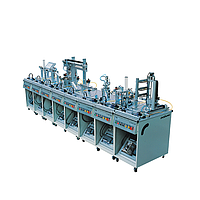
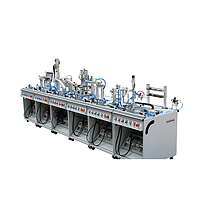
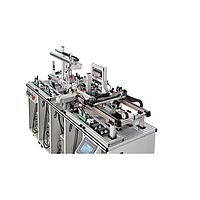
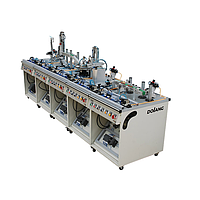
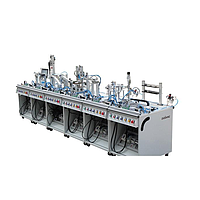
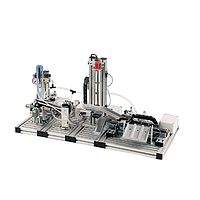
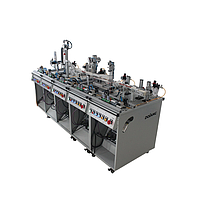
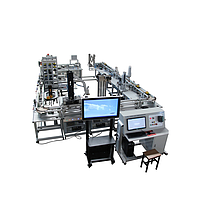
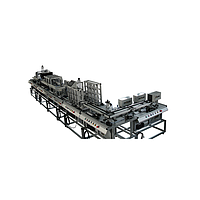
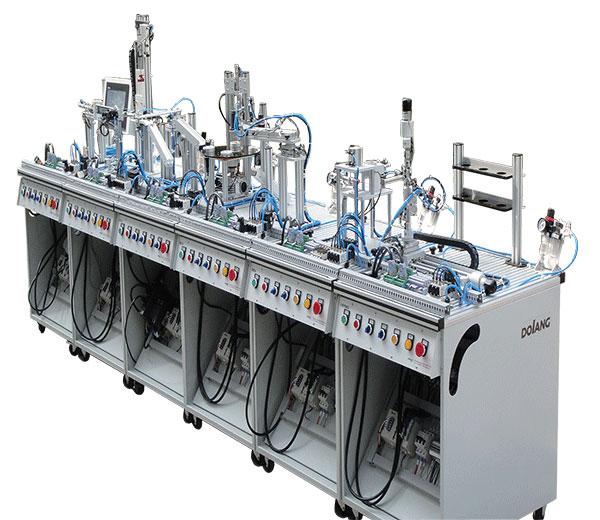
Most solutions in this category are built around a station-based layout. Each module performs a defined task, such as feeding a part, checking a condition, moving a workpiece, pressing or processing it, and finally sorting or storing the result. This modular architecture supports progressive learning, from basic station control to coordinated line operation.
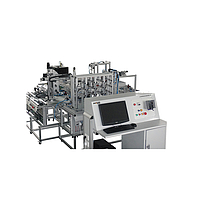
Several listed systems illustrate this well. The DOLANG DLMPS-205 Modular Flexible Production System includes distribution, testing, handling, pressing, and sorting units, making it suitable for demonstrating a compact but complete production flow. The DOLANG DLMPS-400A Mini Mechatronics System uses distribution, testing, handling, and sorting stations with PLC-centered control and PC-based monitoring, which is helpful for introductory mechatronics and control integration exercises.
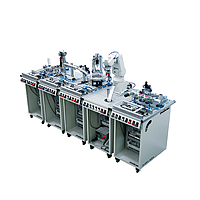
At a more advanced level, the DOLANG DLMPS-500A and DLMPS-500C systems expand the training scope with five-station configurations that include processing, robot handling, and sorting or storage functions. This creates a stronger foundation for teaching coordinated motion, station interlocking, and manufacturing sequence management.
Key training topics supported by these platforms
One of the main strengths of this category is its ability to support multiple disciplines within the same equipment set. Instructors can use one platform to teach PLC programming, industrial sensors, pneumatic actuation, sequence control, alarm handling, and operational safety. Systems such as the DOLANG DLDS-S361A Instrumentation and Intelligent Sensing Technology Application System are also relevant where training needs extend toward instrumentation, intelligent sensing, and distributed control concepts.
These platforms are also useful for demonstrating how data moves through a manufacturing process. Learners can practice input and output mapping, timing logic, process verification, and fault diagnosis under realistic operating conditions. In programs that combine mechanical and digital skills, they complement areas such as information technology training by showing how software and control logic connect directly to physical equipment.
Examples from the DOLANG training range
DOLANG is the main manufacturer represented in this category, with several systems aimed at different training levels and space requirements. Compact models such as the DLMPS-400A are suitable for introducing core mechatronics concepts, while mid-range modular systems like the DLMPS-500B, DLMPS-500C, and DLMPS-600A provide broader station coverage and more complex process flow.
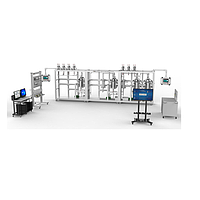
For users focused on larger-scale production training, the DLFMS-1700B Modern Industrial Production Assembly Training System and the DLFMS-8000 Flexible Manufacturing System extend the scope toward assembly and flexible manufacturing line behavior. The DLWL-800A Modular Modern Logistics Manufacture Process System is also relevant where the curriculum needs to include logistics flow and production coordination, not only isolated automation tasks.
Across these examples, the training value comes less from a single component and more from the way each system combines control, transport, detection, and process execution. That makes the category relevant to vocational schools, universities, training labs, and industrial learning centers building practical curricula around smart production.
How to choose the right training configuration
The best choice depends on the learning objective, not simply on system size. If the goal is to teach basic PLC programming and sensor-actuator interaction, a smaller station set may be enough. If the program needs to demonstrate multi-station coordination, robotic handling, storage logic, or PC-based supervision, a larger flexible production platform will be more appropriate.
It is also important to consider available utilities and lab conditions. The listed systems show different power requirements, footprint sizes, optional accessories such as computers or PLC modules, and in some cases compressed air needs. These practical factors matter in educational environments where installation space, maintenance planning, and student access must be balanced carefully.
Another useful selection criterion is curriculum depth. Entry-level teaching may focus on I/O behavior, sequence diagrams, and basic commissioning, while advanced programs may need interfaces for secondary development, external control integration, or a closer link to robotics and distributed control. For institutions covering a wider engineering pathway, related areas such as civil engineering training or other technical disciplines may sit alongside this category, but modular manufacturing platforms remain especially valuable where automation and industrial process education are central.
Who uses modular flexible manufacturing training systems
This category is well suited to vocational colleges, engineering universities, industrial training departments, and research-oriented teaching labs. It supports classroom demonstration, guided lab practice, project-based learning, and skills assessment. Because the systems model real manufacturing logic in a controlled environment, they are useful for both beginners and more advanced learners.
They can also support trainer development and interdisciplinary teaching. Mechanical, electrical, instrumentation, and control students can work on the same platform from different perspectives, which reflects the way industrial projects are delivered in practice. That makes these systems a strong fit for institutions looking to improve practical readiness rather than relying only on simulation or theory.
Building stronger automation training outcomes
Choosing from this category means investing in a training setup that reflects how modern production systems are structured: modular, interconnected, and increasingly data-driven. Whether the focus is mechatronics fundamentals, flexible manufacturing workflow, instrumentation, or logistics-oriented process training, these platforms help users understand how separate technologies function as one coordinated system.
If you are comparing available options, it helps to start with the target learning outcomes, required station functions, control depth, and installation constraints. A well-matched modular training system can support long-term teaching value by giving learners repeated exposure to realistic automation tasks, troubleshooting scenarios, and integrated manufacturing logic.
Get exclusive volume discounts, bulk pricing updates, and new product alerts delivered directly to your inbox.
By subscribing, you agree to our Terms of Service and Privacy Policy.
Direct access to our certified experts