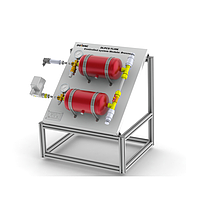
Process Control Training
Hands-on process control training is essential when students, technicians, and industrial maintenance teams need more than theory. In laboratory and technical education environments, the ability to work with real signals, feedback loops, sensors, and controller responses helps bridge the gap between classroom learning and practical automation tasks.
Process Control Training systems are used to simulate and study common industrial variables such as level, flow, pressure, and temperature. They support structured learning around instrumentation, PLC interaction, closed-loop control, calibration, and tuning, making them relevant for vocational schools, engineering labs, industrial training centers, and research-oriented teaching setups.
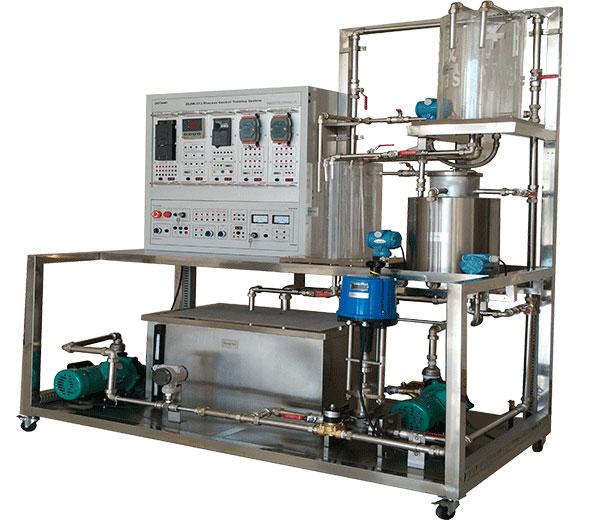
What this category is designed to support
This category focuses on training platforms that help learners understand how a process behaves, how measurements are acquired, and how control actions influence system stability and performance. Rather than presenting automation only at the software level, these systems make it possible to observe real process dynamics such as response delay, overshoot, disturbance rejection, and setpoint tracking.
Typical teaching goals include understanding PID control, interpreting analog and digital I/O, working with transmitters and actuators, and practicing integration between field devices and PLC-based control. In many training programs, this type of equipment is also used to introduce concepts such as cascade control, ratio control, sensor calibration, and communication between process instruments and supervisory systems.
Key process variables covered in training setups
One of the strengths of this product group is its coverage of the core variables found across industrial plants. Level control trainers are used to study tank filling, discharge behavior, and multi-tank dynamics. Flow training systems help learners examine valve behavior, pump response, and the relationship between measurement and control output.
Pressure and temperature trainers add another layer of realism, especially for users learning how process conditions change over time and how loop tuning affects final performance. More advanced platforms combine several variables in one station, allowing learners to compare single-loop and multi-loop control strategies in a more realistic environment.
Examples in this category include the DOLANG DLGK-YL101 Pressure Process Control Trainer, DOLANG DLPCS-LL02 Flow Control Training System, and DOLANG DLPCS-YW101 Level Process Control Training Equipment. These systems are useful when the training objective is to isolate one variable at a time before moving to broader integrated process exercises.
From basic loop studies to advanced integrated experiments
Training needs can vary significantly depending on the user group. For introductory courses, a compact trainer focused on one variable may be enough to explain sensor input, controller logic, and output regulation. This is often suitable for foundational lab work in instrumentation and automation programs.
For more advanced learning, integrated systems provide a wider range of experiments. The DOLANG DLGK-373 Process Control Training System, for example, is representative of a broader educational setup where learners can explore hardware composition, object characteristic testing, single-loop control, and more complex control structures. Similarly, the DOLANG DLGK-JD3 Advanced Process Control Trainer is aligned with training scenarios that include communication-oriented process applications and more advanced experimentation around process behavior.
Where the goal is to study a complete water supply or utility-style application, the DOLANG DLLY-HYGS462 Constant Pressure Water Supply Training System can support practical understanding of regulation under changing demand conditions. This makes the category relevant not only for classroom instruction, but also for technical retraining and application-focused industrial education.
How to choose the right process control trainer
The right platform depends on the learning outcome, not simply on system size. If the aim is to teach fundamentals of measurement and feedback control, a single-variable unit for pressure, flow, level, or temperature may be the most efficient choice. It keeps the training sequence focused and helps learners understand cause and effect more clearly.
If the course requires broader PLC interaction, analog signal handling, or comparative experiments across multiple control methods, a larger process station may be more appropriate. Buyers should also consider practical factors such as available lab space, power supply conditions, I/O requirements, and whether the program includes HMI, communication modules, or PC-based configuration software.
For institutions building a wider automation curriculum, it can also be useful to align these systems with related training areas such as application training equipment or information technology training where software, networking, and control logic may complement process-oriented practice.
DOLANG solutions in this category
DOLANG is the featured manufacturer in this category, with a range of educational systems built around industrial control principles. The lineup includes compact trainers for specific variables as well as broader platforms intended for complete process control experiments. This allows training centers to select equipment according to curriculum depth, student level, and available laboratory infrastructure.
Representative models include the DOLANG DLGK-53B Plane Type Process Control Trainer for process study in a structured training format, the DOLANG DLPLC-YLJC2 Temperature and Pressure Test Training System for combined variable instruction, and the DOLANG DLPLC-MP Mixing Process Training System for learners who need exposure to process sequencing and coordinated control actions. Across these examples, the educational value comes from seeing how measurement, actuation, and control logic work together in a real training environment.
Common use cases in education and industrial training
These systems are often selected by technical colleges, vocational institutions, university laboratories, and industrial training departments. In academic settings, they support courses in automation, instrumentation, mechatronics, and process engineering. In corporate environments, they can be used for skill development in maintenance, commissioning, and troubleshooting.
Because process control is closely tied to real plant operation, training equipment in this category can also help learners practice structured diagnostics. They can observe how changes in sensor input affect controller behavior, how tuning changes loop response, and how disturbances influence system stability. This makes the learning process more concrete than software simulation alone.
Organizations developing broader technical labs may also review adjacent categories such as basic practice equipment or civil engineering training when building multidisciplinary education spaces.
Why process control training remains important
As industrial systems become more connected and more automated, the need for solid fundamentals does not disappear. Engineers and technicians still need to understand how a loop behaves, why a sensor must be calibrated correctly, and how a controller interacts with physical equipment under real operating conditions. Strong practical training reduces the gap between theory, software configuration, and field implementation.
This category brings together equipment intended for that purpose, from focused variable-specific trainers to more comprehensive process training systems. Whether the requirement is introductory lab teaching or more advanced study of industrial automation and feedback control, the available platforms support a practical path toward better technical understanding and more effective skills development.
Get exclusive volume discounts, bulk pricing updates, and new product alerts delivered directly to your inbox.
By subscribing, you agree to our Terms of Service and Privacy Policy.
Direct access to our certified experts