Hardware
Reliable mechanical support is often what makes an electrical or electronic assembly easier to install, safer to operate, and simpler to maintain over time. In many projects, the difference between a clean build and a problematic one comes down to choosing the right hardware for mounting, sealing, spacing, protection, and everyday handling.
This category brings together practical components used across control panels, industrial equipment, embedded systems, instruments, and OEM assemblies. Whether the requirement is vibration damping, enclosure sealing, clamp mounting, PCB support, or small mechanical finishing parts, the right selection helps improve fit, durability, and serviceability without overcomplicating the design.
Why hardware matters in technical assemblies
Mechanical details are easy to overlook during early design stages, but they directly affect product reliability in the field. Mounting points, sealing elements, feet, spacers, and accessory parts all contribute to alignment, stress distribution, cable routing, environmental resistance, and ease of replacement during maintenance.
For engineers, integrators, and procurement teams, a dedicated hardware category helps streamline sourcing for small but essential parts that support the overall system. It is also a useful complement to broader electromechanical items such as relays, contactors, and solenoids, where accessory hardware is often required to complete an installation.
Typical hardware functions covered in this category
This range supports several common mechanical tasks in industrial and electronic builds. Some parts are intended for direct fastening or mounting, while others are used for spacing, panel finishing, sealing, or reducing shock and vibration at contact points.
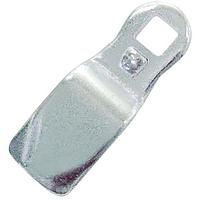
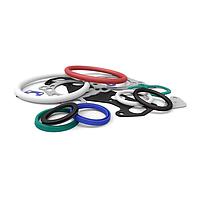
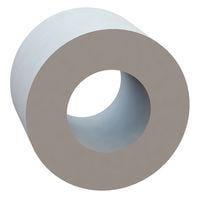
Examples from the available product mix show that this category is not limited to one hardware type. It includes items such as the Advantech DLG-A-MNT-701262 sandwich plate for clamp mounting, as well as sealing and support components like Aavid O-rings in nitrile, silicone, EPDM, and FKM materials. It also extends to protective contact elements such as the 3M Electronic Specialty SJ-5076 red-orange cylindrical bumper, which can be useful in equipment protection and surface cushioning.
Material choice and sealing performance
When selecting hardware, material compatibility is often just as important as dimensions. O-rings and related mounting accessories are chosen not only by size, but also by their resistance to temperature, pressure, chemicals, cleaning agents, and the media they may contact during normal operation.
In this category, Aavid examples illustrate several common elastomer options. NBR or nitrile variants are widely used for general-purpose sealing, while silicone options may suit applications that need flexibility and broad temperature tolerance. FKM materials are often considered where higher chemical resistance or elevated temperature capability is needed, and EPDM may be relevant in applications involving water or certain cleaning environments. The correct choice depends on the surrounding operating conditions rather than on price or availability alone.
Representative brands and product examples
Several recognized manufacturers appear in this category, including Aavid, 3M Electronic Specialty, and Advantech. Their presence reflects the broad nature of hardware sourcing, where different brands may focus on sealing elements, protective bumpers, or mounting accessories for equipment integration.
A few examples help clarify the scope. The Aavid AS568-009 FKM O-Ring is a clear fit for applications requiring a defined sealing profile, while Aavid N140-90/2-425 and similar nitrile or silicone O-rings support general mounting and sealing needs across assemblies. The 3M Electronic Specialty SJ-5076 cylindrical bumper is more aligned with impact reduction, spacing, or protective contact surfaces. Meanwhile, the Advantech DLG-A-MNT-701262 mounting hardware item shows the category also supports practical installation hardware for device mounting structures.
How to choose the right hardware for your application
A good starting point is to identify the actual function of the part within the assembly. Ask whether the hardware is primarily for mounting, sealing, spacing, vibration damping, surface protection, or operator interaction. This prevents over-selecting a part with the wrong geometry or material simply because it appears mechanically similar.
Next, review the operating environment. Temperature range, exposure to fluids, compression requirements, hardness, and installation method all matter. For example, an O-ring in a static enclosure seal may have very different requirements than a bumper used as a stop or foot on an instrument housing. If the application is part of a larger mechanical build, it may also be useful to review related pneumatic equipment or nearby component groups to ensure compatibility across the full assembly.
- Check the part’s mechanical role in the design.
- Match material type to the environment and media exposure.
- Confirm dimensional fit and compression or contact behavior.
- Consider maintenance, replacement frequency, and assembly access.
- Use manufacturer-specific items where mounting interfaces must align correctly.
Where these hardware products are commonly used
Hardware components like these are used across a wide range of B2B applications, from control cabinets and factory automation equipment to test benches, instrumentation, embedded systems, and commercial devices. Even where the part itself is small, it often has a meaningful role in mechanical stability and long-term performance.
Sealing elements may be used in enclosures, connectors, panel interfaces, and serviceable subassemblies. Protective bumpers and feet are common on housings, bench devices, and access panels. Mounting accessories support equipment integration in mobile, fixed, or clamp-mounted installations. In many cases, these parts are purchased together with other hardware solutions or adjacent electromechanical categories to complete a build efficiently.
Procurement and engineering considerations
For purchasing teams, hardware selection often involves balancing standardization with application-specific needs. Standard elastomer materials, common form factors, and recognized manufacturer series can simplify replenishment and maintenance planning. At the same time, exact material grade or mounting geometry may need to be preserved to avoid fit or reliability issues.
For design engineers, it is useful to treat hardware as part of the system architecture rather than as an afterthought. A correctly specified seal, bumper, or mounting accessory can reduce rework, improve assembly consistency, and support cleaner field service. This is especially important in environments where vibration, repeated access, cleaning cycles, or temperature variation place stress on small mechanical parts.
Finding a better fit for real-world assemblies
This hardware category is designed to support the practical mechanical needs that surround electrical and electronic systems. From Aavid sealing components to 3M Electronic Specialty protective bumpers and Advantech mounting accessories, the product mix serves applications where fit, protection, and installation details matter.
When comparing options, focus on function, material, and operating conditions first. That approach usually leads to better long-term performance than choosing by appearance alone, and it helps ensure the selected hardware fits naturally into the wider assembly, maintenance process, and sourcing strategy.
Get exclusive volume discounts, bulk pricing updates, and new product alerts delivered directly to your inbox.
By subscribing, you agree to our Terms of Service and Privacy Policy.
Direct access to our certified experts