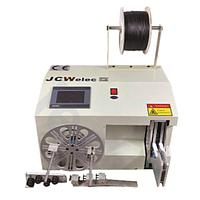
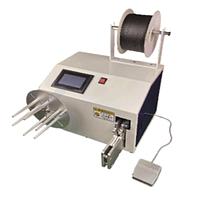
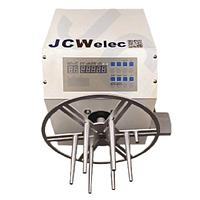
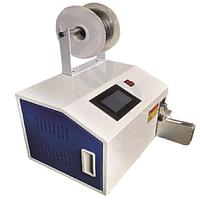
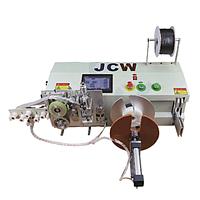
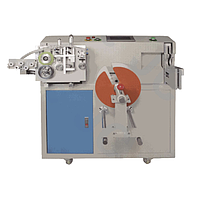
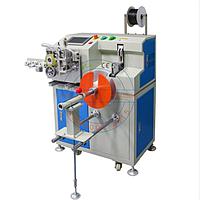
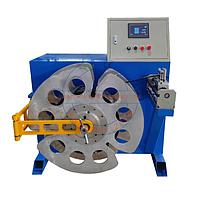
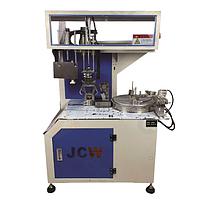
Winding & Bundling Machine
When cable assemblies need to be packed neatly, counted consistently, and prepared for the next production step, the winding stage becomes just as important as cutting or crimping. A well-matched Winding & Bundling Machine helps standardize coil shape, reduce manual handling, and improve throughput for wire harness, cable, and lead processing workflows.
This category brings together equipment designed for cable coiling, wire winding, and automatic tying or binding. It is especially relevant for manufacturers that want cleaner output, repeatable bundle dimensions, and smoother integration into a broader wire processing line.
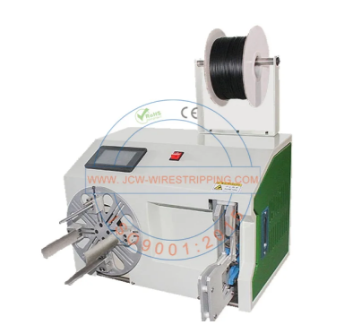
Where winding and bundling machines fit in cable processing
In many production environments, the final presentation of a cable matters for both downstream handling and product quality. Coils that are too loose, uneven, or inconsistent can slow packaging, create tangling issues, and make storage less efficient. Winding and bundling equipment addresses this by forming controlled coils and, in some cases, automatically securing them.
These machines are commonly used after upstream processes such as wire and cable cutting, stripping, or terminal preparation. In a more complete line, they can also complement equipment such as a wire crimping machine when finished leads need to be organized before inspection, packing, or shipment.
Main equipment types in this category
This category covers several machine formats rather than one single machine design. Some units focus on cable coiling, where the main task is to wind cable into a consistent reel or loop diameter. Others are intended for wire winding and tying, combining the coiling step with automatic bundling to reduce manual work at the end of the cycle.
There are also automatic wiring winding machines designed for adjustable turn counts, inner diameters, and disc sizes. These are useful when production needs vary by cable length, bundle diameter, or handling requirement. For operations that also need surface protection or harness consolidation, nearby process steps may involve a tape wrapping machine depending on the product structure.
Typical applications and production scenarios
Winding and bundling machines are used across cable assembly, harness preparation, and general industrial wire processing. They are suitable for organizing finished cable lengths into round coils or figure-eight style winding patterns where required by handling or packaging needs. This improves consistency compared with manual coiling, particularly when production batches are large.
They are also helpful in semi-automated and automated workstations where operators need predictable cycle times. A machine that winds and ties in one sequence can shorten handling time between production and packing, while a coiling-only model may be sufficient when bundles are secured in a separate step.
Representative machines from Sedeke
Several products in this category illustrate the range of available machine roles. The Sedeke CC-380 and Sedeke CC-680 are examples of cable coiling machines intended for controlled winding with defined coil diameter ranges. For users needing faster handling or dual-reel functionality, the Sedeke CC-380D provides an alternative configuration for cable winding and coiling tasks.
Where automatic tying is needed, models such as the Sedeke CB-WT630, CB-WT645, and CB-WT680 combine winding and bundling in one machine. These are suited to different tie length and bundling diameter ranges, making them practical for matching machine capacity to the cable size being processed. For broader winding applications, Sedeke CB-B10CS, CB-B15CS, CB-B30CS, CB-B150CS, and CB-F500MCS show how loading capacity and machine size can vary depending on production demand.
Another useful example is the Sedeke CB-B15CST, which combines coiling and binding in a single automatic process. This type of machine can be a good fit where stable bundle shape and reduced manual tying are both important.
What to consider when selecting a winding and bundling machine
The first point to review is the physical range of the product being processed. Coil diameter, inner diameter, bundling diameter, cable tie length, and loading weight all affect whether a machine will suit a given cable or harness type. Even when two machines look similar, their practical working range may differ significantly.
The second factor is the required level of automation. Some applications only need single-cycle cable coiling, while others benefit from fully automatic operation with completion detection, integrated tying, or safety features such as a pneumatic safety door. If operators handle multiple cable types in one shift, adjustable turns, variable winding speed, and flexible bundle formats can be more important than maximum speed alone.
It is also worth thinking about line layout and process flow. A compact machine may suit a bench-based workstation, while larger systems are better for higher-volume output or heavier cable loads. If upstream preparation is still manual, pairing the winding stage with a wire stripping machine or other processing equipment may help improve overall consistency across the line.
Benefits for quality, handling, and productivity
A properly selected machine supports more than just faster coiling. It helps create uniform bundles that are easier to count, pack, transport, and inspect. That consistency can reduce rework caused by irregular winding, loose ties, or damaged cable from unnecessary manual handling.
From a production standpoint, automated winding and bundling can improve operator efficiency and reduce variability between shifts. In environments where cables are produced in repeat lengths and frequent batches, this kind of equipment can make output more predictable and easier to integrate with packing or labeling operations.
Choosing by process need rather than model count
For many buyers, the best approach is to start with the process requirement rather than the model name. Consider whether the job calls for simple cable coiling, winding plus tying, or a heavier-duty automatic winding platform with higher load capacity. Then compare working range, cycle style, and machine footprint against the actual cables being produced.
If your operation includes multiple wire preparation steps, it can also help to view winding and bundling as part of a connected production workflow rather than a standalone purchase. That makes it easier to identify where automation will have the greatest effect on labor, consistency, and final product presentation.
Conclusion
This Winding & Bundling Machine category is built for manufacturers and industrial users who need orderly cable output, repeatable bundle quality, and better control over the finishing stage of wire processing. From cable coiling machines to automatic winding and tying systems, the available range supports different bundle sizes, coil formats, and production volumes.
Review the machine type, cable dimensions, automation level, and workflow requirements together before choosing. That approach usually leads to a more practical match between the equipment and the real production task, especially in cable assembly and wire harness applications where consistency at the final stage matters.
Get exclusive volume discounts, bulk pricing updates, and new product alerts delivered directly to your inbox.
By subscribing, you agree to our Terms of Service and Privacy Policy.
Direct access to our certified experts